Have you ever filled out an official form and paused at the question: “What is your mother tongue?” — and then spotted another field asking for your native language? Most people shrug and write the same answer in both boxes. But are these two terms really identical? Mother Tongue vs Native Language.
Not always. While they often overlap, mother tongue and native language carry distinct meanings — especially for immigrants, bilingual families, and multilingual individuals. Understanding the difference matters in education, government paperwork, cultural identity, and everyday communication.
This guide breaks it all down clearly, with real-life examples, a handy comparison table, and answers to the most common questions.
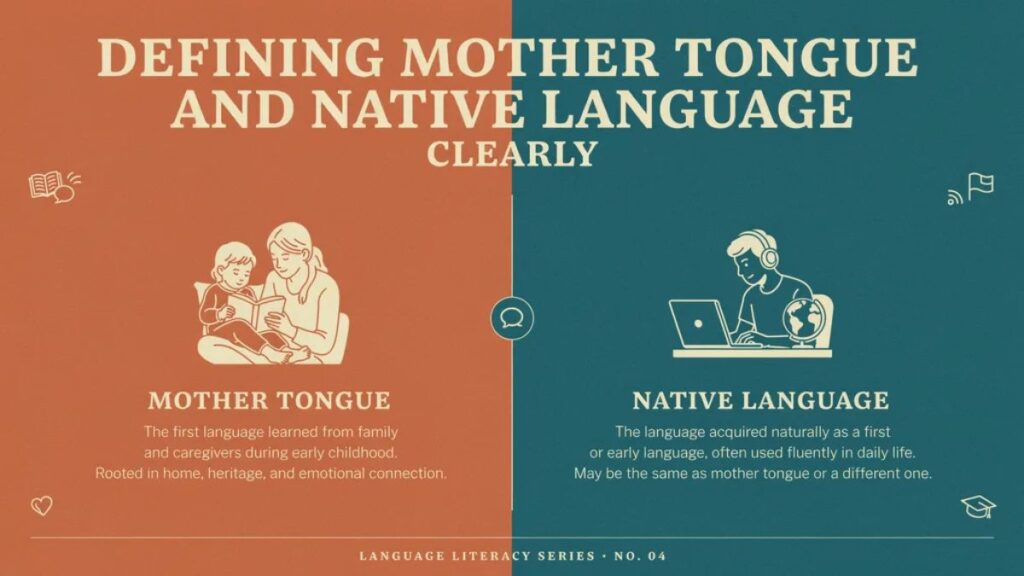
Defining Mother Tongue and Native Language Clearly
Before comparing the two, it helps to pin down what each term actually means — because the confusion usually starts at the definition level.
What Is Mother Tongue?
Your mother tongue is the first language you were exposed to as a child, typically learned at home from parents, grandparents, or caregivers. The word “mother” here is deeply personal — it evokes family warmth, heritage, and cultural roots.
Key characteristics of a mother tongue:
- Learned naturally through early childhood exposure
- Usually the language spoken by your family or ethnic community
- Carries emotional and cultural significance
- Tied to personal identity, traditions, and memory
- May not always be the language you speak most fluently today
Think of it this way: your mother tongue is the language you first felt in, long before you could analyze or define it.
What Is Native Language?
Your native language is the language you use most fluently in daily life — in school, work, and social settings. The word “native” points outward, toward the country or society you grew up in or currently live in.
Key characteristics of a native language:
- Reflects fluency and practical dominance in communication
- Shaped by schooling, environment, and social interaction
- Often the official or dominant language of your country
- Used in formal contexts: education, government, legal documents
- Can change over time with migration or assimilation
In simple terms: your native language is the language your brain prefers for thinking, writing, and operating in the world.
Key Differences Between Mother Tongue and Native Language
| Feature | Mother Tongue | Native Language |
|---|---|---|
| Definition | First language learned at home | Language of highest fluency/dominance |
| Origin | Family and caregivers | Country, school, society |
| Emotional link | Strong cultural and personal bond | More functional and formal |
| Can it change? | Rarely changes | Can shift with environment |
| Used in | Home, heritage, identity | Education, work, public life |
| Example | Punjabi spoken at home | English used at school and work |
Overlaps and Grey Areas
For many people — especially those raised in monolingual households — the mother tongue and native language are the same language. A child born and raised in Japan, speaking only Japanese at home and school, would have Japanese as both their mother tongue and native language.
But life is rarely that straightforward.
Grey zones appear when:
- Bilingual parents teach two languages at home simultaneously (both can qualify as mother tongues)
- Immigration causes a child to adopt the new country’s dominant language as native while retaining the home language as mother tongue
- Language attrition occurs — when limited use causes fluency in the mother tongue to fade, while the native language takes over
- Adopted children grow up speaking a language entirely different from their biological heritage
These overlapping cases are exactly why understanding the distinction matters.
Real-Life Scenarios
Scenario 1: Punjabi Mother Tongue, English Native Language
A child born in Pakistan to Punjabi-speaking parents immigrates to the UK at age five. At home, the family speaks Punjabi — that remains the child’s mother tongue. But once enrolled in a British school, English becomes the primary language for learning, socializing, and eventually working. Over time, English becomes the native language, while Punjabi holds its place as the emotional, cultural anchor.
Scenario 2: Spanish at Home, English in School
A Mexican-American child in Texas grows up hearing Spanish from parents and grandparents. Spanish is undeniably the mother tongue. But daily schooling in English, an English-speaking peer group, and English-language media gradually make English the dominant, native language. Both languages coexist — but they serve different roles.
Scenario 3: Adopted Child and Language Shift
A child born in South Korea is adopted by a Dutch family at age two. Raised entirely in Dutch, the child grows up with Dutch as both their functional and emotional language — making it both the mother tongue (by upbringing) and native language. The biological heritage language never takes root.
Why the Distinction Matters
Understanding the difference between mother tongue and native language is more than an academic exercise. It has real, practical consequences:
- Education: Teachers who know a student’s mother tongue can provide better bilingual support and bridge learning gaps
- Cultural preservation: Recognizing the mother tongue helps communities maintain heritage languages at risk of disappearing
- Census and government data: Countries collect both data points to design fair language policies and allocate resources
- Personal identity: Knowing where your languages come from helps you understand your own multicultural background better
- Workplace communication: Professionals in global environments communicate more effectively when they understand native language fluency versus heritage language background
Common Misconceptions
1. Mother Tongue Equals First Language
Not always. Some linguists distinguish “first language” as the language a person develops earliest, which may or may not align with the language spoken most at home. The term “mother tongue” is more culturally charged, while “first language” is a more neutral, chronological label.
2. Native Language Cannot Change
It absolutely can. Immigrants who move to a new country in early childhood often develop a stronger command of the new country’s language than of their heritage language. Over decades, the new language can become the dominant, native one.
3. Fluency Defines Cultural Identity
Fluency is a skill — identity is something deeper. A person may lose conversational fluency in their mother tongue after years abroad but still deeply identify with the culture, music, food, and values tied to that language.
4. Only One Mother Tongue Exists
Children raised in bilingual households — where both parents speak different languages at home — can acquire two mother tongues simultaneously. Linguistics recognizes this as a normal and healthy pattern of early language development.
Mother Tongue and Native Language in a Globalized World
Globalization has blurred the lines significantly. Today, millions of people grow up as heritage language speakers — familiar with a family language but formally educated in another. The rise of international schools, cross-border marriages, digital communication, and global migration means many individuals carry layered linguistic identities.
According to UNESCO, 21 February is celebrated as International Mother Language Day — a recognition of the importance of preserving linguistic diversity worldwide. The organization also notes that nearly 40% of the global population lacks access to education in the language they understand best, which highlights how critical it is to distinguish between home languages and school languages.
Practical Guidance for Readers
If You Want to Preserve Your Mother Tongue
- Speak the language regularly at home, even if the wider environment uses a different one
- Read books, watch films, and listen to music in your mother tongue
- Connect with community groups that share your heritage language
- Teach it to children early — the critical period for language acquisition closes around puberty
If You Want to Improve Native Language Fluency
- Immerse yourself in the language through daily media, news, and podcasts
- Practice writing formally — emails, articles, notes — to build professional-level command
- Engage in conversation with fluent speakers as often as possible
- Focus on idiomatic expressions and natural phrasing, not just grammar rules
How to Identify Your Language Type
Ask yourself these simple questions:
- What language did you first hear as a baby? → That is likely your mother tongue.
- What language do you think, dream, or count in? → That points to your native or dominant language.
- What language do you use for work, school, or formal communication? → That is typically your native language.
- What language connects you to your family’s past? → That is almost certainly your mother tongue.
Role of Language in Education
Language plays a foundational role in how children learn. Research consistently shows that children who receive early education in their mother tongue develop stronger literacy skills, critical thinking, and cognitive flexibility. However, fluency in the native or official language is equally important for academic and professional success.
Bilingual education models — which teach in both the mother tongue and the dominant societal language — are widely recognized as the most effective approach for children navigating two linguistic worlds.
Social and Cultural Importance
Language is never just a tool for communication — it is a vessel for culture. Folktales, proverbs, songs, humor, and even the way emotions are expressed are all shaped by language. Losing a mother tongue often means losing access to generations of cultural knowledge encoded within it.
At the same time, mastering a native language opens doors to education, employment, and social integration. The healthiest approach is to honor both: the mother tongue as a cultural anchor, and the native language as a practical bridge to the wider world.
Future Trends in Language Identity
The concept of a single, fixed “native language” is evolving. Younger generations increasingly identify as multilingual from birth, moving fluidly between languages depending on context. Technology — from AI translation tools to multilingual digital content — is making it easier than ever to maintain multiple languages simultaneously.
Linguists now speak of plurilingual identity: the idea that a person does not merely switch between languages but holds all of them as part of a single, integrated linguistic self. The old question of “which is your real language?” is giving way to the richer reality that many people simply are more than one language at once.
Mother Tongue vs Native Language – Quick Summary
| Aspect | Mother Tongue | Native Language |
|---|---|---|
| Learned | At home, from family | In society, school, environment |
| Feel | Emotional, personal | Functional, formal |
| Can change? | Rarely | Yes, especially after migration |
| Multiple possible? | Yes (bilingual homes) | Yes (true bilinguals) |
| Used for | Heritage, identity, family | Work, school, public life |
Famous Quote About Language
“A language is not just words. It’s a culture, a tradition, a unification of a community, a whole history that creates what a community is.” — Noam Chomsky
FAQ’s
What is the difference between mother tongue and native language?
Mother tongue is the first language learned at home from family, carrying cultural and emotional roots. Native language is the language a person uses most fluently in daily life, often shaped by schooling and society.
Can you have more than one mother tongue?
Yes. Children raised in bilingual households can acquire two mother tongues simultaneously, as both languages are learned naturally in the home environment from an early age.
Can a person’s native language change over time?
Absolutely. Immigrants, especially those who migrate in childhood, often develop stronger fluency in the new country’s language, which gradually becomes their dominant native language.
Is the first language always the mother tongue?
Not necessarily. “First language” is a neutral chronological term, while “mother tongue” carries cultural and familial meaning. In most cases they align, but in some multilingual contexts they can differ.
Why do official forms ask about both mother tongue and native language?
Governments and institutions collect both data points to understand linguistic diversity, design bilingual education programs, and create fair language policies for their populations.
Conclusion:
🌍 Mother Tongue vs Native Language: Understanding the Real Difference in Simple Words helps you see that these two terms are not always the same. Mother Tongue vs Native Language. Your mother tongue is the language of your family and roots. Your native language is the one you use every day in school, work, and society.
🌍 Mother Tongue vs Native Language: Understanding the Real Difference in Simple Words also shows that both languages matter. One connects you to your culture. The other connects you to the world. Honor both.