Shown and showed are both past forms of the verb show, but they don’t work the same way. Showed is the simple past tense. Shown is the past participle, always paired with a helper verb. Shown vs Showed.
Get this wrong and even polished writing falls apart instantly.
Knowing exactly when to use each form sharpens your writing across every context — emails, essays, reports, casual conversation. This guide breaks down every rule, comparison, and trick you need.
What Kind of Verb Is “Show”? (And Why It Matters)
Most English verbs are boring and predictable. Take “walk,” for instance — it becomes “walked” in the past and “walked” again as a past participle. Simple, consistent, forgettable.
The show doesn’t play by those rules. It’s an irregular verb, meaning its forms don’t follow the standard pattern. Instead of just slapping -ed on the end across the board, it does this:
| Base Form | Simple Past | Past Participle |
|---|---|---|
| show | showed | shown |
| walk | walked | walked |
| eat | ate | eaten |
See the difference? Regular verbs repeat their past form as the participle form. Irregular verbs like show and eat develop a distinct third form. That third form — shown — is your past participle, and it behaves very differently from showed.
This is the core of the whole shown vs showed issue. Grasp this table, and you’re already halfway there.
When to Use “Showed” — And Only “Showed”
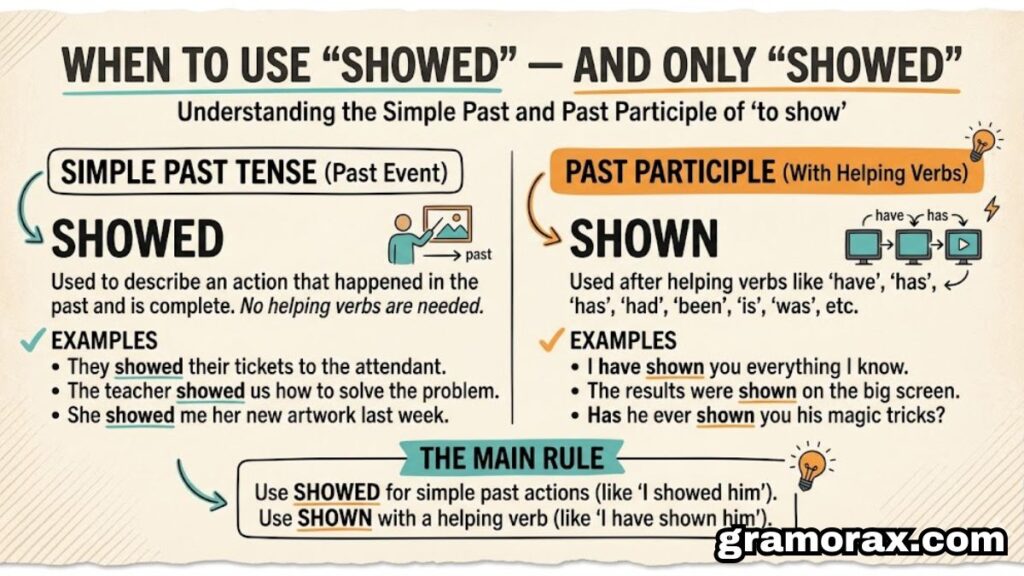
Showed is the simple past form of show. That’s its only job. It tells you that someone performed the action of showing at a specific, completed point in the past.
The key rule here: showed stands alone—no helper verb needed. No has, no was, no were. Just showed, doing its job solo.
Examples:
- She showed me the contract yesterday.
- He showed remarkable patience during the meeting.
- They showed up three hours late.
Notice the time markers — yesterday, during the meeting, three hours late. These signal a completed action in the simple past tense. That’s exactly where showed belongs.
The “Showed Stands Alone” Rule
Think of showed as the independent type. It doesn’t lean on anything. Whenever you’re describing a past action with no auxiliary verb in the sentence, showed is your word.
Quick check — spot the correct sentences:
| Sentence | Correct? |
|---|---|
| She showed me the report. | ✔ Yes |
| She has showed me the report. | ❌ No |
| He showed the client around the office. | ✔ Yes |
| The results were showed in the graph. | ❌ No |
The two incorrect ones? They need shown — because a helping verb is present. More on that shortly.
Quick Self-Test
Fill in the blank with showed or shown:
- The teacher ______ us a new method last Friday.
- I have never been ______ how to do that properly.
- Marcus ______ incredible resilience throughout the ordeal.
(Answers at the end of the practice section below.)
When to Use “Shown” — The Past Participle Explained Clearly
Here’s where things get interesting. Shown is the past participle of show, and unlike showed, it never works alone as a verb. It always needs a helper verb beside it.
Think of shown as the one that needs a sidekick. Every single time.
The most common helping verbs that team up with shown:
- have, has, had (for perfect tenses)
- is, was, were, are, been, being (for passive voice)
Without one of these partners, shown cannot function as a verb in a sentence. This is the rule that most people unknowingly break.
“Shown” in Perfect Tenses (With Examples)
Perfect tenses combine a form of have with a past participle. Since shown is the past participle of show, it slots perfectly into all three perfect tenses:
Present Perfect — have/has + shown
- I have shown you this technique before.
- She has shown real leadership this quarter.
Past Perfect — had + shown
- By the time we arrived, he had shown them everything.
- They had shown great promise before the setback.
Future Perfect — will have + shown
- By Friday, the team will have shown all stakeholders the prototype.
- She will have shown three clients the proposal by noon.
See how have, has, had, and will have are always there? That’s not optional. Remove them, and the sentence collapses grammatically.
“Shown” in Passive Voice (With Examples)
Passive voice flips the typical sentence structure. Instead of the subject doing the action, the subject receives the action. This structure always demands the past participle, which means shown, never showed.
- The results were shown on the projector screen.
- New evidence has been shown to support the theory.
- The film was shown to a private audience.
- The data is shown in the chart below.
Passive voice is especially common in academic writing, scientific reports, and formal business communication — exactly the contexts where getting this right matters most.
The “Shown Needs a Buddy” Rule
Repeat this to yourself: shown never shows up alone.
If you write shown in a sentence and there’s no helper verb sitting beside it, you’ve made an error. Swap it for showed or restructure the sentence.
✔ The report has shown a decline in revenue. ❌ The report shown a decline in revenue.
Showed vs Shown — Head-to-Head Comparison

Let’s put them side by side and settle this once and for all.
What Each Form Actually Does
| Feature | Showed | Shown |
|---|---|---|
| Verb type | Simple past | Past participle |
| Needs a helper verb? | No | Always |
| Used in passive voice? | No | Yes |
| Used in perfect tenses? | No | Yes |
| Stands alone? | Yes | No |
| Common in formal writing? | Moderately | Very common |
| Common in casual speech? | Very common | Common |
Side-by-Side Example Sentences
These pairs express similar ideas — but notice how the grammar shifts completely:
| Showed (Simple Past) | Shown (Past Participle) |
|---|---|
| She showed the data last week. | The data has been shown clearly. |
| He showed courage under pressure. | He has shown courage under pressure. |
| They showed the film at midnight. | The film was shown at midnight. |
| I showed him the exit. | I have shown him the exit. |
| Marcus showed the client the proposal. | The proposal had been shown to the client. |
Same events, different grammar structures — and both forms are correct in their own context.
Register and Style Notes
One nuance most grammar guides skip: showed tends to feel more natural in spoken English and casual writing, while shown (especially in passive voice) dominates formal and academic contexts.
Example in casual speech: “He showed me how it works.” Example in a research paper: “Results were shown to be statistically significant.”
Neither is more correct — they’re just serving different audiences.
The Grey Zone — When “Showed” Appears as a Past Participle
Fair warning: language is messy. Some older texts and certain regional dialects — particularly in informal American English — use showed as a past participle. You might encounter sentences like:
- “I have showed you this before.”
- “She has showed real talent.”
Linguistically speaking, these aren’t entirely unheard of. However, modern standard English — both American and British — strongly prefers shown in this role. Major style guides, grammar handbooks, and edited publications consistently use shown as the past participle.
The verdict? In any formal, professional, or academic context, always use shown as your past participle. Reserve this grey area for informal conversation only — and even then, shown is the safer, cleaner choice.
As the Merriam-Webster Dictionary notes, shown is the standard past participle form of show in contemporary English usage.
Common Errors — And How to Fix Them Fast
These mistakes show up constantly — in business emails, student essays, and even published articles. Knowing them cold means you’ll never make them.
The Most Frequent Mistakes
❌ “I have showed you the results.” ✔ “I have shown you the results.” Why: The helper verb have signals a perfect tense — that demands the past participle shown, not the simple past showed.
❌ “The data was showed in the chart.” ✔ “The data was shown in the chart.” Why: This is passive voice — was is the auxiliary verb that triggers the need for a past participle.
❌ “She has showed great dedication.” ✔ “She has shown great dedication.” Why: Has is a helping verb — it always pairs with the participle form, never the simple past.
❌ “The documentary was showed on national television.” ✔ “The documentary was shown on national television.” Why: Again, passive voice requires shown.
Error Pattern Cheat Sheet
| Wrong Form | Correct Form | Grammar Reason |
|---|---|---|
| has showed | has shown | Present perfect needs past participle |
| have showed | have shown | Present perfect needs past participle |
| had showed | had shown | Past perfect needs past participle |
| was showed | was shown | Passive voice needs a past participle |
| were showed | were shown | Perfect passive needs the past participle |
| has been showed | has been shown | Perfect passive needs past participle |
Shown vs Showed in Different Writing Contexts
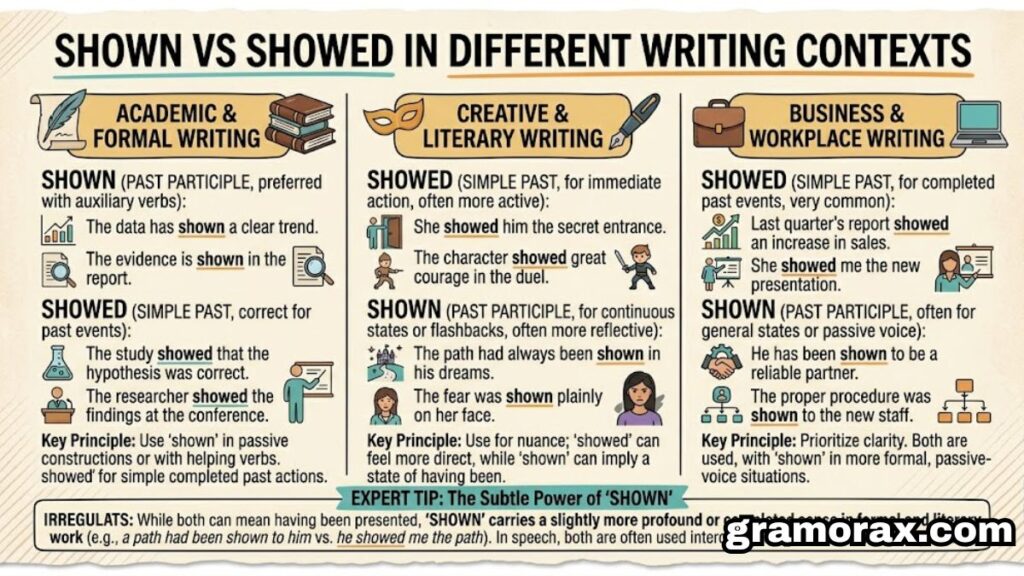
Context shapes everything in writing. Here’s how each form plays out across different settings:
Academic Writing Shown dominates here — especially in passive voice. Scientists and researchers write things like “Results were shown to be consistent” or “Evidence has been shown to support…” Showed rarely appears unless narrating a specific historical event.
Business Writing Formal reports and professional emails lean toward shown in perfect tenses: “The data has shown a clear trend.” Using showed is fine for narrative past — “The Q3 report showed a 12% increase” — and actually sounds natural.
Creative Writing Showed thrives in fiction and narrative nonfiction. “She showed him the letter” feels immediate and alive. Passive voice is used sparingly, so shown appears less often.
Casual Speech and Informal Writing. Both forms float freely in conversation. You’ll hear showed slightly more often — but shown is never out of place.
5 Memory Tricks That Actually Stick
These memory tricks work because they tap into patterns your brain already knows. Solid grammar memory aids don’t just tell you the rule — they anchor it.
Trick 1 — “Shown Needs a Sidekick”
Shown never appears alone as a verb. If there’s no helper verb beside it, something’s wrong. Think: shown always brings a friend.
Trick 2 — “Showed Is the Loner”
Showed handles the simple past all by itself. No has, no was, no were required. It’s the self-sufficient one.
Trick 3 — The “Eaten” Swap Test
This is the most reliable grammar memory aid in the toolkit. Swap your word with eaten and ask: Does the sentence still work grammatically?
- “I have eaten“ ✔ → “I have shown“ ✔
- “I eaten yesterday” ❌ → “I shown yesterday” ❌
If it fits, shown fits. If it doesn’t, use showed. Works every single time.
Trick 4 — “Passive Voice = Shown, Always”
Spot a be verb (is, was, were, been)? The verb that follows must be a past participle. For show, that’s always shown. No exceptions in standard English.
Trick 5 — The Quick Gut-Check Question
Before you write, ask yourself: “Is there a helping verb in this sentence?”
- Yes → Use shown
- No → Use showed
It’s that binary. Two options, one question, zero confusion.
Practice Exercises — Test Yourself
Work through these, and you’ll lock in everything you’ve learned. These aren’t trick questions — they’re practical English practice built to build real confidence.
Fill in the Blank
Choose showed or shown for each sentence:
- The professor ______ the class a short film on Thursday.
- The evidence ______ in court proved his innocence.
- She has ______ incredible creativity in her designs.
- He ______ up to the meeting fifteen minutes late.
- The results were ______ to be statistically significant.
- By the time I arrived, she had ______ them the entire building.
- The data clearly ______ a downward trend in 2022.
- Nothing has ever been ______ to work faster in clinical trials.
- They ______ the concept beautifully in their presentation.
- The film was ______ at three different festivals last year.
Answers + Explanations
| # | Answer | Why |
|---|---|---|
| 1 | showed | Simple past, no helper verb |
| 2 | shown | Passive voice — shown in court |
| 3 | shown | Present perfect — has shown |
| 4 | showed | Simple past stands alone |
| 5 | shown | Passive voice — were shown |
| 6 | shown | Past perfect — had shown |
| 7 | showed | Simple past, no helper verb |
| 8 | shown | Perfect passive — been shown |
| 9 | showed | Simple past, stands alone |
| 10 | shown | Passive voice — was shown |
How did you do? If you nailed 8 or more, you’ve genuinely mastered this. If a few tripped you up, re-read the “Shown Needs a Buddy” rule and run through the Eaten Swap Test again.
Shown vs Showed in Academic and Professional Case Studies
Two brief real-world scenarios to cement this:
Case Study 1 — The Research Paper A graduate student writes: “The experiment showed that the compound was effective.” Her supervisor marks it and asks her to revise it to passive voice for the abstract. The corrected version: “The compound was shown to be effective.” Same finding — different grammatical structure, different form.
Case Study 2 — The Business Report A marketing analyst writes: “Q4 data has shown strong consumer sentiment.” His editor flags it immediately. The correction: “Q4 data has shown strong consumer sentiment.” After that, you need the past participle — full stop.
Both cases illustrate something important: the shown vs showed error is common even among educated, experienced writers. It’s not a beginner mistake. It’s a subtle grammatical distinction that requires explicit knowledge to get right consistently.
Conclusion
The shown vs showed distinction is simple once it clicks. The show stood alone in the simple past. Shown always needs a helper verb. Two rules. Shown vs Showed. Zero exceptions in formal writing. Shown vs Showed.
Master these two forms and your writing instantly feels more confident and correct. Shown vs Showed. Whether you’re crafting a business report or a casual email, getting shown vs showed right makes a real difference. Shown vs Showed. Bookmark this complete guide, practice the exercises, and you’ll never second-guess yourself again.
FAQs
What is the difference between shown and showed?
Showed is the simple past tense — it stands alone. Shown is the past participle — it always needs a helper verb like has, have, or was.
Is “has showed” correct in modern English?
No. Modern English grammar is considered non-standard. The correct form is always shown in both American and British English.
Can “shown” be used without a helper verb?
Never as a verb. Shown always needs an auxiliary verb beside it — has shown, was shown, have shown. Alone, it can only function as an adjective.
Which form is correct in passive voice?
Always shown. Passive voice uses a be verb plus a past participle — so was shown, were shown, and has been shown are all correct.
Is “showed” still used as a past participle in 2025?
Rarely and informally. Current grammar standards in academic, business, and professional writing require the use of the past participle. Using showed in that role is still considered an error in formal English.