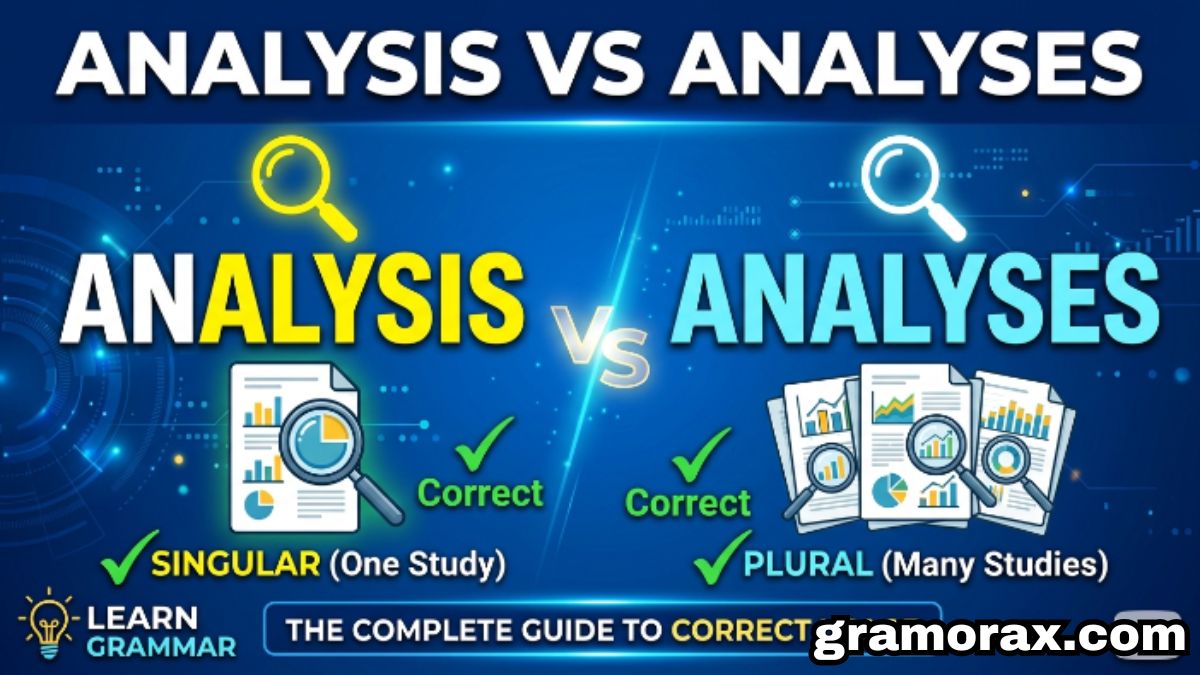
Analysis refers to a single, detailed examination of something — data, text, or evidence. Analyses is simply its plural. One letter shifts the meaning entirely. Most writers treat them as interchangeable. Analysis vs Analyses. They aren’t.
Here’s the uncomfortable truth: misusing these words in a research paper, business report, or academic presentation quietly signals carelessness — even when everything else is flawless.
Rooted in ancient Greek, this word pair follows rules most English speakers never learned. Master them once, and you’ll write with a precision that genuinely sets your work apart.
Quick Answer: Analysis vs Analyses at a Glance
Before diving into the deep end, here’s the short version.
| Term | Form | Usage | Example Sentence |
|---|---|---|---|
| Analysis | Singular noun | One examination or study | “The analysis confirmed our hypothesis.” |
| Analyses | Plural noun | Multiple examinations or studies | “Three independent analyses reached the same conclusion.” |
| Analysises | ❌ Not a word | Never correct | Don’t use this — ever. |
Simple enough. But the why behind this is where things get genuinely interesting — and where the English grammar rule becomes unforgettable.
What Does “Analysis” Mean?
The Core Definition
Analysis is a singular noun. It refers to a single, detailed examination of something — whether that’s a dataset, a piece of literature, a chemical compound, a financial report, or a patient’s symptoms. The word carries the idea of breaking something complex down into its parts to understand the whole.
Here’s how it shows up across different fields:
- Science: “A spectroscopic analysis of the compound revealed unexpected carbon chains.”
- Finance: “The quarterly analysis showed a 12% decline in consumer spending.”
- Literature: “Her analysis of Hamlet focused on Ophelia’s psychological fragility.”
- Medicine: “A blood analysis ruled out viral infection.”
One study. One examination. One analysis.
Analysis as a Countable vs. Uncountable Noun
Here’s something most grammar guides skip: analysis can function as both a countable and uncountable noun — and that distinction matters.
Uncountable (abstract concept):
“Analysis is the backbone of good research.”
Here, “analysis” refers to the process in general, not a specific instance. No article, no plural.
Countable (a specific study):
“We need to run an analysis before publishing.”
In this case, it’s one specific examination, countable, with an article. And when you have more than one? That’s where analyses comes in.
What Does “Analyses” Mean?
The Plural Defined
Analyses is the plural form of analysis. It refers to multiple separate examinations, studies, or systematic breakdowns. The word shifts from four syllables to still four syllables — but the ending changes from -sis to -seez.
Real-world examples:
- “The two analyses contradicted each other, prompting a third review.”
- “Our analyses of six clinical trials showed consistent results.”
- “The analyses conducted by rival labs were methodologically flawed.”
Notice that “analyses” always takes a plural verb. That’s non-negotiable.
Subject-Verb Agreement With “Analyses”
This is where a lot of writers slip up — even experienced ones.
✅ Correct: “The analyses reveal a strong correlation.” ❌ Wrong: “The analyses reveal a strong correlation.”
Because analyses is plural, it demands a plural verb. Every time. Think of it like “results” or “findings” — plural noun, plural verb.
The Greek Origin: Why This Plural Looks So Different
Etymology of “Analysis”
Here’s where the story gets interesting. Analysis didn’t start in English. It came from the ancient Greek word ἀνάλυσις (análysis), meaning “a breaking up” or “an undoing.” The word breaks down as:
- ana- = up, throughout
- lysis = a loosening or releasing (from lyein, to loosen)
The idea is literally taking something apart, which is exactly what an analysis does conceptually. The word entered English in the 16th century via Late Latin, carrying its Greek plural structure intact.
In ancient Greek, the plural of análysis was analýseis (ἀναλύσεις). English preserved that pattern almost verbatim: analysis → analyses.
“The Greeks didn’t just give us democracy and philosophy — they gave us some of the most confusing plurals in the English language.” — A sentiment shared by every grammar teacher who’s ever taught this rule.
The -is → -es Pattern: A Greek Plural Rule
The rule is clean once you see it. For Greek-origin words ending in -is, the plural drops the -is and adds -es. That’s it.
Here’s the full family of words that follow this lexical pattern:
| Singular | Plural | Field of Common Use |
|---|---|---|
| Analysis | Analyses | Science, research, business |
| Thesis | Theses | Academic writing |
| Crisis | Crises | Politics, medicine, economics |
| Hypothesis | Hypotheses | Scientific research |
| Diagnosis | Diagnoses | Medicine |
| Basis | Bases | General writing |
| Axis | Axes | Mathematics, geography |
| Parenthesis | Parentheses | Grammar, typography |
| Synthesis | Syntheses | Chemistry, philosophy |
| Emphasis | Emphases | Rhetoric, writing |
Learn this pattern once, and you’ve unlocked the plural of a dozen high-frequency academic words simultaneously. That’s efficient language learning.
Why “Analysises” Is Grammatically Impossible
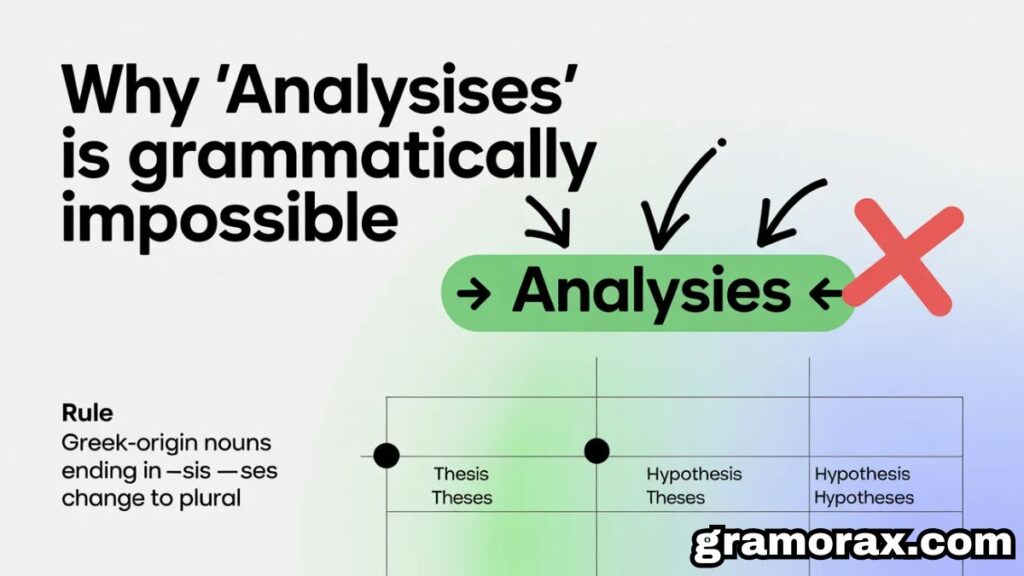
Let’s be direct: analysises is not a word. It’s not informal. It’s not a regional variant. It doesn’t exist in any dialect of English, anywhere.
The reason people write it is understandable, though. English speakers learn early that you make most words plural by adding -s or -es:
- Box → boxes
- Bush → bushes
- Analysis → analysises ❌
That instinct — called overgeneralization in linguistics — is a normal part of language learning. Your brain applies a pattern it knows. Unfortunately, Greek-origin words resist that pattern entirely.
Saying “analysises” is exactly as wrong as saying “crises” or “theses.” Those words don’t exist either. The -is → -es rule isn’t optional for these nouns — it’s the only grammatically valid option.
Spell-checkers don’t always catch it. That makes it more dangerous, not less.
Pronunciation: They Sound Different, Too
This is one of the most overlooked parts of the analysis vs analyses confusion — and it matters especially if you give presentations, defend dissertations, or speak in professional settings.
How to Pronounce “Analysis”
- Phonetic: /əˈnæl.ɪ.sɪs/
- Sounds like: uh-NAL-ih-sis
- Syllables: 4 — uh / NAL / ih / sis
- Stress: Second syllable (NAL)
How to Pronounce “Analyses”
- Phonetic: /əˈnæl.ɪ.siːz/
- Sounds like: uh-NAL-ih-seez
- Syllables: 4 — uh / NAL / ih / seez
- Stress: Still the second syllable (NAL), but the ending shifts to a long ee sound followed by z
Side-by-Side Comparison
| Word | Phonetic | Ending Sound | Rhymes With |
|---|---|---|---|
| Analysis | /əˈnæl.ɪ.sɪs/ | “sis” | “bliss” |
| Analyses | /əˈnæl.ɪ.siːz/ | “seez” | “fees” |
The key difference? That final syllable. Analysis ends in a short i sound (“sis”). Analyses end in a long ee + z sound (“seez”). They rhyme with different words entirely.
Pronouncing them identically in a conference room or viva voce examination signals — fairly or not — a lack of command over the material. It’s worth drilling this until it’s automatic.
Pronunciation Drill: Say these aloud three times, alternating:
“One analysis (uh-NAL-ih-sis)… two analyses (uh-NAL-ih-seez).”
American English vs British English: Any Real Difference?
Short answer: not for these specific words.
The analysis vs analyses distinction is identical across both major dialects. No spelling divergence, no alternative plural forms. Both American and British English use analyses as the only correct plural.
Where the two dialects do diverge is with the verb form:
| Feature | American English | British English |
|---|---|---|
| Noun (singular) | analysis | analysis |
| Noun (plural) | analyses | analyses |
| Verb (to examine) | analyze | analyse |
So “analyze” vs “analyse” — that’s a real transatlantic split. But the noun forms? Perfectly unified. No exceptions.
Common Errors and How to Fix Them
Mistake #1 — Using “Analyses” as a Singular
❌ “The analyses was inconclusive.” ✅ “The analysis was inconclusive.”
If you’re talking about one study, one test, one examination — use analysis, full stop. “Analyses” can never function as a singular noun.
Fix it: Ask yourself — how many examinations are we talking about? One → analysis. More than one → analyses.
Mistake #2 — Using “Analysis” for Multiple Cases
❌ “We conducted five analysis of the water samples.” ✅ “We conducted five analyses of the water samples.”
Any time a number or quantifier precedes the noun — five, several, multiple, both, three — you almost certainly need the plural form. Numbers are a reliable trigger.
Quantifiers that signal you need “analyses”:
- Several analyses
- Multiple analyses
- Both analyses
- A series of analyses
- Numerous analyses
- Two competing analyses
Mistake #3 — Subject-Verb Agreement Failure
❌ “The analyses shows a clear trend.” ✅ “The analyses show a clear trend.”
Analyses is plural. It takes a plural verb — show, reveal, suggest, indicate, confirm — never the singular shows, reveals, etc.
Mistake #4 — Writing “Analysises”
❌ “Three analysises of the compound were performed.” ✅ “Three analyses of the compound were performed.”
No asterisk, no footnote, no dialect where this is acceptable. Drop -is, add -es. That’s the rule.
Mistake #5 — Pronouncing Both Words Identically
This one’s harder to catch in writing but stands out immediately in speech. If you say “uh-NAL-ih-sis” for both singular and plural, listeners — especially academic examiners and professional peers — will notice.
Remember: The plural ends in “seez.” If it doesn’t buzz, it’s not the plural.
Practical Usage Across Different Fields
Academic Writing and Research Papers
In academic writing, the distinction between analysis and analyses is structural, not just grammatical. Most research papers use both forms — often in the same document.
- Methods section: “Three independent analyses were conducted to verify reproducibility.”
- Results section: “The analysis of variance (ANOVA) revealed significant differences.”
- Discussion section: “These analyses collectively support the null hypothesis rejection.”
Using the wrong form in a peer-reviewed submission can signal carelessness to reviewers. It’s a small detail that carries outsized weight.
Pro tip: In APA style, “data analysis” (uncountable) and “the analyses” (specific plural) are both acceptable — but context determines which to use.
Scientific and Medical Writing
Medicine and science are where the plural form appears most frequently — and where precision is non-negotiable.
Consider meta-analysis vs meta-analyses. A meta-analysis pools data from multiple studies to reach a broader conclusion. Run more than one? You’ve got meta-analyses. This pair is itself frequently misused:
❌ “Several meta-analysis were published last year.” ✅ “Several meta-analyses were published last year.”
Case Study: In a 2022 systematic review published in The Lancet, researchers pooled 47 randomized controlled trials. The paper correctly referred to “the analyses of pooled data” when discussing multiple statistical procedures and “the primary analysis” when referencing a single pre-registered outcome measure. That distinction made the methodology section unambiguous.
Business and Financial Writing
In corporate reports, pitch decks, and strategy documents, these words carry professional weight.
- Singular: “The market analysis supports a Q3 product launch.”
- Plural: “Competitive analyses from three independent consultancies aligned on the same recommendation.”
Misuse in a boardroom presentation or investor report doesn’t just look careless — it suggests imprecision in thinking, not just writing. Finance professionals, in particular, notice.
Journalism and General Writing
In everyday journalism, “analysis” appears far more often than “analyses.” Most news articles reference one piece of detailed examination — one expert’s breakdown, one report’s findings. The plural tends to appear in long-form, comparative, or investigative pieces.
The Economist, The Atlantic, and academic journals consistently model correct usage. Reading these publications regularly recalibrates your intuition for this.
Tips for ESL Learners
English’s irregular plurals are one of its most frustrating features for non-native speakers. The good news? The Greek plural rule is entirely consistent. Once you internalize it, it applies across a whole family of high-frequency words.
The Pattern to Memorize
Don’t just memorize “analysis → analyses” in isolation. Learn the family:
| Singular (-is) | Plural (-es) |
|---|---|
| analysis | analyses |
| thesis | theses |
| crisis | crises |
| hypothesis | hypotheses |
| diagnosis | diagnoses |
| emphasis | emphases |
Memory trick: Think of the -is ending as a snake’s tail — and the plural -es as the snake growing legs and walking away. The shape changes completely at the end.
Visual Memory Cue
Look at the word itself:
analysis → analyses
The -sis tail becomes -ses. It’s a direct letter swap. If you can picture that transformation, you’ve got the rule locked in.
Pronunciation Trick for ESL Learners
The singular ends in a hiss — sis (like the sound a snake makes). The plural ends with a buzz — seez (like bees).
One snake (analysis — hiss)… many bees (analyses — buzz).
Absurd? Sure. But you’ll never forget it.
Quick Practice: Fill in the Blank
Test yourself. Answers below.
- “The lab performed three ______ on the tissue sample.”
- “Her ______ of the financial data was presented to the board.”
- “Both ______ pointed to the same systemic flaw.”
- “A thorough ______ of user behavior revealed unexpected patterns.”
- “Multiple ______ of the ancient text produced conflicting interpretations.”
Answers: 1. analyses | 2. analysis | 3. analyses | 4. analysis | 5. analyses
Why Proper Pluralization Matters in Research
Beyond grammar, this is about academic credibility and intellectual precision.
Consider: a scientist who writes “analysises” in a research paper signals — whether fairly or not — that they may not be rigorous in other areas too. Peer reviewers are human. First impressions form fast.
In research papers, your language is your methodology made visible. Sloppy grammar suggests sloppy thinking. Correct usage says: I know my field. I know my language. You can trust this work.
Dr. Robert Cialdini’s research on authority cues in persuasion supports this intuitively — competence signals, including linguistic precision, meaningfully affect how audiences evaluate the credibility of a message. Grammar isn’t superficial. It’s a trust signal.
Conclusion
The difference between analysis and analyses is small but powerful. One refers to a single examination. The other covers multiple studies. Mix them up, and your credibility takes a quiet hit — especially in academic or professional writing.
Getting analysis vs analyses right isn’t about impressing grammar purists. It’s about saying exactly what you mean, every time. Analysis vs Analyses. The rule is simple: one study, one analysis. Several studies, several analyses. Know it. Use it. Your writing will immediately sound sharper and more authoritative.
FAQs
What is the difference between analysis and analyses?
Analysis is singular — one examination or study. Analyses is plural — multiple examinations. Simple rule: count your studies first.
Is “analysises” ever correct?
Never. Not informally, not regionally — nowhere. The only correct plural of analysis is analyses, following the Greek -is → -es rule.
How do you pronounce analyses correctly?
Say uh-NAL-ih-seez. The ending shifts from “sis” to “seez.” Most style guides and linguistic references confirm this pronunciation universally.
Which plural form does APA 7th Edition recommend?
APA 7th Edition (2020) consistently uses analyses as the plural. It appears throughout official APA publications, sample papers, and their online Style Guide.
Do AI writing tools get analysis vs analyses right?
Not always. Tools like Grammarly catch obvious errors but miss subtle subject-verb agreement mistakes with analyses. Manual proofreading still beats automated grammar checks here.