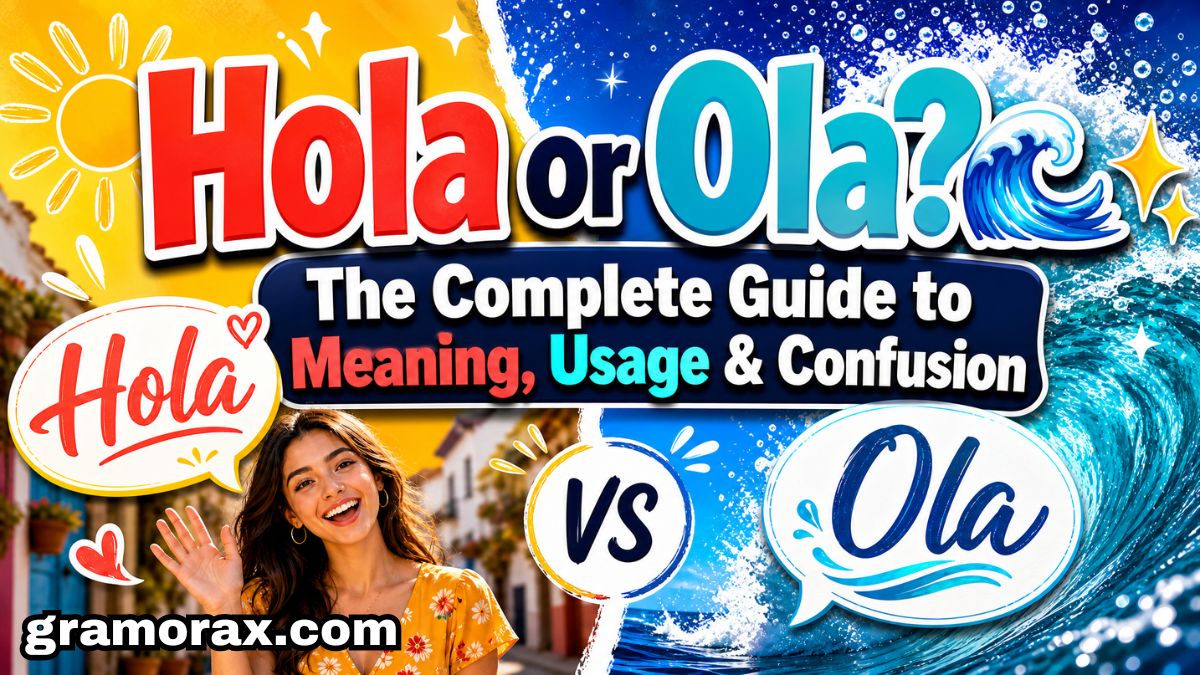
Hola is the universal Spanish greeting — warm, casual, and instantly recognizable worldwide. Ola means wave, like the ocean kind. One silent letter separates a friendly hello from a crashing wave.
That single letter trips up millions of people daily — in texts, captions, emails, and classrooms.
From its Germanic roots to TikTok captions, hola has traveled centuries to become the world’s most recognized Spanish word. Understanding the difference isn’t just about spelling — it’s about speaking with confidence across cultures.
Hola vs. Ola — The Core Difference in 30 Seconds
Here’s the short version for anyone in a hurry.
- Hola = Hello (a Spanish greeting, an interjection)
- Ola = Wave (a noun — think ocean wave, heat wave, or stadium wave)
- Both words are pronounced identically: OH-lah
That’s what makes this so tricky. In spoken Spanish, you literally cannot tell them apart. Context does all the work. In writing, spelling is the only thing standing between you and an embarrassing mix-up.
| Word | Meaning | Part of Speech | Language |
|---|---|---|---|
| Hola | Hello / Hi | Interjection | Spanish |
| Ola | Wave (ocean, heat, stadium) | Noun (feminine) | Spanish |
| Olá | Hello | Interjection | Portuguese |
“In Spanish, the H is always silent — which means hola and ola sound identical. Context and spelling are everything.”
What Does “Hola” Actually Mean?
Hola is the most universally recognized word in the Spanish language. It’s the informal equivalent of “hi” or “hello” — casual, warm, and instantly familiar across every Spanish-speaking country on the planet.
What makes hola special is its emotional tone. Unlike the English “hello,” which can sound stiff or transactional (think customer service calls), hola almost always carries warmth. It signals friendliness before the conversation even starts. That’s why it travels so well across cultures.
It functions as an interjection — grammatically speaking, it stands alone. You don’t conjugate it. You don’t pluralize it. you just say it. And the world opens up.
Common uses include:
- “Hola, ¿cómo estás?” — Hi, how are you?
- “Hola, buenos días.” — Hello, good morning.
- “Hola a todos.” — Hello, everyone.
- “Hola hola” — A playful, doubled-up greeting, especially common on social media
- “Holaaa” — The drawn-out version used in texts and DMs to sound extra friendly
The Origins of “Hola” — Where Did This Word Come From?
Etymology and Linguistic Roots
Hola didn’t appear out of thin air. Its roots trace back to Old Spanish, which borrowed heavily from Germanic languages during the early medieval period. The most likely ancestor is the Germanic exclamation “holla” — a shout used to hail someone, get their attention, or call out across a distance. Think of it as the medieval version of “Hey!”
French played a role too. The Old French “holà” (still used today as “hold on!” or “whoa!”) shares the same function and the same linguistic DNA. As the Iberian Peninsula developed its own distinct Romance language, hola settled into everyday use as a simple, friendly greeting — no shouting required.
Romance languages like Spanish, French, Italian, and Portuguese all evolved from Latin. But Latin itself didn’t have a strong tradition of informal greetings the way modern languages do. The hola family of words filled that gap, borrowing energy from the Germanic tribes that swept through Europe after Rome’s decline.
Why Did the “H” Survive If It’s Silent?
This is one of linguistics’ most satisfying questions. The silent H in Spanish isn’t laziness or an accident — it’s a fossil. A linguistic artifact.
Here’s what happened: Latin used the letter H and actually pronounced it (like a soft breathy sound). As Latin evolved into Old Spanish over several centuries, speakers gradually stopped pronouncing it. The sound disappeared entirely from native Spanish words. But the letter stayed — preserved by scribes and scholars who wanted to honor the word’s Latin origins.
The Real Academia Española (RAE) — Spain’s official authority on the Spanish language, founded in 1713 — codified these spellings and has maintained them ever since. Their reasoning is partly etymological (honoring history) and partly orthographic (keeping written Spanish consistent and traceable).
So when you see an H at the start of a Spanish word, remember: it’s there to tell you where the word came from, not how to say it.
How “Hola” Evolved Culturally
Originally, hola carried more urgency — closer to “hey!” or “hold on!” than the gentle greeting it is today. Over centuries, language evolution softened it. By the 20th century it had become the default casual hello across all Spanish-speaking communities.
Then the internet arrived. TikTok, Instagram, WhatsApp messages, reggaeton lyrics, and Netflix’s explosion of Spanish-language content pushed hola into global consciousness at a scale no word had experienced before. Today, non-Spanish speakers in New Zealand, London, and Texas use it casually — a textbook case of language borrowing driven by pop culture and digital connection.
Pronouncing “Hola” Correctly — It’s Simpler Than You Think
The Exact Pronunciation
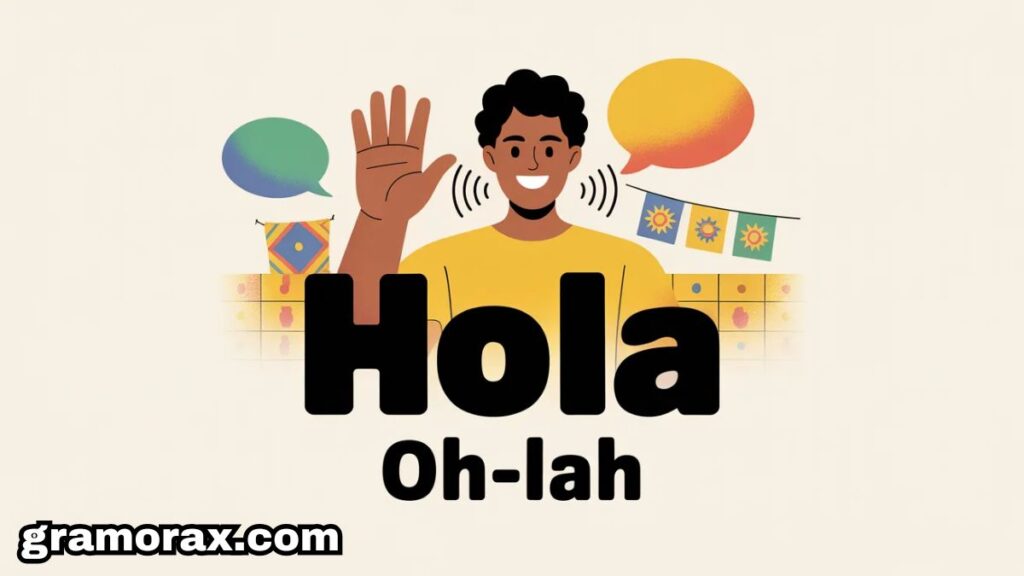
Pronunciation essentials first: hola is two syllables, stress on the first.
- IPA notation: /ˈo.la/
- Break it down: OH (like the letter O) + lah (rhymes with “spa” or “ah”)
- Stress: Falls on the first syllable — OH-lah, not oh-LAH
Try this: say the word “old,” drop the D, and add an “ah” at the end. OH-lah. That’s it.
Why Is the H in “Hola” Silent?
Spanish phonetics follows a clean rule: the letter H (called hache in Spanish) is always silent in native Spanish words. No exceptions for native vocabulary. Zero.
This silent letter rule applies uniformly across the entire Spanish-speaking world — from Mexico City to Buenos Aires to Madrid. A Mexican and a Spaniard might pronounce certain vowels differently, but neither one sounds the H in hola.
The only partial exceptions involve certain loanwords — foreign words adopted into Spanish — like hotel or hámster. Even then, many Spanish speakers naturally drop the H sound. Phonetic simplification is just what languages do over time.
Compare this to English, where H is wildly inconsistent:
- Hour — silent H
- Honest — silent H
- Hello — pronounced H
- Herb — Americans drop it, British don’t
Spanish is actually more consistent here than English. The rule is simple: H is silent. Full stop.
The Most Common Mispronunciations by English Speakers
English speakers coming to Spanish often stumble in predictable ways:
- “HOH-lah” — Adding an English H sound at the start. Completely wrong.
- “OH-lee-ah” — Over-splitting the syllables into three.
- “AH-lah” — Flattening the O into an A sound.
- “HO-la” (with a hard H like in “hot”) — The most common mistake among beginners.
The fix is simple: trust the rule. If you see an H at the start of a Spanish word, ignore it completely. The word starts with the next letter’s sound.
What Does “Ola” Mean? A Deeper Look
Ola as a Spanish Noun
Ola is a perfectly ordinary Spanish noun meaning wave. It’s feminine: la ola, las olas. You’ll see it constantly in everyday Spanish — it’s not obscure vocabulary at all.
Common phrases using ola:
| Phrase | Translation |
|---|---|
| Las olas del mar | The ocean waves |
| Una ola de calor | A heat wave |
| Una ola de frío | A cold snap |
| Hacer la ola | To do the stadium wave |
| Una ola de violencia | A wave of violence |
| Ola de turistas | Wave of tourists |
Notice how versatile it is. Ola works for physical waves, weather events, crowd movements, and metaphorical waves of anything — crime, immigration, enthusiasm. That range makes it one of the more useful nouns in conversational Spanish.
Ola in Portuguese — A Critical Distinction
Here’s where confusion escalates internationally. In Portuguese, olá (with an accent) genuinely does mean hello. It’s the standard informal greeting — the Portuguese equivalent of hola.
So when a Brazilian or Portuguese person texts you “Ola!” — they’re greeting you correctly in their language. But if a Spanish speaker writes it, they’ve just sent you a wave.
This cross-linguistic confusion catches a lot of people. Portuguese and Spanish are close enough that learners sometimes blend their rules — and the olá/ola/hola triangle is one of the most common casualties.
“Ola” as a Given Name
Ola also appears worldwide as a personal name:
- Scandinavian countries: short form of Olaf, traditionally masculine
- West Africa (Nigeria, Ghana): a common given name in several ethnic groups
- Eastern Europe: used as a feminine name in some regions
Context is everything when you encounter this word in the wild.
Ola vs. Hola — The Full Side-by-Side Breakdown
The key differences between these two words go beyond just meaning. Here’s the complete picture:
| Feature | Hola | Ola |
|---|---|---|
| Primary meaning | Hello / Hi | Wave |
| Extended meanings | — | Heat wave, cold snap, crowd wave, metaphorical wave |
| Part of speech | Interjection | Noun (feminine) |
| Grammar article | None (interjections don’t take articles) | la ola / las olas |
| Language | Spanish | Spanish (+ Portuguese with accent: olá) |
| Pronunciation | /ˈo.la/ | /ˈo.la/ |
| Written accent | None | None in Spanish; olá in Portuguese |
| Common error | Spelling it as “ola” | Using it as a greeting in Spanish |
| Register | Casual to semi-formal | Neutral |
Real Sentence Examples
Seeing both words in context makes the semantic distinction obvious:
- ¡Hola, buenos días! → Hi, good morning!
- ¡Hola a todos, bienvenidos! → Hello everyone, welcome!
- Las olas del Pacífico son enormes. → The Pacific waves are huge.
- Hubo una ola de calor en julio. → There was a heat wave in July.
- El estadio hizo la ola tres veces. → The stadium did the wave three times.
- ¿Qué tal? is often used right after Hola — “Hi, how’s it going?”
Spanish Homophones — Hola and Ola Aren’t Alone
Why Spanish Has So Many Homophones
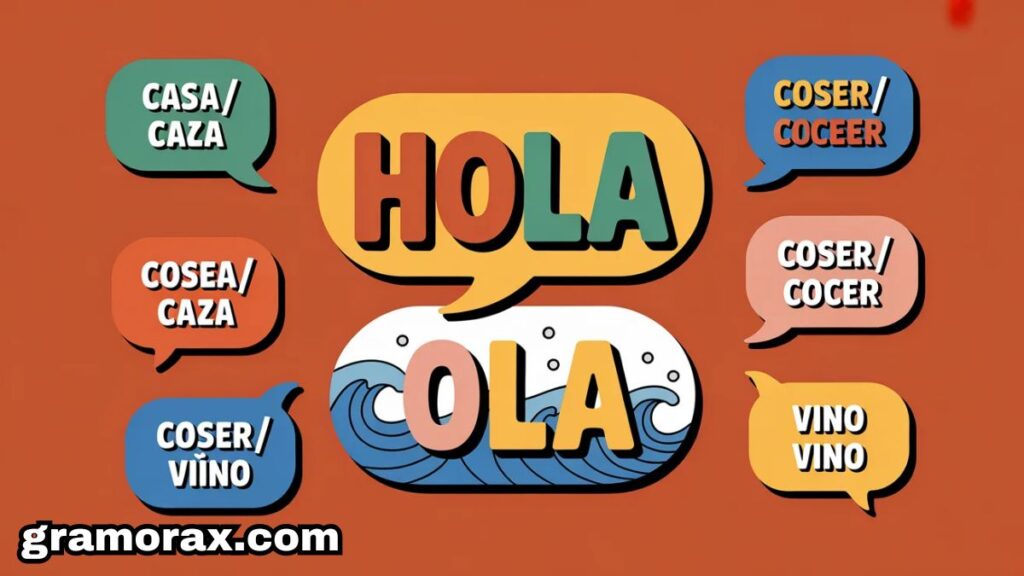
Spanish homophones — words that sound the same but mean different things — exist for a few interconnected reasons. The silent H automatically creates homophone pairs for any word that starts with H. But regional accent patterns multiply the effect.
In many Latin American countries, a phenomenon called seseo means that the letters S, C (before E or I), and Z all merge into a single /s/ sound. In parts of Spain, ceceo does the reverse. These dialect variations create additional homophone pairs that don’t exist across the whole Spanish-speaking world — just within specific regions.
Phonetic simplification is natural in all spoken languages. The challenge is that Spanish spelling remains highly consistent and phonetic — except for that one silent H. Which means H-words will always be a written language trap.
Common Spanish Homophone Pairs
| Homophone Pair | Word 1 | Meaning 1 | Word 2 | Meaning 2 |
|---|---|---|---|---|
| hola / ola | hola | hello | ola | wave |
| haber / a ver | haber | to have (auxiliary verb) | a ver | let’s see |
| hay / ahí / ay | hay | there is/are | ahí | there (location) |
| honda / onda | honda | deep / slingshot | onda | wave (sound/radio) |
| hasta / asta | hasta | until | asta | flagpole / animal horn |
| echo / hecho | echo | I throw / I pour | hecho | done / made |
| votar / botar | votar | to vote | botar | to throw away / bounce |
Tips for Language Learners
Mastering Spanish homophones comes down to a few practical habits:
- Lean on context. In spoken Spanish, the surrounding sentence almost always clarifies meaning. “¡Hola, ¿cómo estás?” can only be a greeting. “Las olas del mar” can only be about waves.
- Use a mnemonic. Try this one: “Hola has an H for Hello.” Simple, sticky, effective.
- Spell-check your written Spanish — especially in WhatsApp messages and online chats where autocorrect loves to drop or add H’s randomly.
- Check the RAE dictionary at dle.rae.es whenever you’re unsure. It’s free, authoritative, and available in Spanish.
- Use SpanishDict at spanishdict.com for quick look-ups with example sentences and audio pronunciation.
“Hola” Across the Spanish-Speaking World
Is It Used the Same Everywhere?
One of hola‘s most remarkable qualities is its regional usage consistency. Unlike much Spanish vocabulary — where the same object might have five different names depending on which country you’re in — hola is essentially universal. You say it in Mexico, Argentina, Colombia, Cuba, Puerto Rico, Chile, or Spain, and everyone understands.
The spelling never changes. The pronunciation never changes. The meaning never changes.
What does vary is what comes alongside it, and how often people reach for alternatives.
Regional Greeting Alternatives Used Alongside “Hola”
| Region | Common Casual Alternatives | Notes |
|---|---|---|
| Mexico | ¿Qué onda?, ¿Qué tal?, ¿Cómo va? | ¿Qué onda? is extremely common among youth |
| Argentina | ¡Buenas!, ¿Cómo andás? | Hola po isn’t used here; buenas is big |
| Spain | ¿Qué pasa?, ¡Buenas!, ¿Qué hay? | Very casual registers drop hola entirely |
| Colombia | ¿Quiubo?, ¡Épale! | ¿Quiubo? is a contraction of ¿Qué hubo? |
| Caribbean (Cuba, Puerto Rico) | ¡Aló!, ¡Ey!, ¡Oye! | Faster-paced, shorter greetings dominate |
| Chile | ¡Hola po!, ¿Cómo estái? | Po is a distinctly Chilean filler particle |
| Formal (universal) | Buenos días / tardes / noches | Always safe, always respectful |
When “Hola” Isn’t Quite Enough
Hola is deeply casual. In most spoken contexts, that’s perfectly fine — even in workplaces. But in formal written communication — job applications, official letters, business emails — buenos días or estimado/a (dear) is the safer bet.
This varies by country. Spain’s corporate culture tends to be more relaxed about hola in professional emails. Colombia, Chile, and parts of Mexico lean more formal in business writing. If you’re unsure, err toward buenos días/tardes and you’ll never offend anyone.
“Hola” in Other Languages — A Surprisingly Wide Footprint
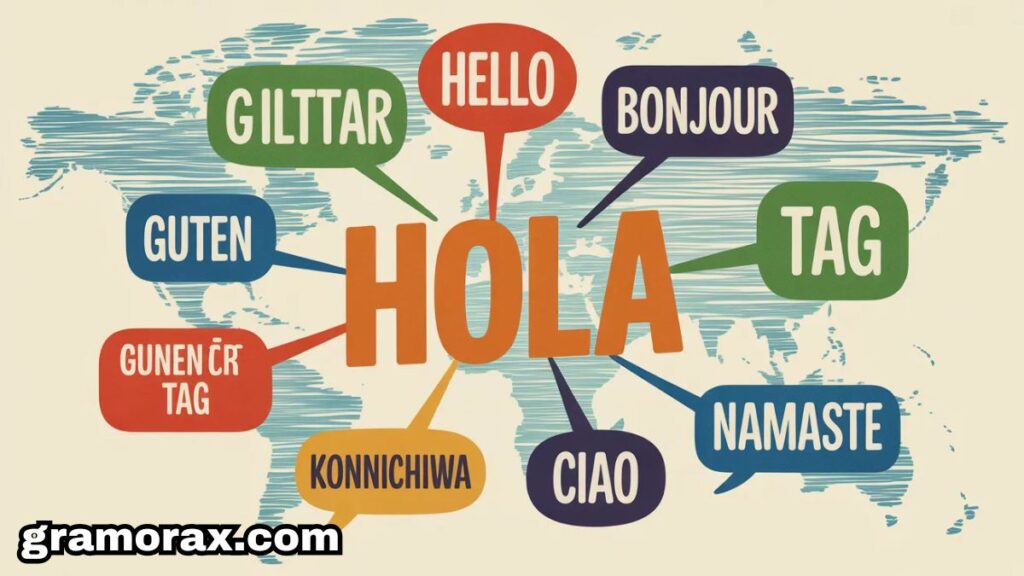
Hola didn’t stay contained to the Spanish-speaking world. Language borrowing — the process by which words migrate across linguistic boundaries — has carried it far.
Languages Where “Hola” Appears
- Chavacano (Philippines): A Spanish-based creole spoken in Zamboanga City — hola is standard vocabulary, a direct inheritance from over 300 years of Spanish colonial presence
- Papiamentu (Caribbean): The creole language of Aruba, Bonaire, and Curaçao uses hola regularly
- Ladino (Judeo-Spanish): The language of Sephardic Jewish communities, which preserved medieval Spanish, retains hola from its 15th-century Spanish roots
- Tagalog (Philippines): Older generations in certain communities use hola informally, a remnant of Spanish language colonial influence
Hello Around the World — A Comparison
| Language | Word | Pronunciation |
|---|---|---|
| Spanish | Hola | OH-lah |
| Portuguese | Olá | oh-LAH |
| French | Bonjour | bon-ZHOOR |
| Italian | Ciao | CHOW |
| German | Hallo | HAH-loh |
| Japanese | Konnichiwa | kon-NEE-chee-wah |
| Swahili | Habari | hah-BAH-ree |
| Arabic | Marhaba | mar-HAH-bah |
Notice how close hola and olá are — same letters, different stress, different language, completely different word. That proximity is exactly what fuels the confusion.
How English Speakers Can Use “Hola” Naturally
Bilingualism and code-switching — moving between languages in a single conversation — are increasingly normal in multicultural cities, online communities, and multilingual households. Hola is one of the most common entry points for English speakers experimenting with Spanish.
When It Feels Natural
- Greeting a Spanish-speaking friend, colleague, or neighbor
- Casual social media captions: “Hola from Mexico City! 🌮”
- Hospitality communication and tourism settings where warmth matters
- Bilingual community spaces — schools, neighborhoods, workplaces with mixed-language teams
- Text messaging and WhatsApp messages with people who speak Spanish
When It Feels Forced
- Using it performatively to seem worldly with zero actual Spanish connection
- Dropping it into formal presentations or business writing without context
- Overusing it as an affectation — the way some people say merci instead of “thanks” to seem sophisticated
Spanglish — the natural blend of Spanish and English common in communities across the US, particularly in Texas, California, Florida, and New York — gives hola its most organic home in English-dominant speech. In those contexts, “Hola, what’s up?” isn’t code-switching for effect. It’s just how people talk.
Code-Switching Done Right
- “Hola everyone, welcome to today’s session!” — Warm, inclusive, works perfectly
- “Hola! Just following up on that project” — Casual professional, fine with the right audience
- “Hola, I will now present the quarterly revenue figures” — Probably not the move
The rule of thumb: use hola when it reflects genuine connection, not when it’s a costume.
“Hola” in Pop Culture, Social Media & the Internet
Film, TV, and Music
Pop culture has done more for hola‘s global spread than any language textbook ever could. Consider the scale:
- Reggaeton and Latin hip-hop — artists like Bad Bunny, J Balvin, and Daddy Yankee open tracks, interviews, and social posts with hola, broadcasting it to hundreds of millions of listeners worldwide
- Netflix’s Spanish-language catalog — La Casa de Papel (Money Heist), Narcos, Elite, and Squid Game (dubbed) have normalized Spanish greetings for audiences in over 190 countries
- Shakira and Pitbull built entire crossover careers on bilingual music that made hola feel as natural as “hey” to English-speaking fans
- ¡Hola! magazine — Spain’s iconic celebrity weekly, founded in 1944, now published in multiple languages including an English edition (Hello! in the UK). The brand itself is a global ambassador for the word.
Social Media and Internet Culture
On TikTok and Instagram, bilingual content creators — many of them Latinx Americans navigating two languages simultaneously — use hola as a signal of cultural identity. It’s not just a greeting; it’s a flag. A declaration.Hola or Ola.
Viral memes have embedded hola into internet culture in ways that transcend language. The “Hola” dog meme, the countless “Hola, soy Dora” references, the exaggerated “Holaaa” in comment sections — these aren’t Spanish lessons. They’re cultural touchpoints. Hola or Ola.
In online gaming chats and multiplayer communities, hola functions as a quick, universally understood peace signal. You might be playing with someone from Brazil, South Korea, or Germany — dropping a hola in the chat communicates friendliness across the language gap.
Case Study: Bilingual Social Media Creators
Consider the pattern across large Spanish-English bilingual Instagram and TikTok accounts. Creators with audiences of 500K+ followers who blend Spanish and English typically:
- Open videos with “Hola everyone” or “Hola familia” — immediately signaling cultural identity
- Use hola as a comment response to Spanish-speaking followers while replying in English to others
- Incorporate holaaa or hola hola in story stickers and text overlays for playful warmth
This isn’t accidental. It’s deliberate cultural linguistics — using one word to speak to two audiences at once.
Conclusion
The Hola or Ola confusion ends with one simple rule — hola greets people, ola describes waves. That silent H changes everything. Hola or Ola. Spell it right and you’ll never send the wrong message again.
Language is alive. Hola proves it — four letters that crossed continents, survived centuries, and still spark genuine human connection today. Hola or Ola. Use it boldly, spell it correctly, and let it open doors wherever you go. 🌊✨
FAQs
What is the correct spelling — Hola or Ola?
Hola is correct when greeting someone in Spanish. Ola means wave — not hello. One silent letter, two completely different meanings.
Why is the H in Hola silent?
Spanish stopped pronouncing the letter H centuries ago as Latin evolved into modern Spanish. The H stayed for historical spelling reasons but never returned to spoken use.
Can you use Hola in formal situations?
Yes, but carefully. In casual speech it’s universally fine. For formal emails or official letters, buenos días or estimado/a is the safer and more professional choice.
What does Ola mean in Portuguese?
In Portuguese, olá (with an accent) genuinely means hello — unlike Spanish, where ola means wave. Same spelling, different language, completely different meaning.
Is Hola used outside Spanish-speaking countries?
Absolutely. Hola appears in Filipino Chavacano, Caribbean Papiamentu, and Ladino — and globally through reggaeton, Netflix shows, and social media since the early 2000s.