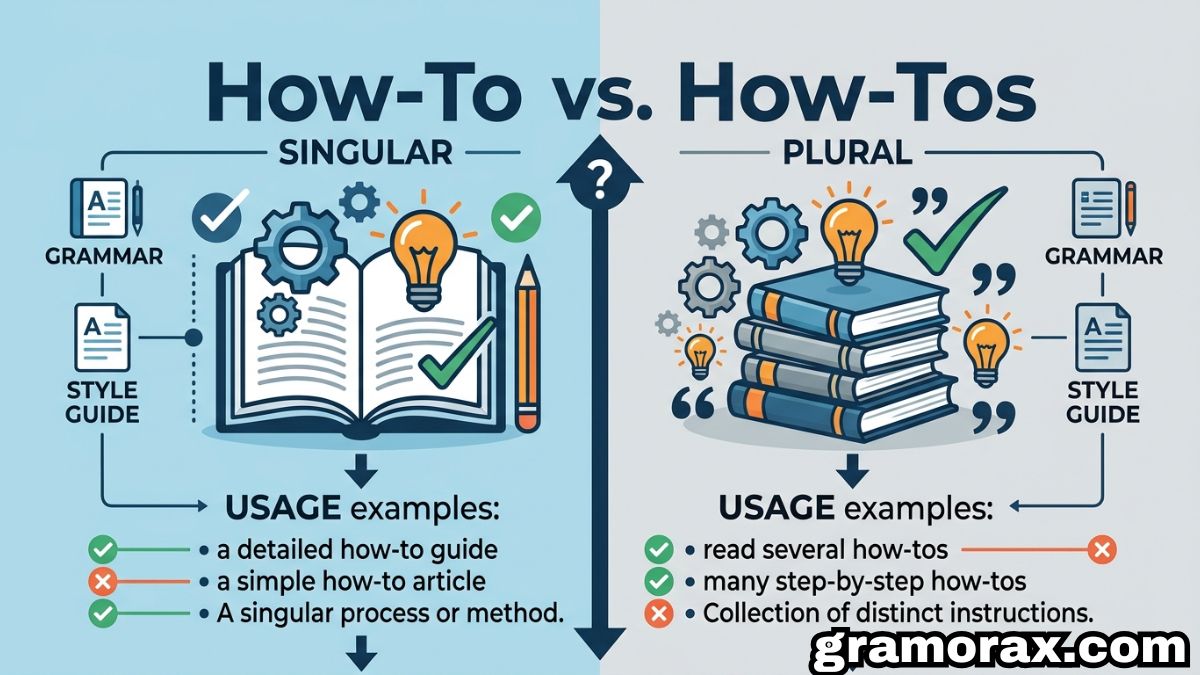
How-to is a hyphenated compound word functioning as either a noun or modifier — and how-tos is its correct plural form. Simple enough, right? Yet writers across every industry consistently fumble this tiny but mighty punctuation call. How To vs How Tos.
Here’s the truth: one misplaced apostrophe silently signals carelessness to every editor, publisher, and sharp-eyed reader who encounters it.
Mastering how-to vs. how-tos separates polished, credible writers from the rest. This definitive guide cuts through the confusion — covering hyphenation, pluralization, and real-world usage — so you never second-guess yourself again.
Why This Grammar Question Matters More Than You Think
Misusing how-to or how-tos might seem like a minor slip. But in publishing, editorial guidelines, and professional instructional writing, punctuation isn’t decorative. It’s structural. It signals meaning.
Think about it this way: a surgeon doesn’t leave most of the incision clean. Clarity in writing works the same way — precision matters everywhere, not just in the obvious places.
Here’s what’s at stake when writers get this wrong:
- SEO performance takes a hit when titles use inconsistent or incorrect compound forms
- Reader experience suffers when punctuation sends mixed signals
- Editorial credibility erodes — fast — especially in digital publishing contexts
- Consistency across a document breaks down, and readers notice pattern breaks even when they can’t name them
The publishing industry — from digital textbooks to instructional content platforms — standardizes this terminology precisely because inconsistency costs trust. And trust, in content, is everything.
What “How-To” Actually Means — Breaking Down the Grammar
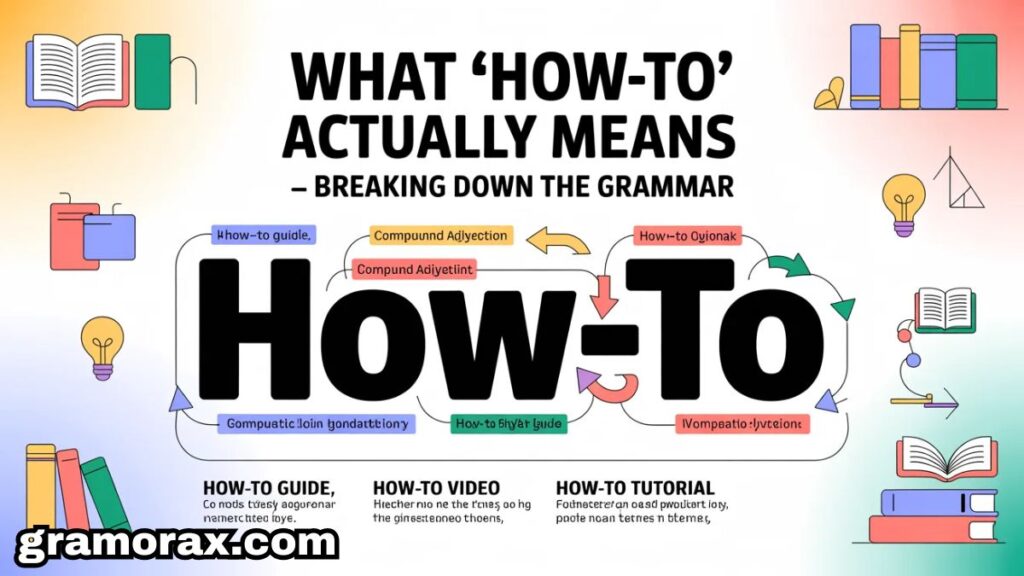
Before tackling plurals, let’s nail down what how-to actually is. It isn’t one thing. It’s three — depending entirely on how you use it in a sentence structure.
“How-To” as a Noun
When how-to functions as a noun, it refers to a set of instructions, a guide, or a tutorial. It’s a thing — something you can write, read, publish, or share.
“She published a how-to that went viral overnight.” “This how-to covers everything from setup to launch.”
Notice the hyphen stays in place. The hyphenated noun form is standard — confirmed by Merriam-Webster, which lists how-to as an official dictionary entry.
Think of similar compound nouns in English: a run-through, a check-in, a write-up. Same structure. Same behavior. The hyphenation is part of the word’s identity.
“How-To” as an Adjective (Noun Modifier)
When how-to comes before another noun, it acts as a noun modifier — essentially an adjective describing what kind of thing follows.
“She filmed a how-to video for her YouTube channel.” “The company published a how-to guide for new employees.”
In this role, how-to is a descriptor — a compound modifier. The hyphen is non-negotiable here. Drop it and you’ve changed the syntax. The words drift apart and lose their connected meaning.
A useful test: if you can replace how-to with the word instructional and the sentence still makes sense, you’re in modifier territory. Hyphenate.
“How To” as a Verb Phrase (The One That Tricks Everyone)
Here’s where most grammar mistakes happen. When how to introduces an infinitive verb phrase or clause, it’s not a compound at all.
“She learned how to code in three months.” “Nobody told me how to handle this situation.”
No hyphen. No compound. Just two separate words functioning together as part of a phrase. The semantics are completely different — this form describes an action, not a thing.
Table: Three Forms of “How-To” at a Glance
| Form | Example Sentence | Hyphen? | Function |
|---|---|---|---|
| Noun | “Read this how-to before starting.” | ✅ Yes | Names a thing |
| Modifier | “Watch the how-to video first.” | ✅ Yes | Describes a noun |
| Verb phrase | “She knows how to fix it.” | ❌ No | Describes an action |
Master this table and you’ve solved half the problem already.
The Hyphenation Rules — When to Use It, When to Drop It
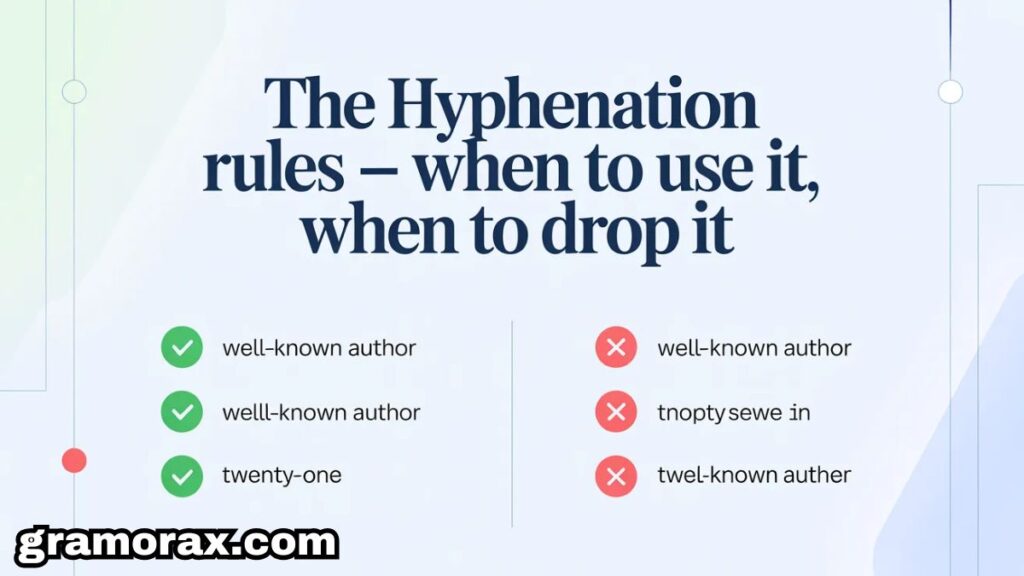
Hyphenation guidelines in English exist for one reason: clarity. The hyphen tells readers that two words are working together as a single unit. Remove it and you create ambiguity. Add it where it doesn’t belong and you create confusion.
Hyphenate “How-To” When…
- It functions as a noun (“This how-to is helpful.”)
- It modifies another noun (“a how-to tutorial,” “a how-to lesson”)
- It appears in a headline or title in either of those roles
Rule of thumb: If you can substitute the word guide or tutorial for how-to, you’re dealing with a compound. Hyphenate it.
Don’t Hyphenate When…
- How to introduces an infinitive (“Learn how to build a website.”)
- It follows a linking verb without modifying a noun directly
- The phrase describes what someone does, not what something is
Common trap to avoid: “I don’t know how-to do this.” — Wrong. No hyphen needed here because how to is part of a verb phrase, not a compound noun or modifier.
What the Major Style Guides Actually Say
The major stylebooks align more than most writers realize:
- Merriam-Webster lists how-to as a standard hyphenated dictionary entry — both noun and adjective uses are documented
- The AP Stylebook supports hyphenating compound modifiers before nouns, which covers the adjective form
- The Chicago Manual of Style backs compound noun and modifier hyphenation guidelines consistently
The verdict across editorial guidelines? Hyphenated when it’s a compound. Open (no hyphen) when it’s a verb phrase. Clear, consistent, and logical.
Quick-Reference Hyphenation Chart
| Sentence | Correct Form | Reason |
|---|---|---|
| “Watch this ___ video.” | how-to | Modifies a noun |
| “She published a ___.” | how-to | Functions as a noun |
| “He knows ___ fix it.” | how to | Verb phrase / infinitive |
| “This is a ___ guide.” | how-to | Compound modifier |
| “I learned ___ code.” | how to | Infinitive clause |
The Plural Problem: “How-Tos” vs. “How-To’s” vs. “How To’s”
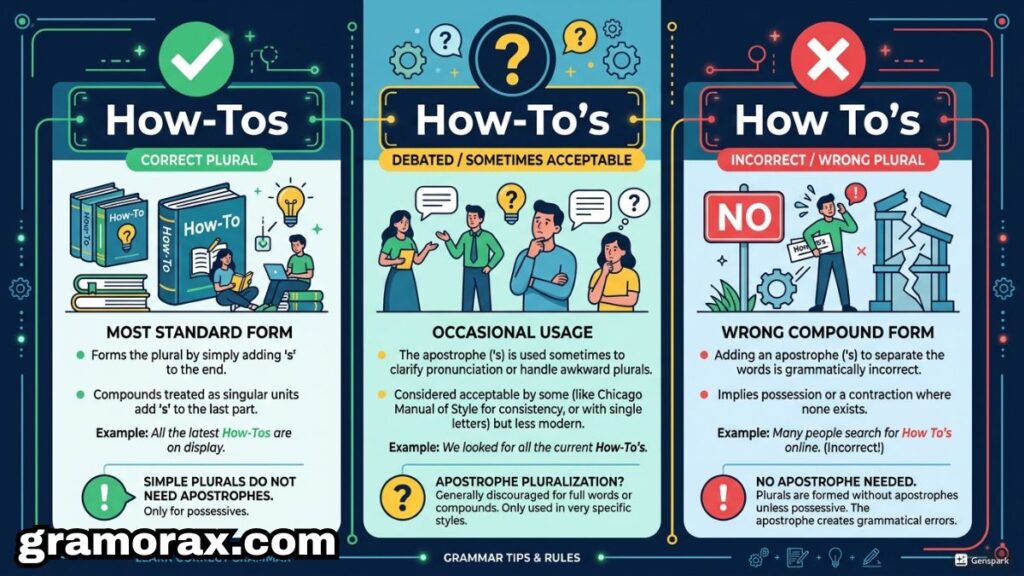
Now we reach the heart of the matter. Plural form — and this is where even careful writers stumble.
Three versions float around the internet:
- how-tos
- how-to’s
- how to’s
Only one is correct. The other two are grammar mistakes — and understanding why they’re wrong is just as important as knowing which one is right.
Why Pluralizing Compound Words Feels Awkward
English has a rule for compound nouns: you pluralize the head word — the main noun carrying the meaning.
Consider these examples:
- mothers-in-law → the head word is mother, so that gets the s
- runners-up → the head word is runner
- passers-by → the head word is passer
In how-to, the head word is to — so the s attaches there. The result? How-tos. The hyphen stays because it’s part of the compound’s identity. You’re just adding s to the end.
“How-Tos” — The Correct Plural Form
Merriam-Webster explicitly lists how-tos as the standard plural noun form. It follows standard pluralization rules: add s to the end, keep the hyphen intact.
The pattern matches other familiar compound plurals:
| Compound Noun | Correct Plural |
|---|---|
| check-in | check-ins |
| run-through | run-throughs |
| write-up | write-ups |
| how-to | how-tos |
Memory trick: If you can write check-ins, you can write how-tos. Same logic. same structure. Same rule.
“She published five how-tos on home improvement last month.” “The platform hosts hundreds of how-tos on DIY projects.”
Both sentences: clean, correct, and professional.
“How-To’s” — Why the Apostrophe Doesn’t Belong Here
This is the most seductive mistake. The apostrophe looks like it’s doing something useful. It isn’t.
In English, apostrophes serve two functions:
- Contraction — replacing missing letters (don’t, isn’t, I’ll)
- Possessive — showing ownership (the editor’s decision, the writer’s voice)
That’s it. Apostrophes do not — in standard English grammar rules — create plurals.
The one narrow exception? Pluralizing single lowercase letters (dot your i’s, mind your p’s and q’s). But that exception exists to prevent confusion — is versus is — and doesn’t apply to compound words like how-to.
Writing how-to’s implies something belongs to the how-to. But what? Nothing. The apostrophe creates apostrophe confusion without adding any meaning. It’s grammatical noise.
Side-by-side comparison:
| ❌ Incorrect | ✅ Correct |
|---|---|
| “She wrote three how-to’s.” | “She wrote three how-tos.” |
| “These how-to’s are well-researched.” | “These how-tos are well-researched.” |
| “I bookmarked a dozen how-to’s.” | “I bookmarked a dozen how-tos.” |
“How To’s” — The Double Error
This form manages to make two mistakes simultaneously: it drops the hyphen and adds an apostrophe. You end up with an incorrect plural that signals neither a proper compound noun nor a standard plural.
Why does it persist? A few reasons:
- Informal digital writing spreads faster than corrections travel
- Autocorrect catches spelling errors — not grammar mistakes
- Writers imitate what they see, and how to’s appears constantly in low-edited content
Seeing something repeated doesn’t make it right. Readability and clarity both suffer when this form sneaks into professional content.
How Punctuation Rewires Meaning Entirely
Here’s a striking demonstration. Take the same cluster of letters — h, o, w, t, o, s — and watch how punctuation completely changes what they communicate:
| Written Form | What It Signals | Correct Use Case |
|---|---|---|
| how to | Verb phrase / infinitive | “Learn how to write well.” |
| how-to | Compound noun or modifier | “Read this how-to first.” |
| how-tos | Correct plural noun | “She publishes how-tos weekly.” |
| how-to’s | Incorrect possessive attempt | Avoid in all professional writing |
| how to’s | Double error | Avoid entirely |
The takeaway here is important: punctuation isn’t decoration — it’s load-bearing.
A misplaced apostrophe doesn’t just look untidy. It shifts semantics. It tells your reader — subconsciously, instantly — that ownership is involved when none exists. And that small signal breaks the reading flow in ways that erode reader experience over time.
Real-World Usage — Where “How-Tos” Shows Up and Why It Matters
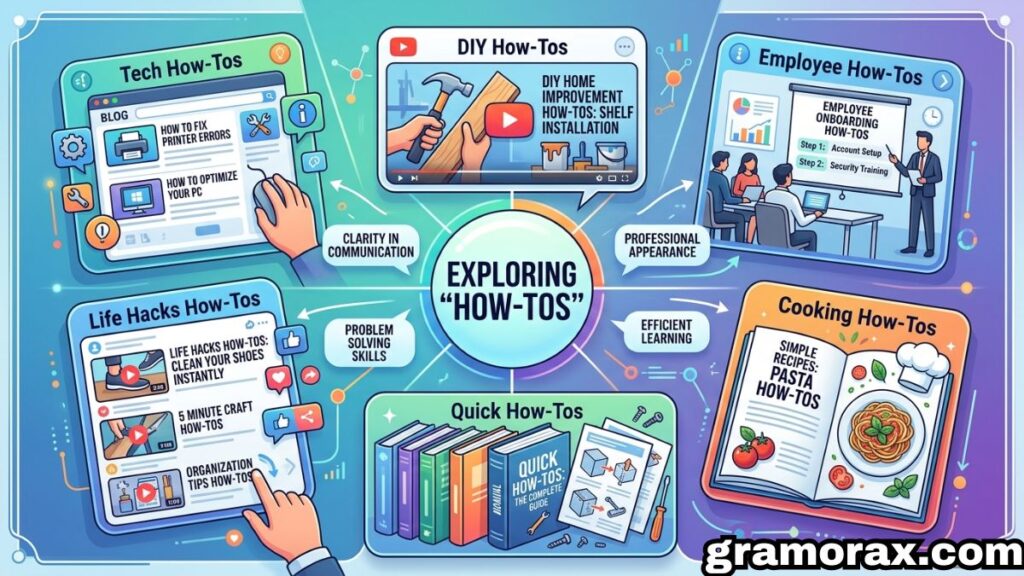
Instructional content drives some of the highest monthly traffic across every major content platform. Getting the terminology right isn’t just grammatically correct — it’s strategically smart.
Content Marketing and SEO Writing
How-to content and how-tos as a category dominate search queries. Titles, meta descriptions, and H2 headers that use the correct form signal professionalism to both readers and search engines.
According to Google Search Central’s helpful content guidelines, demonstrating expertise and accuracy — including in instructional phrase usage — directly supports SEO performance.
When your how-to blog uses how-to’s in headlines while a competitor uses how-tos, the competitor signals stronger editorial control. That matters for trust — and trust influences rankings.
Publishing and Editorial Standards
In the publishing industry, editing cycles exist precisely to catch errors like how-to’s before they reach readers. Major instructional publishers — think O’Reilly, Wiley, and educational content houses producing digital textbooks — standardize how-tos in their series titles and content categories.
An acquisitions editor at a major publisher once described the apostrophe-in-plural error as “the fastest way to date a manuscript.” It signals that the writer hasn’t internalized basic editorial guidelines — and that creates extra work in every subsequent editing cycle.
Technical Writing
Instructional guides, user manuals, API documentation, and SaaS onboarding materials all follow strict style guidelines. The Microsoft Writing Style Guide and similar resources used in technology and coding contexts treat compound nouns like how-to consistently. How-tos is the accepted plural across technical writing communities.
A laptop repair tutorial site, a coding documentation hub, a business onboarding manual — they all benefit from getting this right. Consistency builds authority.
Social Media and Branded Content
Even informal how-to video captions and how-to tutorial thumbnails carry brand weight. A company that writes how-to’s in its Instagram bio signals sloppiness — even to followers who couldn’t explain why it looks off.
In gardening communities, DIY forums, woodworking groups, home improvement subreddits, and leadership blogs, the writers who build loyal audiences tend to be the ones who sweat the details. Small things compound. How To vs How Tos.
Smart Workarounds — When You’d Rather Sidestep the Plural Altogether
Sometimes the cleanest solution is a graceful rewrite. Avoiding how-tos entirely isn’t weakness — it’s craft.
When Rewrites Make Sense
- When how-tos sounds clunky in a specific sentence rhythm
- When your audience skews general and tutorials or guides lands more naturally
- When readability benefits from a more familiar term
Practical Rewrite Options
| Instead of… | Consider… |
|---|---|
| “Five how-tos for beginners” | “Five guides for beginners” |
| “Read these how-tos first” | “Read these tutorials first” |
| “A collection of how-tos“ | “A collection of step-by-step articles“ |
| “Our how-tos cover everything” | “Our instructional guides cover everything” |
That said — how-tos is correct. Use it with confidence when it fits.
Common Mistakes Writers Make — and the Thinking Behind Them
Understanding why these errors happen makes them easier to avoid. Let’s break down each one.
Mistake — Writing “How To” as a Noun (No Hyphen)
Why it happens: Writers see the verb-phrase form constantly (“learn how to code”) and over-apply it.
Fix: Ask yourself — is this a thing you can point to, or an action someone performs? Things get hyphens. Actions don’t.
Mistake — Pluralizing with an Apostrophe (“How-To’s”)
Why it happens: Apostrophes feel active. They look like they’re working. But they’re not doing what writers think.
Fix: Reserve apostrophes for contractions and possessives. Plurals get s — just s.
Mistake — Dropping the Hyphen in the Plural (“How Tos”)
Why it happens: Writers assume that adding s means removing the hyphen. It doesn’t.
Fix: The hyphen belongs to the compound word itself. Adding s changes the number, not the compound’s structure. How-tos keeps the hyphen because how-to always does.
Mistake — Inconsistency Within a Single Document
This one’s subtle but damaging. Using how-to correctly in paragraph one and then writing how to (as a noun, no hyphen) in paragraph four creates inconsistency that undermines reader experience.
Fix: Decide on your usage before you start writing. Then run a Find & Replace check before publishing. Consistency across a document matters as much as correctness in individual sentences. How To vs How Tos.
Conclusion
How-to vs. how-tos isn’t complicated once you know the rules. Hyphenate when it’s a noun or modifier. Skip the hyphen when it’s a verb phrase. And always pluralize with just an s — never an apostrophe. Three rules. Zero exceptions. How To vs How Tos.
Getting how-to vs. how-tos right marks you as a careful, credible writer. Small details build big reputations. How To vs How Tos. Now you have the definitive guide — go use it confidently.
FAQs
What is the correct plural of “how-to”?
The correct plural is how-tos — keep the hyphen and add only an s. No apostrophe needed, ever.
Is “how-to’s” grammatically correct?
No. Apostrophes signal possession or contraction — not plurals. How-to’s is a common but incorrect form rejected by Merriam-Webster and AP style.
Should “how-to” always be hyphenated?
Only when it functions as a noun (“read this how-to”) or modifier (“a how-to guide”). As a verb phrase (“learn how to code”), drop the hyphen.
Do major style guides agree on “how-tos”?
Yes. Merriam-Webster, the AP Stylebook, and Chicago Manual of Style all support how-tos as the standard plural form of the hyphenated compound word.
Why do so many writers still use “how-to’s” incorrectly?
Mostly habit and imitation. Informal digital content spreads fast and autocorrect doesn’t catch grammar mistakes — only spelling errors. Frequency doesn’t equal correctness.