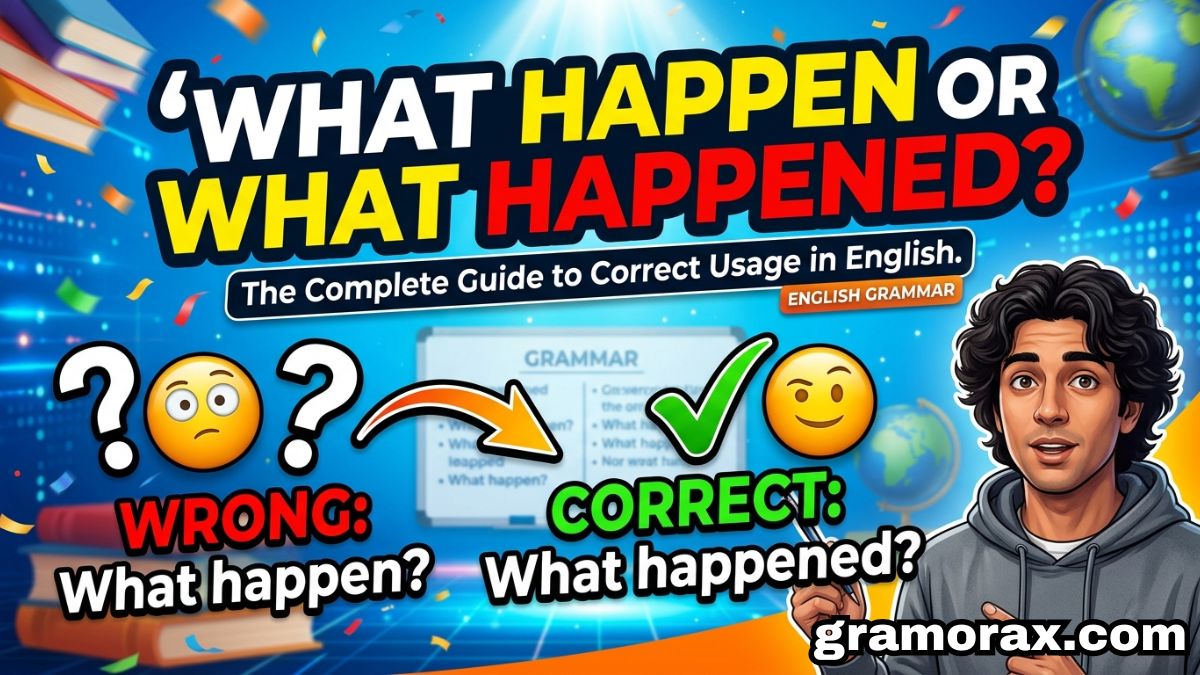
“What happened” is the grammatically correct past tense form used to ask about a completed event. “What happen” uses the bare base verb — signaling present tense — which makes it incorrect when referring to past events in standard English.
That one missing letter — d — is the difference between sounding fluent and sounding like a beginner. It’s a small mistake with a loud impact.
Understanding why one form works and the other doesn’t transforms your spoken English and written English permanently. This guide covers every rule, every error pattern, and every context — clearly and completely.
The One-Word Mistake That Makes Fluent Speakers Cringe
Here’s the truth: “what happen” is never correct in standard English. Not in formal writing, not in casual speech, not in a text message to your best friend. Yet millions of English learners — especially speakers of Spanish, Urdu, Arabic, Tagalog, and Mandarin — type or say it every single day.
Why? Because in many languages, verbs don’t change form to signal past tense the way English verbs do. You can drop the tense marker, and the sentence still makes sense. English doesn’t work that way. Verb tenses carry essential meaning, and stripping them out breaks the sentence’s internal logic.
The good news? Once you understand why “what happened” is correct, you’ll never second-guess it again.
A 60-Second Crash Course on English Verb Tenses
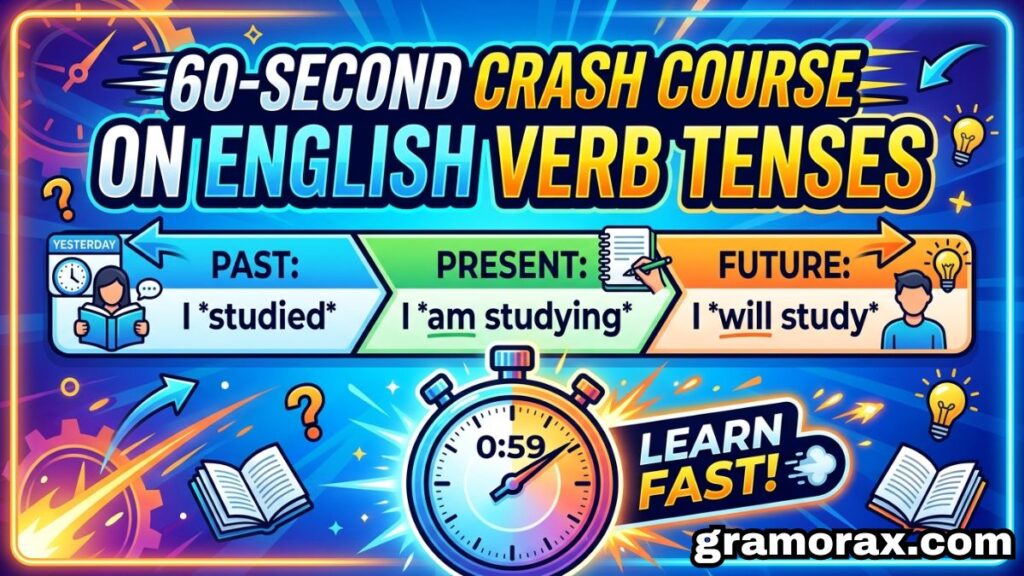
Verb tenses aren’t decoration — they’re the clock built into every sentence. They tell your listener when something occurred, is occurring, or will occur. English uses tense markers like “-ed” and “-ing” and auxiliary verbs to indicate time.
Here’s a quick map of the most relevant verb tense forms for “happen”:
| Tense | Form | Example |
|---|---|---|
| Simple Present | is/are happening | Things happen every day. |
| Simple Past | happened | It happened yesterday. |
| Present Perfect | happen/happens | It has happened before. |
| Past Perfect | had happened | It had happened before I arrived. |
| Present Continuous | is / are happening | Something is happening outside. |
The past tense form — happened — signals a completed action. The event is done, finished, over. That “-ed” suffix does serious grammatical heavy lifting, and removing it sends the sentence crashing.
Key fact: English has 12 distinct tense forms. Among the most commonly confused are simple past (happened) and base form (happen). They look similar but function completely differently.
What Kind of Verb Is “Happen” — and Why That Matters
Not all verbs behave the same way. Happen is an intransitive verb — meaning it never takes a direct object. You can’t “happen something.” Things… happen.
Compare these:
- Transitive: She kicked the ball. (Ball = direct object ✅)
- Intransitive: Something happened. (No object possible ✅)
Why does this matter? Intransitive verbs form questions differently from transitive ones. And it’s precisely this difference that trips people up when they produce incorrect usage like “what happen.”
When an intransitive verb sits at the center of a question, the word “what” actually becomes the subject. This triggers a special grammar rule — one most learners never learn explicitly.
Why “What Happen” Is Grammatically Wrong — Every Single Time
Let’s be blunt. “What happen” commits two errors simultaneously:
Error 1 — Wrong tense. “Happen” is the base verb (present tense, base form). You’re asking about something that already occurred. That calls for the past tense form: happened.
Error 2 — Wrong question structure. In English, yes/no questions and object questions use auxiliary verbs like do, does, and did to carry the tense:
- Did it happen? ✅
- What did you see? ✅
But subject questions — where “what” or “who” replaces the subject — skip the auxiliary entirely. The verb carries the tense all on its own. So “What happened?” needs no “did.” It stands alone.
When a learner says “what happen,” they’re producing a form that:
- Has no auxiliary verb (so it can’t be an object question)
- Has no past tense marker (so it communicates present tense, not past)
- Leaves the sentence grammatically incomplete
In short, it falls between two chairs. It’s neither a proper subject question nor a proper object question. It’s a nonstandard grammar error, full stop.
Why This Mistake Is So Common Among Language Learners
Languages like Spanish, Tagalog, and Urdu mark tense differently — often through context, separate time words, or verb endings that don’t resemble English “-ed.” When learners translate mentally from their native tongue, the base form slips through.
It’s not a sign of carelessness. It’s a predictable tense confusion that comes from how languages are wired differently. Knowing why it happens is the first step to fixing it.
Why “What Happened” Is Always the Correct Form

“What happened” works because it follows both rules of English grammar perfectly.
Here’s the structure breakdown:
What    happened    to you?
  ↓         ↓
Subject   Past tense verb (no auxiliary needed)
“What” acts as the subject of the sentence. It asks: what thing caused this event? Since “what” is already the subject, English doesn’t need “ to form the question. The verb (happened) carries the past tense marker — the “-ed” ending — and that’s all the sentence needs.
Side-by-side comparison:
| ❌ Incorrect | ✅ Correct |
|---|---|
| What happen to you? | What happened to you? |
| What happen at school? | What happened at school? |
| Tell me what happen. | Tell me what happened. |
| What happen yesterday? | What happened yesterday? |
| What happen to him? | What happened to him? |
Notice something? Not one of those correct versions needs did. That’s the subject question rule in action — and it’s one of the most elegant shortcuts in English grammar.
Subject Questions vs. Object Questions — The Rule Nobody Taught You
This is the grammar rule that unlocks everything. Most learners were never taught it explicitly, which is exactly why “what happen” feels confusing.
English questions fall into two camps:
Subject Questions
The question word (who, what) replaces the subject of the sentence.
- Something happened. → What happened?
- Someone arrived late. → Who arrived late?
No auxiliary verb needed. The main verb carries the tense. This is why “What happened?” has no did.
Object Questions
The question word targets the object — something other than the subject.
- You saw something. → What did you see?
- She bought something. → What did she buy?
Here, did is required because the subject (you, she) is still in the sentence and the verb needs help carrying the tense.
The test is simple: Ask yourself, is “what” acting as the subject, or are you asking about an object? If it’s the subject, skip did and make sure the verb is in past tense. If it targets an object, did is your friend — and the main verb stays in the base form.
Every Real Context Where “What Happened” Is Correct
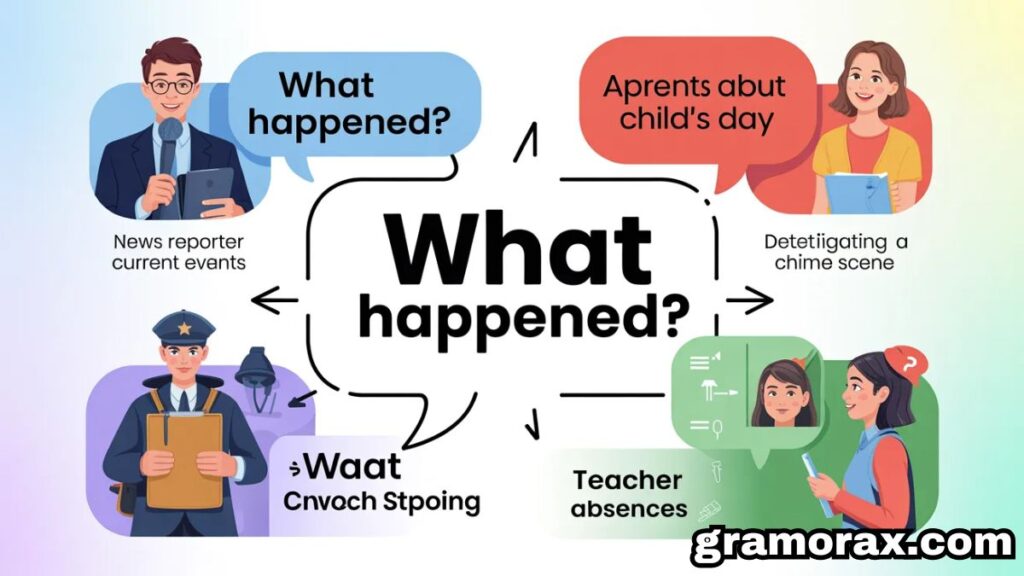
“What happened” isn’t just one phrase — it’s a workhorse. Here’s where it shows up:
Asking About Past Events
The most common use. Something occurred, and you want details.
- “What happened at the conference?”
- “What happened during the experiment?”
- “What happened after I left the party?”
Expressing Surprise or Disbelief
When something unexpected shows up, what happened carries emotional weight.
- “What happened to your car?!”
- “What happened to your hair?!”
Narrative Transitions in Storytelling
Writers and speakers use it to move a story forward.
- “Here’s what happened next.”
- “Let me tell you what happened.”
Indirect Questions and Reported Speech
When “what happened” sits inside a longer sentence, it becomes an embedded clause — and the word order stays the same. That’s one of the cleaner features of written English grammar.
- “She asked what happened.” ✅
- “Nobody knows what happened.” ✅
- “Do you know what happened to John?” ✅
Notice that the clause doesn’t flip to question-word order. It stays in statement form: what happened, not what did happen.
Spoken English vs. Written English — Does the Rule Change?
Short answer: No.
Some learners assume that casual speech plays by looser rules — that native speakers drop endings in fast talk and “what happen” might slip by unnoticed. Here’s the reality:
Native speakers don’t say “what happen.” Not in fast speech. Not in slang. not in informal texting. It simply doesn’t appear in natural, fluent English, regardless of formality level.
What does change between spoken English and written English is contraction usage and vocabulary:
| Context | What changes | What doesn’t change |
|---|---|---|
| Casual conversation | “What’s happened?” (contracted) | Still uses past tense |
| Text messaging | “omg what happened??” | Still uses happened |
| Formal writing | Full, uncontracted sentences | Still uses happened |
| Academic writing | Precise, structured sentences | Still uses happened |
The tense marker never drops. In professional emails, reports, workplace communication, and exam writing, “what happened” is non-negotiable. In casual conversation, it’s equally non-negotiable — it just sounds more relaxed in delivery.
Common Errors Learners Make Around “What Happened”
The “what happen” error has several close cousins. Here are the most frequent incorrect verb usage patterns and exactly why they fail:
❌ “What happen to you?”
The error: Missing past tense marker. “Happen” is the base verb — it signals present tense, not past. The fix: What happened to you?
❌ “What is happened?”
The error: Two problems at once. “Is” signals present tense; “happened” signals past. They can’t coexist this way. This is tense mixing at its most jarring. The fix: What happened?
❌ “What did happened?”
The error: Classic overcorrection. The learner correctly reaches for did — but then also adds “-ed” to the verb. In English, tense gets marked once, not twice. With did present, the main verb must stay in the base form. The fix: What happened? (drop did) or What did happen? (keep did, use base form — though the first option is more natural)
❌ “What has happen?”
The error: Mixing present perfect aspect (has) with the base verb (happen). The present perfect needs the past participle (happened), not the base form. The fix: What has happened?
❌ “Whats happen?”
The error: Contraction error plus missing tense. A double stumble. The fix: What’s happened? (informal, present perfect) or What happened? (simple past)
Real Sentences — Correct vs. Incorrect, Side by Side
Context matters. Here’s how “what happened” vs. “what happen” plays out across a dozen real-world scenarios:
| Context | ❌ Incorrect | ✅ Correct |
|---|---|---|
| Office meeting | What happen at the meeting yesterday? | What happened at the meeting yesterday? |
| Accident | What happen to your arm? | What happened to your arm? |
| News event | What happen in the city last night? | What happened in the city last night? |
| Storytelling | Let me tell you what happen. | Let me tell you what happened. |
| Reported speech | She told me what happen. | She told me what happened. |
| Surprise | What happen to your phone?! | What happened to your phone?! |
| Indirect question | Do you know what happen? | Do you know what happened? |
| Loud noise | What happen out there? | What happened out there? |
| Broken vase | What happen here? | What happened here? |
| Workplace report | Describe what happen. | Describe what happened. |
| Conversation | I don’t know what happen. | I don’t know what happened. |
| Academic writing | Explain what happen during the experiment. | Explain what happened during the experiment. |
The One Rule That Locks This In Forever
Grammar rules can feel abstract until you boil them down to something concrete. Here it is:
If the event is already over — if it’s a completed event — you need “happened.”
That’s it. If you’re asking about something that already occurred, the past tense form is the only option. The “-ed” ending isn’t optional decoration. It’s the signal that tells your listener: this is done, this is finished, this event occurred in the past.
A quick mental check: Can you replace “what happened” with “something happened” in statement form?
- “Something happened at the party.” ✅ → “What happened at the party?” ✅
- “Something happen at the party.” ❌ → Red flag — the base form doesn’t fit a past event
If the statement form sounds wrong, your question form needs fixing, too.
Three Quick Practice Drills
Try completing these correctly before reading the answers:
- “Can you tell me what _______ to the report?”
- “What _______ after the meeting ended?”
- “Nobody told me what _______ that night.”
Answers: happened, happened, happened. Every single time.
How to Train Your Brain to Stop Making This Mistake
Knowing the rule and feeling the rule in your bones are two different things. Here’s how to close that gap:
Shadowing. Listen to native English speakers — podcasts, interviews, TV dramas — and repeat what they say in real time. When you hear “what happened,” say it out loud with them. Your mouth and ear start to recognize the correct form as natural.
Read English fiction. Novels are packed with past-tense narration and natural English dialogue. Your brain absorbs correct tense forms through repeated exposure — passively and effectively.
Self-correct in real time. The moment “what happen” starts to leave your mouth, pause and add “-ed.” Don’t wait until someone corrects you. Catching your own errors builds language fluency faster than any textbook. What Happen or What Happened.
Write one sentence a day. Pick a completed event from your day and write it in a question form: “What happened when I…?” Simple. Free. Shockingly effective.
Conclusion
The answer is simple. “What happened” is always correct. “What happen” is always wrong. This isn’t about formal or casual English — it’s about using the right past tense form for completed events. One small “-ed” ending makes all the difference. What Happen or What Happened.
Mastering what happen or what happened isn’t difficult. What Happen or What Happened. It just takes awareness. Now you know the rule, the reason, and the fix. What Happen or What Happened. Apply it confidently — in conversations, emails, and exams. Your English just got sharper.
FAQs
Is “what happen” ever correct in English?
No. “What happen” is always grammatically incorrect. “What happened” is the only accepted form in both spoken English and written English.
Why do ESL learners say “what happen” instead of “what happened”?
Most ESL learners come from languages where verb endings don’t change for the past tense. This causes them to drop the “-ed” marker naturally.
Can I say “what did happened” instead of “what happened”?
No. “What did happened” double-marks the past tense — a common overcorrection error. The correct forms are either “what happened” or “what did happen.”
Is “what’s happened” the same as “what happened”?
Not exactly. “What’s happened” means what has happened — using the present perfect tense. “What happened” uses simple past. Both are correct but signal different time references.
Which form should I use in professional emails and academic writing?
Always use “what happened” in formal communication. It’s the grammatically correct standard English form accepted in the workplace, academic, and professional writing globally.