Become vs became are two forms of the same irregular verb — one lives in the present, one anchors the past. Knowing which to use determines whether your writing sounds polished or amateur.
One wrong verb form can quietly destroy your credibility — in job applications, essays, and professional emails. Native speakers make this mistake daily.
Master these verb forms and you unlock precision in every tense: simple past, present perfect, even past perfect. This guide makes the rules permanent, not just memorable.
The Anatomy of “Become” — An Irregular Verb With Rules Worth Knowing
What Kind of Verb Is “Become”?
Become is a linking verb — it connects a subject to a state or identity. It works like “be” or “seem,” but it specifically signals change. Think of it as a transformation verb.
“She became confident.” → She wasn’t confident before, but she is now.
What makes it tricky is that become is one of English’s irregular verbs. Regular verbs follow the “-ed” pattern: walk → walked, help → helped. Irregular verbs don’t follow that pattern. They change their own way.
Become follows the same pattern as its root verb come:
| Root Verb | Simple Past | Past Participle |
|---|---|---|
| come | came | come |
| become | became | become |
| overcome | overcame | overcome |
Notice something? The past participle of become is become — not became. That single fact eliminates the most common mistake writers make.
The Root and Origin — Why “Became” Looks the Way It Does
Become comes from Old English becuman, meaning “to come to be” or “to arrive at a state.” The be- prefix intensifies the transformation. That’s why it’s always about change — not just existing, but shifting from one state to another.
Understanding this helps you feel the verb, not just memorize it.
“Become” — The Present Tense and Infinitive Form
Exactly When to Use “Become”
Use become (the base form) in these situations:
- With I, you, we, they in the present tense: “They become anxious before exams.”
- After modal verbs (will, can, might, must, should, could): “She will become a great leader.”
- For general truths and habitual actions: “Habits become automatic over time.”
- As an infinitive after verbs like want, need, hope: “He wants to become a pilot.”
Subject-verb agreement is straightforward here. For most subjects, the base form stays unchanged.
“Become” After Modal Verbs — A Rule That Never Breaks
This is where many learners slip up. When a modal verb precedes the main verb, the main verb always stays in its base form. No exceptions.
✅ “You must become more disciplined.” ✅ “She could become the next CEO.” ✅ “This might become a problem.” ❌ “You must became more disciplined.” ← Never correct.
Modal verbs (will, would, can, could, may, might, shall, should, must) are frozen in their own tense. They carry the tense load so the main verb doesn’t have to.
Examples of “Become” Across Real Contexts
- Career: “If you keep practicing, you’ll become fluent in a year.”
- Science: “Caterpillars become butterflies through metamorphosis.”
- Relationships: “Strangers become friends through shared experience.”
- Philosophy: “We become what we repeatedly do.” — Aristotle (paraphrased by Will Durant)
“Became” — Mastering the Simple Past Form
When Exactly to Use “Became”
Became is the simple past form of become. Use it when an action or transformation was completed in the past — especially at a specific or implied point in time.
The key question to ask yourself: Can I attach a past time stamp to this sentence?
- “She became a doctor in 2019.” ✅ (specific year)
- “He became curious when he saw the map.” ✅ (specific moment)
- “They became best friends during college.” ✅ (defined period)
If the answer to “when?” is a specific past moment — use became.
“Became” vs. “Has Become” — The Distinction That Changes Everything
This is where the two forms diverge in meaning. They’re not interchangeable. Not even close.
| Sentence | Tense | What It Signals |
|---|---|---|
| “She became famous in 2015.” | Simple past | Fame happened. That chapter is complete. |
| “She has become famous.” | Present perfect | She became famous and is still famous now. |
Simple past = finished, closed event. Present perfect = past action with present-day relevance.
This distinction matters enormously in storytelling, journalism, and professional writing.
“The town became a tourist destination in the 1980s” implies it may or may not still be one. “The town has become a major tourist destination” tells readers it’s relevant right now.
Common Mistakes Even Fluent Speakers Make
| ❌ Incorrect | ✅ Correct | Explanation |
|---|---|---|
| “She has became confident.” | “She has become confident.” | Past participle = become, never became |
| “He become a teacher last year.” | “He became a teacher last year.” | Past tense needs became |
| “They had became tired.” | “They had become tired.” | Same rule — participle form stays as “become” |
| “It will becomes clear.” | “It will become clear.” | Modal + base form only |
| “She is become stronger.” | “She is becoming stronger.” | Progressive form needs -ing |
“Becomes” — The Third-Person Singular Present
The Simple “-S” Rule
Subject-verb agreement in the present tense follows one clean rule: add -s when the subject is he, she, or it. That’s it.
- “It becomes obvious.”
- “She becomes nervous before presentations.”
- “He becomes a different person when he’s on stage.”
- “We become what we focus on.” (no -s for plural/I/you)
“Becomes” in Conditional and Scientific Writing
Becomes appears frequently in formal writing when describing processes, conditions, and general truths.
- “When pressure increases, the gas becomes denser.”
- “If the situation becomes critical, the team activates the emergency protocol.”
- “A habit becomes automatic after consistent repetition.”
These are habitual actions and general truths — the present tense at work.
Perfect Tenses — “Has Become,” “Have Become,” and “Had Become”
This section covers the forms that cause the most confusion. Master these and you’re ahead of 90% of English writers.
“Has Become” — Present Perfect for Singular Subjects
Use has become when:
- The subject is he, she, or it (singular third person)
- The transformation happened in the past but matters right now
Examples:
- “She has become one of the most respected scientists in her field.”
- “The city has become a hub for tech startups.”
- “He has become more patient over the years.”
Notice: no specific past date. Present perfect intentionally avoids pinning a date — it emphasizes the current result, not the moment it happened.
“Have Become” — Present Perfect for I, You, We, They
Same tense, different subjects.
- “I have become more aware of my habits.”
- “You have become the person I always knew you could be.”
- “We have become a more connected society.”
- “They have become better friends since moving in together.”
“Had Become” — The Past Perfect Form Most Guides Ignore
Had become is the past perfect form. Use it when one past event happened before another past event. It establishes a sequence.
“By the time she graduated, she had become fluent in Mandarin.” “He realized the situation had become dangerous hours before anyone else noticed.” “When I returned to my hometown, everything had become unrecognizable.”
Think of it this way: if became is “one step back in time,” had become is “two steps back.” It’s the past of the past.
Timeline visualization:
Further past ──────────────── Recent past ──────────── Present
   HAD BECOME                   BECAME/HAS BECOME          NOW
Why “Has Became” and “Had Became” Are Always Wrong
Here’s the rule that settles this permanently:
After auxiliary verbs (has, have, had), always use the past participle. The past participle of become is become — not became.
Became is the simple past. It stands alone. It never follows has, have, or had.
A parallel that makes this click:
| ✅ Correct pattern | ❌ Wrong pattern |
|---|---|
| I have come | I have came |
| She has become | She has became |
| They had overcome | They had overcame |
The come family of irregular verbs all follow the same pattern. Learn one, you’ve learned them all.
“Would Become” and Conditional Structures
Hypothetical and Future-in-Past Uses
Would become appears in two main situations:
1. Hypothetical (conditional) sentences:
“If you committed to daily practice, you would become exceptional.” “A small investment in 2010 would become a fortune by 2020.”
2. Future-in-past (reported speech / narrative):
“She always knew she would become a writer.” “Nobody predicted it would become the most-watched show of the decade.”
“Would Become” vs. “Will Become” — What Changes?
| Form | When to Use | Example |
|---|---|---|
| will become | Real future possibility or certainty | “She will become a great leader.” |
| would become | Hypothetical, conditional, or reported speech | “He said he would become a doctor.” |
Will = real probability. Would = conditional or reported.
Progressive Forms — “Is Becoming” and “Was Becoming”
These forms get skipped in most grammar guides. Don’t skip them — they change meaning significantly.
When the Process Matters More Than the Result
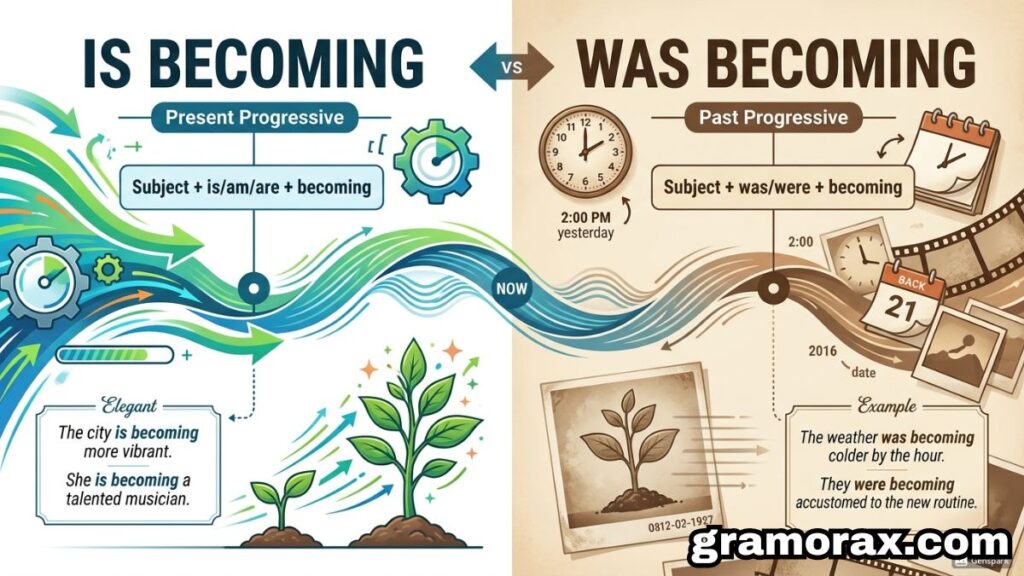
The progressive forms focus on ongoing transformation, not the endpoint.
- “She is becoming more confident with each presentation.” (right now, in progress)
- “The neighborhood is becoming more vibrant.” (gradual, ongoing change)
- “The situation was becoming dangerous.” (ongoing in the past)
- “They were becoming close friends.” (process, not conclusion)
“Become” vs. “Becoming” — Static vs. Dynamic Meaning
| Form | Focus | Example |
|---|---|---|
| became | Completed change | “She became confident.” |
| is becoming | Process in motion | “She is becoming confident.” |
The simple past takes a snapshot. The progressive films a scene. Choose based on what you want the reader to feel.
Master Comparison Table — Every Verb Form in One Place
| Tense / Form | Structure | Example Sentence |
|---|---|---|
| Simple Present (I/you/we/they) | become | “They become nervous easily.” |
| Simple Present (he/she/it) | becomes | “It becomes clear eventually.” |
| Simple Past | became | “He became a teacher in 2018.” |
| Present Perfect (he/she/it) | has become | “She has become very skilled.” |
| Present Perfect (I/you/we/they) | have become | “We have become better communicators.” |
| Past Perfect | had become | “By 2015, it had become a global brand.” |
| Future | will become | “You will become great at this.” |
| Conditional | would become | “It would become a real problem.” |
| Present Progressive | is/am/are becoming | “He is becoming more patient.” |
| Past Progressive | was/were becoming | “It was becoming difficult to manage.” |
“Become” in Formal, Academic, and Literary Writing
Register Matters — Tense Choice Signals Your Intent
In academic writing, the present perfect dominates. It connects past research to present relevance.
“The field has become increasingly data-driven over the past decade.”
In literary writing, simple past creates narrative immersion.
“By morning, the boy had become someone else entirely.”
In journalism, present tense signals ongoing relevance.
“Remote work is becoming the new normal.”
Choosing the right tense isn’t just grammar — it’s tone, intent, and reader experience.
Real-World Case Studies — How Tense Changes Everything
Case Study 1 — The LinkedIn Bio Mistake
A software engineer writes:
❌ “Over ten years, I have became a certified cloud architect.”
This contains two errors: became after have (wrong participle), and the meaning is weakened. The correct version:
✅ “Over ten years, I have become a certified cloud architect.”
This signals continuous growth that’s still relevant today — exactly what a recruiter wants to see. Become vs Became.
Case Study 2 — The Academic Essay Error
A student writes:
❌ “By 2020, renewable energy had became the dominant source in several countries.”
The verb form is wrong. Past perfect requires the past participle:
✅ “By 2020, renewable energy had become the dominant source in several countries.”
The corrected sentence properly sequences two past events: the rise of renewables preceded the 2020 reference point. Become vs Became.
Case Study 3 — Storytelling and Tense Consistency
A writer mixes tenses mid-narrative:
❌ “He became a soldier at eighteen. His training has become brutal. The war has became his entire world.”
Errors: inconsistent tense shift + “has became” (wrong participle). Corrected:
✅ “He became a soldier at eighteen. His training became brutal. The war became his entire world.”
Consistent simple past keeps the reader inside the story. Tense inconsistency jolts them out.
Memory Anchors That Actually Stick
The Irregular Trio — Come, Become, Overcome
All three follow the same conjugation pattern:
| Verb | Simple Past | Past Participle |
|---|---|---|
| come | came | come |
| become | became | become |
| overcome | overcame | overcome |
Know one — you know all three.
The “Time Stamp” Test
Ask yourself: Can I attach “yesterday” or “in [year]” to this sentence and have it make sense?
- “She became a pilot yesterday.” ✅ → use became
- “She has become a pilot yesterday.” ❌ → has become doesn’t take specific past dates
The Auxiliary Trap
Whenever you see has, have, or had before a verb, the verb must be in its past participle form. For become, that form is always become — never became.
Has/have/had + become = always correct. Has/have/had + became = always wrong.
The Come/Became Mirror
If you’d never write “I have came” — and you wouldn’t — then you should never write “I have became.” They fail for exactly the same reason.
Quick-Reference Cheat Sheet
- ✅ become → present tense with I/you/we/they, or after any modal verb
- ✅ becomes → present tense with he/she/it only
- ✅ became → simple past (completed, specific past event)
- ✅ has/have become → present perfect (past action, still relevant now)
- ✅ had become → past perfect (one past event before another)
- ❌ has/have/had became → always wrong — never use this combination
Conclusion
Become vs became follows simple logic once you see the pattern. Completed past? Use became. Still true today? Use has become. Become vs Became. After a modal verb? Always become. These rules don’t bend.
Mastering become vs became sharpens every sentence you write. It signals confidence, clarity, and real command of English grammar. Become vs Became. Small verb choices carry big weight. Get them right — and your writing speaks for itself. Become vs Became.
FAQs
What is the difference between become and became?
Become is the present tense; became is the simple past. Use became for completed past events and become for present situations or after modal verbs.
Is “has became” grammatically correct?
Never. The correct form is always “has become.” After has, have, or had, English grammar requires the past participle — which is become, not became.
When should I use “had become”?
Use had become when one past transformation happened before another past event. Example: “By the time he retired, he had become a legend.”
What is the past participle of become?
The past participle is become — identical to the base form. It follows the same irregular pattern as come → came → come and overcome → overcame → overcome.
Does “become” change with he, she, or it?
Yes. In the present tense, add –s for third-person singular subjects: “She becomes nervous” or “It becomes clear.” All other subjects use become without –s.