Hassle is a real English word — a noun and a verb meaning an annoying inconvenience or persistent pestering. Hastle doesn’t exist. No dictionary lists it, no grammar guide endorses it, yet thousands of people type it daily without blinking. Hassle vs Hastle.
Here’s the uncomfortable truth: one wrong letter quietly chips away at your credibility. In emails, articles, and professional content, small spelling errors speak louder than people admit.
Understanding hassle vs hastle goes beyond fixing a typo — it sharpens your writing, strengthens your communication, and ensures every word you put down actually means what you intend.
The Verdict: Hassle or Hastle — Which Is Right?
Let’s settle this immediately.
✅ hassle — correct, real, dictionary-confirmed ❌ hastle — not a word. Not in any English dictionary. Not anywhere.
Check the three most authoritative English dictionaries yourself:
- Merriam-Webster
- Oxford Learner’s Dictionary
- Cambridge Dictionary
All three list hassle. None of them list hastle — because it simply doesn’t exist.
Still, “hastle” floods online comment sections, forums, and even some published articles. That’s the real problem. Typo propagation — the way online typos spread through copy-paste culture — makes a misspelling look legitimate just through sheer repetition. Your brain sees “hastle” dozens of times and starts thinking it looks right.
It doesn’t. It isn’t. And here’s exactly why so many people get it wrong.
Why Do So Many People Misspell “Hassle” as “Hastle”?
This isn’t random. There are real linguistic reasons behind this spelling confusion — and understanding them actually helps you avoid the mistake for good.
The -STLE Word Family Is Powerful
English has a dominant word pattern ending in -stle. Look at this comparison:
| Word | Spelling | Pattern |
|---|---|---|
| Castle | C-A-S-T-L-E | -stle |
| Hustle | H-U-S-T-L-E | -stle |
| Bustle | B-U-S-T-L-E | -stle |
| Rustle | R-U-S-T-L-E | -stle |
| Jostle | J-O-S-T-L-E | -stle |
| Whistle | W-H-I-S-T-L-E | -stle |
| Hassle | H-A-S-S-L-E | -ssle ← breaks the pattern |
Your brain has absorbed the -stle pattern from years of reading and writing. So when you reach for “hassle,” it quietly inserts a T by habit. That’s phonetic confusion at work — your mental spell-checker autocompletes based on familiar patterns, not actual rules.
Double-Letter Anxiety Is Real
Double-letter mistakes trip up even strong writers. English uses double consonants inconsistently — “occur” but not “ocur,” “embarrass” but not “embaras.” People regularly drop or swap double letters because there’s no reliable rule to lean on. With hassle, the double-S is easy to lose. And once you’ve mentally replaced SS with ST, you’ve written “hastle.”
Auto-Correct Isn’t Always Watching
Auto-correct interference cuts both ways. Modern keyboard suggestion systems on phones and computers catch many typos — but “hastle” sometimes slips through, especially on older devices, niche platforms, or apps with weaker dictionaries. When autocorrect doesn’t flag it, the misspelling feels validated.
You’ve Probably Seen It Online
Online search behavior reflects this confusion daily. Thousands of searches for “hastle” happen every month. Forums, comment threads, and even some low-quality published articles use the wrong spelling. Repeated exposure makes “hastle” look familiar — and familiarity breeds false confidence.
What Does “Hassle” Actually Mean?
Hassle lives in the territory between mild annoyance and genuine ordeal. It’s not catastrophic — but it’s definitely not nothing. Here’s the full picture.
Hassle as a Noun
As a noun, hassle means an inconvenience involving effort, friction, or resistance — something that takes more time, energy, or patience than it should.
The spectrum matters. A hassle can be minor (finding parking) or significant (navigating a broken insurance claims process). What makes something a hassle is the disproportionate effort required — you expected simple, you got complicated.
Noun examples in real life:
- “Dealing with the visa application turned into a three-week hassle.”
- “Subscription cancellation on that platform is an intentional hassle — they make it as hard as possible.”
- “Airport security was a total hassle — the line stretched back to the entrance.”
- “Getting the refund process started took five phone calls. The whole thing was a hassle.”
Hassle as a Verb
As a verb, to hassle someone means to persistently pester, pressure, or harass them. It implies repeated action — not a single uncomfortable moment, but ongoing, unwanted pressure.
Verb examples:
- “Stop hassling me about the deadline — I’ll get it done.”
- “The salesperson kept hassling customers even after they said no.”
- “She felt like her manager was constantly hassling her over minor details.”
What “Hassle” Is NOT
This distinction matters for writing professionalism:
- Not a crisis. A hassle is friction, not disaster. Don’t use it for genuinely serious situations.
- Not emotional pain. Grief, trauma, and heartbreak aren’t hassles. The word belongs to the world of processes and logistics.
- Not formal. Hassle is informal speech — it reads awkwardly in legal documents or academic writing.
| Word | Severity | Tone |
|---|---|---|
| Hassle | Mild to moderate | Informal |
| Nuisance | Mild | Neutral/formal |
| Ordeal | Severe | Neutral/formal |
| Nightmare | Severe | Informal/dramatic |
| Bother | Very mild | Informal |
Etymology: Where Did “Hassle” Come From?
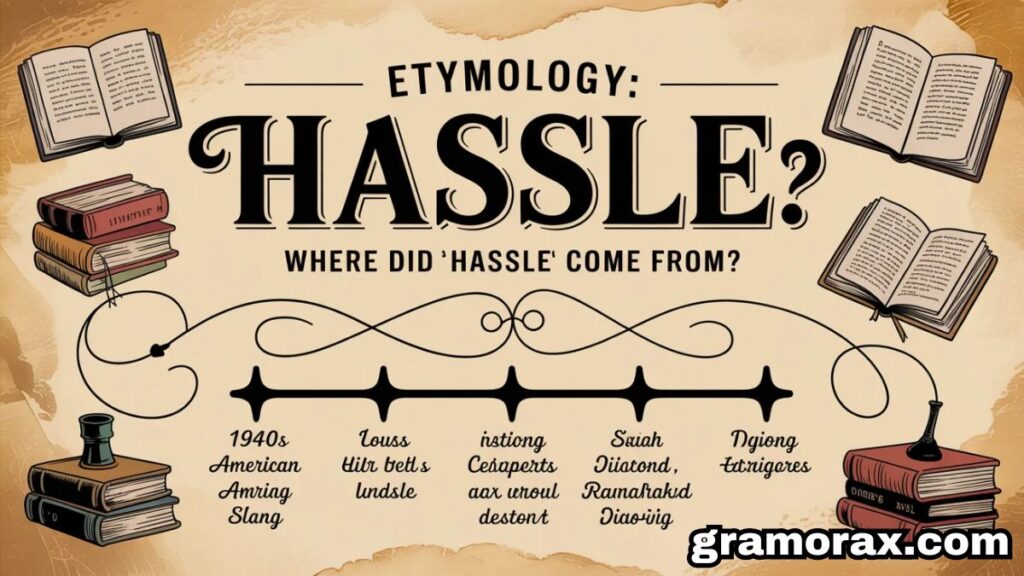
Linguists aren’t entirely sure — and that’s actually fascinating.
Hassle first appeared in American English around the 1940s. Two origin theories have the most support:
Theory 1 — The Blend Theory: Hassle may be a portmanteau of “haggle” (to argue over price or terms) and “tussle” (a physical or verbal struggle). Combine the idea of a verbal sparring match with physical pushing and shoving — and you get something close to what hassle originally meant: a heated argument or physical struggle.
Theory 2 — The Dialectal Theory: Some researchers trace “hassle” to Southern U.S. dialect, where it described heavy, labored breathing — the kind that comes with exertion or struggle. That sense of effort and strain mapped naturally onto troublesome situations that wore people down.
By the 1960s and 70s, the word had shed its rawer origins and settled comfortably into everyday slang. Meaning evolution smoothed it from “fight” to “annoying difficulty” — which is exactly how most people use it today.
“The history of hassle is a history of American frustration finding its voice in language.” — adapted from Merriam-Webster etymology notes
Key linguistic fact: Hassle was born in informal speech, not formal writing. That origin still shapes how the word behaves — it’s conversational by nature, casual by design.
How “Hassle” Shows Up in Real Life
Daily Life Usage
Hassle saturates everyday casual conversation. People reach for it instinctively when something wastes their time or tests their patience.
Common daily-life hassles:
- Traffic congestion on a Monday morning commute
- Parking in a crowded downtown area
- Wi-Fi dropping during a video call
- Dealing with paperwork for anything government-related
- Untangling a subscription cancellation buried in menus
Business and Professional Usage
In business communication and customer service, “hassle” and “hassle-free” are powerful, intentional words. Brands use them because they speak directly to pain points.
- “Our hassle-free experience means no hold times, no transfers, no waiting.”
- Support teams at major retailers are trained to use “hassle-free” in scripted responses — it signals empathy and efficiency simultaneously.
- Customer emails from companies like Amazon, Zappos, and Shopify frequently promise “hassle-free returns” because process optimization is a core selling point.
“Hassle-free” is one of the most-used compound adjectives in modern e-commerce. It works because it names the fear before the customer has to voice it. Hassle vs Hastle.
Professional Writing and UX Copy
In professional writing — especially tech and product copy — hassle appears in:
- UX microcopy: “One-tap checkout. Zero hassle.”
- App onboarding: “We handle the complicated stuff so you don’t have to deal with the hassle.”
- HR communications: “Our benefits enrollment is completely hassle-free.”
Note: Always hyphenate when using “hassle-free” before a noun. “A hassle-free experience” is correct. “The experience was hassle free” drops the hyphen when used predicatively.
Case Studies: When “Hassle” Perfectly Captures the Situation
Case Study — The Customer Service Hassle
Picture this: A customer buys a faulty product. They call support, get transferred three times, explain the problem from scratch each time, and finally get told to send a photo via email — only to receive no response for a week. That entire experience? A customer service hassle. The problem wasn’t unsolvable. The friction was the problem. Automation tools and well-trained support teams exist precisely to eliminate this kind of user frustration.
Case Study — The Travel Hassle
You’re at the airport two hours early — sensible. Then airport security flags your bag for a random check. The delayed flight board updates just as you reach the gate. Your missing luggage arrives three days later at a hotel you’ve already checked out of. No single moment was catastrophic. Together, they added up to a genuine travel hassle. This is hassle at its most relatable — compounded friction across a chain of events.
Case Study — The Workplace Hassle
A team needs a new software tool. The idea is solid, the budget is there. But the process involves getting five signatures, submitting a formal request to HR, waiting on an approval process that takes three weeks, and then onboarding without any documentation. Every step is a workplace hassle. The result? Workplace inefficiencies that erode team morale and slow output — not from malice but from broken systems.
“Hassle” in Pop Culture and Media
Hassle has been a fixture in pop culture and media usage since the 1960s. It shows up in:
- Comedy shows and sitcoms where characters complain about life’s minor indignities
- Drama series where bureaucratic obstruction creates tension
- Books and journalism where writers reach for an informal but precise word for friction
- News interviews where politicians and executives promise to “cut the hassle” out of public services
- Movies — particularly heist films and workplace comedies where characters navigate systems designed to slow them down
Its staying power comes from one thing: universality. Everyone knows what a hassle feels like. The word needs no explanation. Hassle vs Hastle.
How to Never Misspell “Hassle” Again
These memory tricks actually work — they’re grounded in how spelling patterns and vocabulary learning stick in the brain.
The Hustle-Hassle Contrast
“Hustle” has a T. “Hassle” doesn’t. They rhyme — but they diverge at exactly that letter. Make the contrast your anchor. Hustle = T. Hassle = no T. Say it once. Mean it.
Double-S = Double Stress
Hassle has two S’s because it’s doubly stressful. The spelling tricks here is emotional: the word means annoyance and frustration — so it doubles down on the most stressful-looking letter. Two S’s. No T.
The Word Inside the Word
Look carefully: hASSle. Crude — but your brain won’t forget it. Mnemonic devices don’t have to be polished to be effective.
The Tassel Parallel
“Tassel” and “hassle” share the -ssle pattern. Learn one and you’ve reinforced the other. Both follow the same spelling logic. Both are often misspelled. Spelling correction works better when you anchor new patterns to familiar ones. Hassle vs Hastle.
The Six-Letter Rule
H-A-S-S-L-E. Count them: six letters. No T hiding anywhere. Spelling it out slowly while counting is a simple proofreading technique that catches the error before it spreads.
Synonyms and Antonyms Worth Knowing
Strong vocabulary learning means knowing the words around a word, not just the word itself.
Synonyms (words close in meaning to hassle)
| Word | Nuance |
|---|---|
| Inconvenience | More formal; milder than hassle |
| Trouble | Broader; can imply deeper difficulty |
| Bother | Lighter; used for minor irritations |
| Annoyance | Focuses on the emotional response |
| Ordeal | Heavier; implies endurance |
| Rigmarole | Specifically about unnecessary procedures |
| Palaver | British slang; informal fuss or bother |
Antonyms (words opposite to hassle)
| Word | Meaning |
|---|---|
| Ease | Absence of difficulty |
| Convenience | Effortless access or process |
| Simplicity | Lack of complication |
| Smoothness | A frictionless experience |
15 Sentence Examples Using “Hassle” Correctly
As a Noun
- “Renewing a passport during peak season is a genuine hassle.”
- “The visa application process alone took three weeks — total hassle.”
- “Traffic congestion at rush hour is a daily hassle for most commuters.”
- “Getting a refund from that company turned into a month-long hassle.”
- “She avoided the airport security hassle by checking in online.”
- “Contract signing with five different departments was an unexpected hassle.”
- “The Wi-Fi kept dropping — a constant hassle during the remote meeting.”
- “Navigating the approval process without a clear contact was a serious hassle.”
As a Verb
- “He kept hassling the customer service rep even after receiving a resolution.”
- “Don’t hassle me about it — I’ll finish the report by Friday.”
- “The telemarketer hassled them with calls three times a day.”
- “She felt hassled by the constant check-ins from her micromanaging supervisor.”
- “Stop hassling customers over minor policy details — it damages trust.”
As a Compound Adjective
- “Our hassle-free experience guarantee means no hidden fees and instant refunds.”
- “The app promises a hassle-free setup — and for once, it actually delivered.”
Common Mistakes Writers Make With “Hassle”
Beyond the core misspelling issue, here are errors that damage writing accuracy and polished communication:
- Spelling it “hastle” — the central error this whole guide addresses
- Using it for serious situations — calling a medical emergency or bereavement a “hassle” reads as tone-deaf
- Forgetting the hyphen in “hassle-free” when it precedes a noun
- Dropping it into formal writing — academic writing and legal documents call for “inconvenience” or “difficulty” instead
- Overusing it in marketing copy — “hassle-free” loses impact if it appears in every sentence
Hassle: Quick Reference Facts
| Feature | Detail |
|---|---|
| Correct Spelling | hassle |
| Incorrect Variant | hastle |
| Part of Speech | Noun and Verb |
| First Recorded Use | ~1940s, American English |
| Register | Informal / Conversational |
| Common Compound | hassle-free (always hyphenated before noun) |
| Confirmed By | Merriam-Webster, Oxford, Cambridge |
| Synonyms | inconvenience, bother, annoyance, trouble |
| Antonyms | ease, convenience, simplicity |
| Use in Formal Writing? | Avoid — opt for “inconvenience” or “difficulty” |
Conclusion
The hassle vs hastle debate ends here. Hassle is correct. Hastle never existed. Two S’s, no T — simple as that. Spelling it right protects your credibility every single time. Hassle vs Hastle.
Good writing starts with getting the basics right. Now you know the correct spelling, the real meaning, and exactly how to use hassle with confidence. Hassle vs Hastle. No more second-guessing. No more typos slipping through. JHassle vs Hastle. ust clean, polished communication — every time you write. ✍️✨
FAQs
Is “hastle” a real English word?
No. “Hastle” doesn’t exist in any English dictionary. “Hassle” is the only correct spelling.
What does “hassle” mean?
“Hassle” means an annoying inconvenience as a noun, or to persistently bother someone as a verb.
Why do people confuse “hassle” and “hastle”?
Because words like “hustle” and “castle” follow the -stle pattern, the brain automatically inserts a T where it doesn’t belong.
How do I remember the correct spelling of “hassle”?
Remember: two S’s, no T. Think — double stress, double S. H-A-S-S-L-E.
Is “hassle-free” one word or two?
It’s hyphenated — hassle-free — when used before a noun, as in “a hassle-free return policy.”