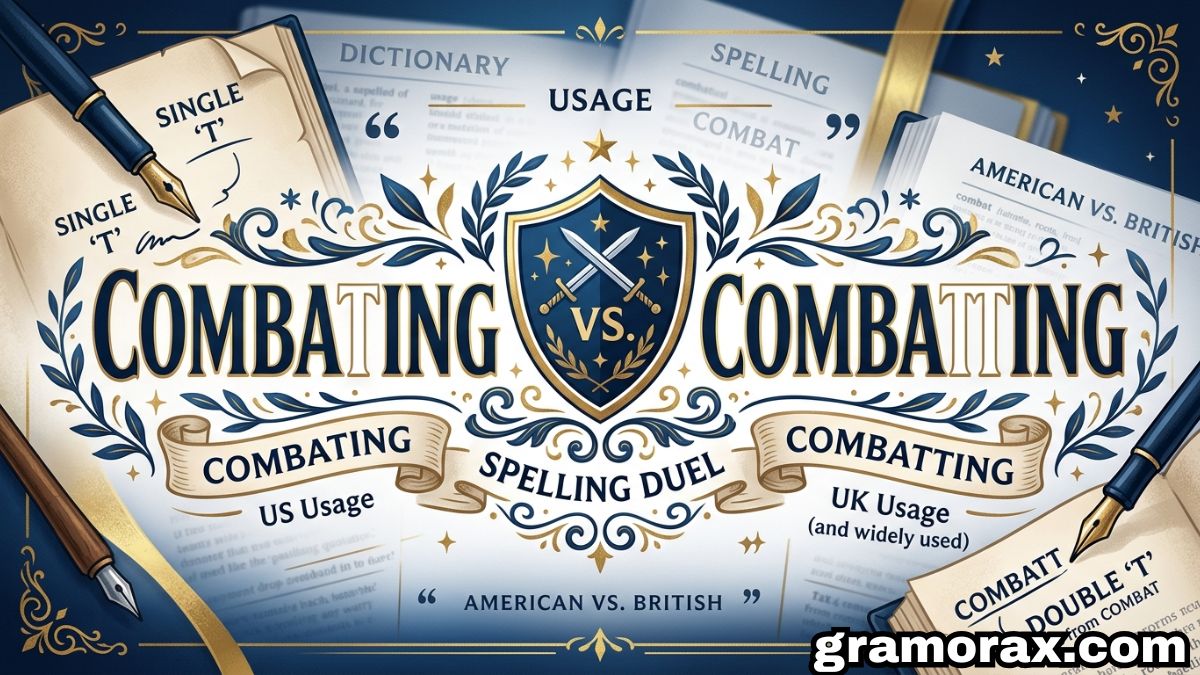
Combating and combatting are two spelling variants of the same present participle — both derived from the verb combat, meaning to actively fight or struggle against something. The only difference between them is regional convention: one belongs to American English, the other to British English. Combating vs Combatting.
Here’s the thing — one misplaced letter can quietly undermine your credibility with editors, professors, and publishers.
Both spellings have deep linguistic roots, shaped by centuries of diverging spelling rules across English dialects. Knowing which one fits your audience isn’t just good grammar — it’s sharp, confident writing.
What’s the Actual Difference? (The Short Answer)
Both combating and combatting are legitimate spellings of the present participle of the verb combat. They mean exactly the same thing. Zero difference in meaning, zero difference in pronunciation. The only thing separating them is geography and regional style.
Here’s your quick-reference verdict:
| Dialect | Preferred Spelling | Style Guides That Agree |
|---|---|---|
| American English | combating (one “t”) | AP Style, Chicago, MLA, APA |
| British English | combatting (two “t”s) | Oxford Style, Cambridge |
| Australian/Commonwealth | combatting (generally) | Follows British norms |
| Global/International | combating (safer default) | Most scientific journals |
If you’re writing for an American publication, use combating. Writing for a UK audience? Combatting is perfectly acceptable. Writing for the whole internet? Default to combating — it’s the dominant form worldwide.
Now, let’s dig into why this split exists in the first place.
The Root Word “Combat” — Where It All Starts

Every inflected form — combating, combatted, combatant — traces back to the root word combat. And understanding that root word is the key to understanding the whole spelling debate.
Combat entered English via French (combattre), which itself came from the Latin com- (together) + battere (to beat). It’s been part of the English language since at least the 16th century, functioning as both a noun (“hand-to-hand combat”) and a verb (“to combat a threat”). That noun-verb flexibility affects how writers instinctively inflect it — and different English dialects developed different habits along the way.
Here’s where it gets interesting: the root word combat has two syllables — COM-bat. That stress placement on the first syllable is the linguistic hinge everything else turns on.
The Consonant Doubling Rule — The Real Culprit
If you’ve ever wondered why running has two “n”s but opening doesn’t, you’ve already bumped into consonant doubling. This spelling rule isn’t random — it follows a clear phonetic logic. But combat sits right at the edge of that logic, which is exactly why the spelling split exists.
When English Doubles the Final Consonant
The standard rule for consonant doubling in English works like this. You double the final consonant when all three of these conditions are true:
- The word ends in a consonant-vowel-consonant (CVC) pattern
- The word has only one syllable — or the stress falls on the last syllable
- You’re adding a vowel suffix like -ing, -ed, or -er
This is why run becomes running (one syllable, CVC pattern, stressed vowel → double the “n”). It’s why begin becomes beginning (two syllables, but stress falls on the last syllable -GIN → double the “n”). And it’s why omit becomes omitting — same story.
Why “Combat” Breaks the Pattern
Combat ends in a CVC pattern (t-a-t… wait, actually b-a-t). It qualifies on that front. But here’s the catch: the stress pattern doesn’t land on the last syllable. Say it out loud — COM-bat. The first syllable takes the punch. The “bat” at the end is unstressed.
According to modern grammar rules and phonetic spelling logic, an unstressed final syllable shouldn’t trigger doubled consonants. So American English, following that principle strictly, gives you combating — one “t,” no doubling needed.
British English applies a looser standard. In traditional patterns of British orthography, doubled consonants are applied more broadly to final consonants before vowel suffixes — even when that final consonant isn’t stressed. Hence combatting — two “t”s, following historical conventions rather than strict phonetic logic.
The CVC Pattern — Comparison Table
| Base Word | Syllables | Stress Falls On | Doubles? | American | British |
|---|---|---|---|---|---|
| run | 1 | RUN | ✅ Yes | running | running |
| begin | 2 | -GIN (last) | ✅ Yes | beginning | beginning |
| omit | 2 | -MIT (last) | ✅ Yes | omitting | omitting |
| combat | 2 | COM- (first) | ❌ Shouldn’t | combating | combatting |
| travel | 2 | TRAV- (first) | ❌ Shouldn’t | traveling | travelling |
| cancel | 2 | CAN- (first) | ❌ Shouldn’t | canceling | cancelling |
| worship | 2 | WOR- (first) | ❌ Shouldn’t | worshiping | worshipping |
Notice the pattern? Every word where American English and British English diverge on doubling is a two-syllable word with first syllable stress. British English doubles anyway, following older habits. American English doesn’t, following standardized spelling logic.
Combating — The American English Standard
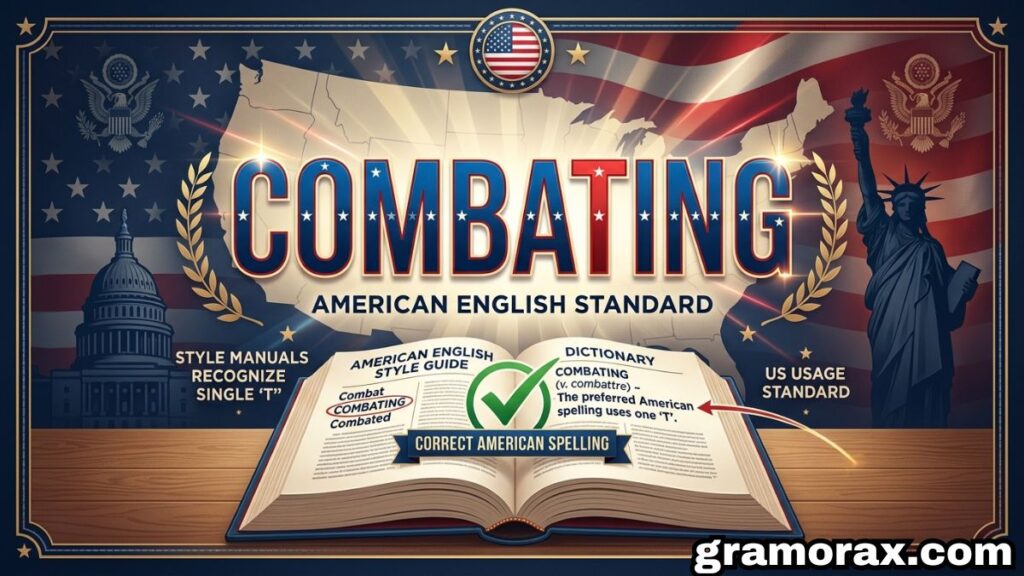
American English landed firmly on combating — one “t” — and it’s been that way since the 19th century. This isn’t a modern trend or a digital-age shortcut. It’s a deliberate standardized spelling choice rooted in simplification movements that reshaped American writing.
Noah Webster and the Great Spelling Simplification
The man behind American English spelling is Noah Webster. His 1806 dictionary (A Compendious Dictionary of the English Language) and his landmark 1828 American Dictionary of the English Language didn’t just record spellings — they standardized them. Webster believed that spelling should reflect pronunciation as closely as possible. Words like colour became color, honour became honor, and unnecessarily doubled consonants got the axe.
Webster’s principle was clear: if the stress pattern of a word doesn’t justify doubling the final consonant, don’t double it. Combat — with its stress on the first syllable — didn’t qualify. So combating became the American English standard, and it’s held ever since.
“Spelling is an art of which simplicity is the greatest excellence.” — Noah Webster
Where You’ll See “Combating” in the Wild
- U.S. government documents: The EPA, CDC, and White House routinely use combating in official policy language — combating air pollution, combating disease outbreaks
- AP Style: The Associated Press Stylebook, the bible of American journalism, opts for combating
- Chicago Manual of Style: Same preference — single “t”
- MLA style and APA: Both follow American English conventions, meaning combating is the correct form in academic papers written for U.S. institutions
- Major American newspapers: The New York Times, The Washington Post, and The Wall Street Journal all use combating
✔️ Use “Combating” When:
- Your audience is primarily American
- You’re following AP style, MLA style, APA, or Chicago style
- You’re publishing in U.S.-based academic journals or policy documents
- You’re writing for a global digital audience and want the most universally accepted form
Combatting — The British English Variant
Across the Atlantic, British English tells a different story. Combatting — with two “t”s — is the accepted form, and it’s backed by Oxford style guides, UK government documents, and centuries of traditional patterns in British orthography.
Why British English Kept the Double “T”
British English has always been more generous with doubled consonants before vowel suffixes. This isn’t arbitrary — it reflects historical spelling conventions that predate Webster’s reforms and were never systematically revised in the UK.
The historical development of British spelling followed a different trajectory. British lexicographers and printers preserved older doubling habits even when phonetic justification was thin. The doubled consonant in travelling, cancelling, and modelling all follow this same traditional logic — and combatting fits right in.
Oxford style guides and Cambridge style guides both accept combatting as the standard British form, and UK Government publications back this up consistently.
Where You’ll See “Combatting” in the Wild
- UK Government reports: Parliamentary papers, Home Office documents, and NHS publications regularly use combatting — combatting knife crime, combatting fraud, combatting public health crises
- British newspapers: The Guardian, The Times, and the BBC favor combatting in editorial content
- Oxford English Dictionary: Lists combatting as the standard British spelling
- Australian and New Zealand publications: Generally follow British English norms, though variation exists
✔️ Use “Combatting” When:
- Your primary audience is British, Australian, or Commonwealth-based
- You’re following Oxford style or Cambridge style guides
- Your document already uses British English spellings throughout (travelling, cancelled, organised)
- The publication you’re submitting to uses traditional patterns of British orthography
How Pronunciation Shapes Spelling — The Stress Argument
Spelling rules in English aren’t just about aesthetics — they’re meant to reflect how words actually sound. The stress pattern of a word carries real phonological weight, and it directly influences consonant doubling decisions.
Say combat aloud right now: COM-bat. Feel how the first syllable gets the emphasis? That’s first syllable stress, and it’s the phonetic reason American English doesn’t double the “t.”
Now compare it to begin: be-GIN. Or omit: o-MIT. In both cases, stress falls on the last syllable, which contains the final consonant you’re about to double. Doubling the consonant in these words signals to the reader: this vowel is short and stressed. It’s a visual pronunciation cue.
With combat, doubling the “t” sends a misleading signal. It implies the second syllable is stressed — com-BAT-ting — when in reality, most speakers say COM-bat-ing. The double “t” in combatting is, phonetically speaking, unnecessary doubling. It’s a historical convention, not a phonetic rule.
This is precisely why modern grammar rules in American English came down on the side of combating — and why British English‘s preference for combatting is better understood as a regional preference than a logical spelling requirement.
“Combating” and “Combatting” as Verb Forms
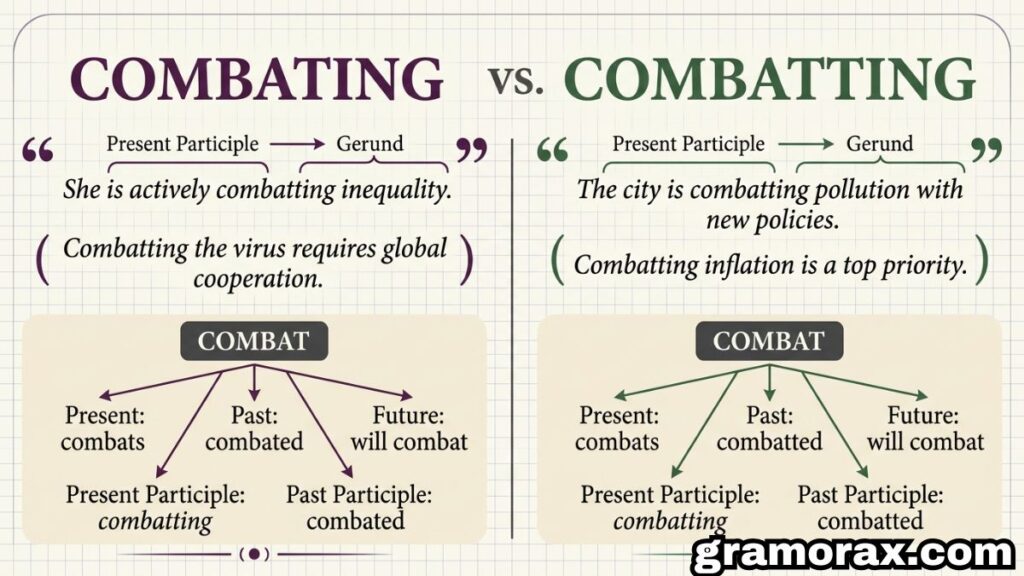
Regardless of which spelling you use, both words function identically in sentences. There’s no grammatical distinction whatsoever — just regional spelling preferences.
Present Participles
Both spellings work perfectly as present participles in continuous tenses. When adding -ing to combat, you get either combating or combatting — same meaning, same grammatical role, same syntax.
Examples:
- “The government is combating rising unemployment with new job initiatives.”
- “The Home Office is combatting fraud with advanced digital surveillance tools.”
Both sentences are grammatically flawless. The only difference is the dialect of the writer.
Gerunds
As a gerund — where the verb form functions as a noun — both spellings are equally correct.
Examples:
- Combating misinformation requires platform-level policy changes, not just individual fact-checking.
- Combatting corruption in public institutions demands independent oversight bodies.
All Inflected Forms — Does the Doubling Pattern Hold?
| Verb Form | American English | British English |
|---|---|---|
| Present participle | combating | combatting |
| Past tense | combated | combatted |
| Past participle | combated | combatted |
| Third-person singular | combats | combats |
| Base form | combat | combat |
| Agent noun | combatant | combatant |
Important note: Combatant never doubles — both American English and British English agree on that. The doubling only applies when you add a vowel suffix (-ing, -ed).
Real-World Usage Examples
Seeing these words in context makes the distinction stick. Here are authentic-style examples that reflect how real publications and institutions use each spelling.
American English in Context
These sentences reflect AP style and American English norms:
- “The CDC launched a national campaign for combating antibiotic resistance in healthcare settings.”
- “Tech companies face mounting pressure when it comes to combating misinformation on social media platforms.”
- “Combating inflation requires coordinated monetary and fiscal policy — there’s no single lever to pull.”
- “Local governments are combating food shortages by expanding urban agriculture programs.”
- “Combating pollution in the Great Lakes has taken decades of international aid and federal investment.”
British English in Context
These reflect UK Government and Oxford style conventions:
- “The Metropolitan Police outlined a new strategy for combatting knife crime in London boroughs.”
- “Ministers emphasized that combatting corruption in public contracting demands independent auditing.”
- “Scientists at Imperial College are combatting antimicrobial resistance with synthetic peptide therapies.”
- “Combatting public health crises requires sustainable transport reforms and cleaner urban air quality.”
- “The report stressed that combatting unemployment in post-industrial regions needed long-term investment.”
Case Study — “Combating Climate Change” vs “Combatting Climate Change” 🌍
Few phrases illustrate this spelling divide more sharply than combating/combatting climate change. It appears in thousands of policy documents, research papers, and news reports every year — and the spelling choice is almost perfectly consistent with the author’s dialect.
How U.S. Policy Documents Use It
American federal agencies are remarkably consistent. The EPA’s climate action resources use combating climate change throughout. White House executive orders, NASA climate publications, and NOAA research papers all follow the same convention — single “t,” every time.
A 2023 U.S. environmental research paper published in Nature Climate Change used the phrase “combating rising sea levels through carbon capture systems” — reflecting both AP style norms and the American English preference for streamlined spelling.
How UK and EU Documents Use It
The UK Government’s Net Zero Strategy — a landmark 368-page policy document — uses combatting when referring to addressing climate change, renewable energy deployment, and sustainable reforms in the energy sector. British think tanks, the House of Commons Environmental Audit Committee, and the BBC’s climate journalism all reflect the same British English habit.
European Union documents published in English — particularly those drafted by UK-based teams — also tend toward combatting, though EU English style is increasingly shifting toward American English norms in scientific contexts.
What Google Trends Reveals
Globally, “combating climate change” dramatically outperforms “combatting climate change” in search volume — often by a ratio of roughly 8:1. Even in the UK, digital searches lean toward combating. This reflects a broader trend: global digital publishing, dominated by American tech platforms, SEO conventions, and international scientific journals, has standardized around American English spelling.
The practical SEO takeaway: If you’re writing for the web with a global audience in mind, combating is the keyword-optimized choice. It captures more search volume and won’t look like an error to American readers — whereas combatting can trigger spell-check warnings in American-English-set tools.
Historical Development — How Did We End Up Here?

The combating vs combatting split didn’t happen overnight. It’s the product of centuries of diverging historical development in English spelling rules.
Key Milestones
16th–17th centuries: English spelling was genuinely chaotic. Printers made their own calls, and the same word could be spelled three different ways in a single document. Doubled consonants were often added purely for aesthetic or typographic reasons — to justify text on the page.
1755: Samuel Johnson published A Dictionary of the English Language, which brought some standardization to British spelling. Johnson preserved many historical conventions, including broad consonant doubling habits. These became embedded in British English usage.
1806–1828: Noah Webster’s American dictionaries arrived like a spelling revolution. Webster stripped out unnecessary doubling, removed silent letters, and aligned American spelling more closely with phonetic logic. Words like travelling became traveling, cancelled became canceled — and combatting became combating.
19th–20th centuries: Mass literacy, newspapers, and eventually radio entrenched both variants in their respective regions. Dictionaries standardized their regional preferences, and the split hardened.
21st century: The internet created a new tension. American platforms, search engines, and spell-checkers defaulted to American English, giving combating a global digital advantage. But British English publications held their ground — combatting remains standard in UK editorial and UK Government contexts.
Other Words That Follow the Same American vs British Divide
Combating/combatting isn’t a one-off quirk. It’s part of a recognizable pattern across English dialects. These comparative word pairs all follow the same first syllable stress logic — American drops the double, British keeps it.
| Base Word | American English | British English | Stress Pattern |
|---|---|---|---|
| travel | traveling | travelling | TRAV-el |
| cancel | canceling | cancelling | CAN-cel |
| model | modeling | modelling | MOD-el |
| label | labeled | labelled | LA-bel |
| worship | worshiping | worshipping | WOR-ship |
| focus | focusing | focussing | FO-cus |
| combat | combating | combatting | COM-bat |
Every single one of these words has first syllable stress. Every single one doubles in British English and doesn’t in American English. The pattern is consistent and predictable — once you see it, you can’t unsee it.
Words like admitting, beginning, and forgetting — where stress falls on the last syllable — double in both dialects, because the phonetic rule genuinely applies.
How to Pick the Right Spelling — A Practical Decision Guide
Here’s a clean, no-nonsense framework for making the right call every time.
Ask Yourself These Three Questions
1. Who is your primary audience?
- American readers → combating
- British, Australian, or Commonwealth readers → combatting is fine
- Global or mixed audience → default to combating
2. What style guide governs your work?
| Style Guide | Preferred Spelling |
|---|---|
| AP Stylebook | combating |
| Chicago Manual of Style | combating |
| MLA Handbook | combating |
| APA Publication Manual | combating |
| Oxford Style Manual | combatting (acceptable) |
| Cambridge Style Guide | combatting (acceptable) |
3. What spelling does the rest of your document use?
This one matters more than people realize. Consistency is the highest publication standard. If your document uses travelling, organised, and colour throughout, use combatting. If it uses traveling, organized, and color, use combating. Mixing dialects looks careless — even if each individual spelling is technically correct. Combating vs Combatting.
When You’re Writing for a Global or Mixed Audience
Default to combating. Here’s why:
- It’s recognized and accepted by readers everywhere — British readers won’t flinch at it
- It dominates global digital media, international NGO reports, and scientific publishing
- It’s the form most SEO tools and search engines index more heavily
- It avoids the spell-check red line in American English-set writing tools
The Spell-Check Trap — Don’t Fall For It
This one surprises people. Spell-checkers aren’t always right — they’re calibrated to your language settings, not to a universal standard.
- Microsoft Word (US English): Flags combatting as an error ❌
- Microsoft Word (UK English): Accepts both ✅
- Google Docs: Accepts both by default ✅
- Grammarly (US setting): Prefers combating ✅
The lesson: always know your style guide before you trust your spell-checker. A tool set to American English will flag perfectly valid British English spellings all day long. Combating vs Combatting.
Common Consonant Doubling Rules — Quick Reference
Here’s a consolidated cheat sheet for English spelling rules around consonant doubling.
Double the Final Consonant When:
- ✅ The word has one syllable AND ends in CVC: run → running, hit → hitting
- ✅ The word ends in a stressed syllable with CVC pattern: begin → beginning, prefer → preferred
- ✅ You’re adding a vowel suffix (-ing, -ed, -er, -est)
Do NOT Double When:
- ❌ The stress falls on the first syllable (in American English): combat → combating, travel → traveling
- ❌ The word ends in two consonants: help → helping, start → starting
- ❌ The word ends in two vowels + consonant: need → needed, cool → cooling
- ❌ You’re adding a consonant suffix: quick → quickly, sad → sadness
Summary Table — Consonant Doubling at a Glance
| Rule | Example | Result |
|---|---|---|
| 1 syllable + CVC + vowel suffix | run + ing | running ✅ |
| Last syllable stressed + CVC | begin + ing | beginning ✅ |
| First syllable stressed (US rule) | combat + ing | combating ✅ |
| First syllable stressed (UK habit) | combat + ing | combatting ✅ |
| Ends in two consonants | start + ing | starting (no double) |
| Ends in silent “e” | hope + ing | hoping (drop e, no double) |
Conclusion
The combating vs combatting debate has a simple answer. Use combating for American audiences. Combating vs Combatting. Use combatting for British ones. Neither spelling is wrong — just know your reader.
Consistency is everything in professional writing. Whether you’re combating misinformation or combatting corruption, pick one spelling and stick with it throughout. Combating vs Combatting. Match your style guide. Match your audience. Combating vs Combatting. Do that, and the combating vs combatting question never slows you down again. ⚔️✨
FAQs
Is “combating” or “combatting” correct?
Both are correct. Combating is standard in American English and combatting is accepted in British English.
Which spelling do major style guides prefer?
AP Style, Chicago, MLA, and APA all prefer combating. Oxford and Cambridge style guides accept combatting.
Does Google prefer one spelling over the other?
Yes. Combating dominates global search volume — making it the smarter SEO choice for international audiences in 2025.
Is “combatting” a spelling error in Microsoft Word?
Only when your language settings are set to US English. Switch to UK English and Word accepts both spellings without flagging either.
Do other English words follow the same doubling pattern?
Absolutely. Traveling/travelling, canceling/cancelling, and modeling/modelling all follow the exact same American vs British English doubling divide.