“Resignate or resonate” — one is a ghost word haunting inboxes and LinkedIn posts everywhere, the other is a precise, dictionary-verified verb with 2,000 years of Latin lineage behind it. Choosing the right word isn’t pedantry. It’s power.
Here’s the uncomfortable truth: every time you write “resignate,” a careful reader quietly loses a little confidence in you — and you’ll never know it happened.
Resonate does something remarkable. It bridges the literal — sound waves vibrating through space — and the deeply human — ideas that echo inside someone long after the conversation ends. Master this word, and your writing doesn’t just inform. It stays.
Why “Resignate” Is Everywhere — And Why That’s a Problem
Open Twitter or LinkedIn on any given day, and you’ll spot it. “This podcast really resignated with me.” “Her story resignated on a deep level.” It’s become shockingly common — not just in casual posts but in corporate emails, keynote speeches, and even published articles.
The problem isn’t just grammatical. Lexical confusion like this signals a lack of precision, and precision is the backbone of credible communication. In branding, leadership writing, and marketing messages, one wrong word can blur your meaning entirely.
Worse, because “resignate” sounds plausible, readers who don’t catch it may absorb a muddled message. And readers who do catch it may lose a little trust in the writer. Neither outcome serves you.
The good news? The fix is simple. The word you want is resonate — and once you understand it fully, you’ll never reach for the wrong one again.
Is “Resignate” a Real English Word?
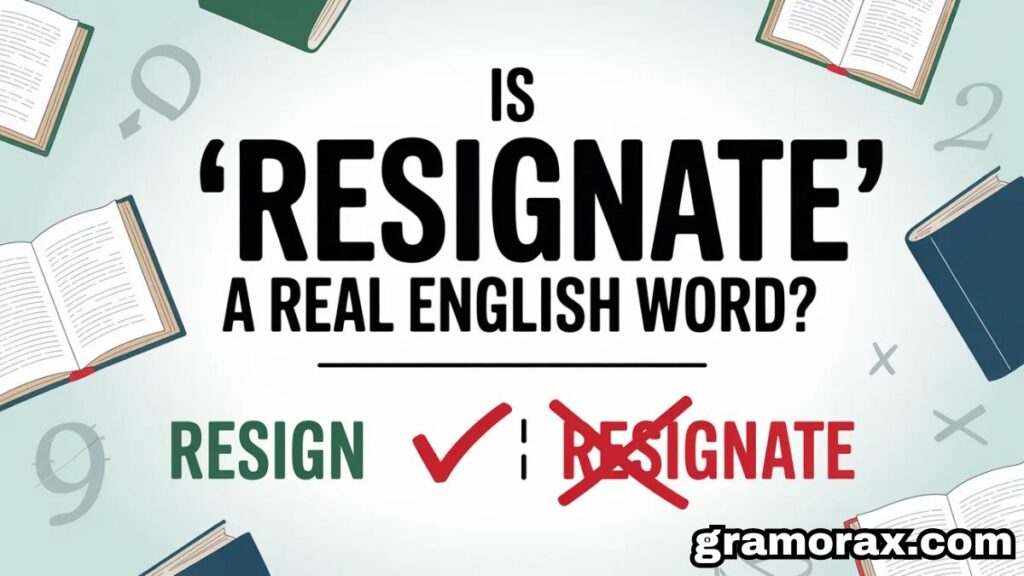
Short answer: no. Longer answer: Also, no, but the reasons why are worth understanding.
What Major Dictionaries Actually Say
Let’s go straight to the authorities. Here’s what every major reference source says:
| Dictionary | Entry for “resignate” | Verdict |
|---|---|---|
| Merriam-Webster | No entry found | ❌ Not a word |
| Oxford English Dictionary | No entry found | ❌ Not a word |
| Cambridge Dictionary | No entry found | ❌ Not a word |
| Dictionary.com | No entry found | ❌ Not a word |
| Macmillan Dictionary | No entry found | ❌ Not a word |
Zero entries. Across every major source. That’s not ambiguous — “resignate” simply doesn’t exist as a recognized term in standard English.
Why It Fails Linguistically
In English, the -ate suffix legitimately forms verbs: communicate, illuminate, designate, originate, terminate. All real. All with traceable Latin roots or recognized morphological patterns. “Resignate” has none of that. It’s a verb form assembled by analogy — the mind glues “resign” to “-ate” because the result sounds like it belongs. But grammatical legitimacy doesn’t work on vibes alone. A word needs either historical use, dictionary recognition, or widespread formal acceptance to qualify as real.
“Resignate” has none of these. It’s a phantom word — convincing at a glance but hollow on inspection.
Could “Resignate” Ever Become a Real Word?
Fair question. Language does evolve, after all. “Selfie” wasn’t in any dictionary twenty years ago. “Irregardless” — long mocked — finally earned a Merriam-Webster entry after decades of widespread (if controversial) use.
So could “resignate” follow the same path? Possibly — but it’s not there yet. For a word to cross into the official definition zone, lexicographers need to see sustained, widespread use in edited, published prose over time. Blog comments and social posts don’t cut it. For now, “resignate” remains firmly in the category of vocabulary misuse rather than legitimate language evolution.
Use it at your own risk.
The Psychology Behind the Mistake
So why do so many people — including smart, articulate people — reach for “resignate”? It’s not carelessness. There are real cognitive mechanisms at work.
Phonetic Overlap — It Sounds Plausible
Say “resonate” and “resignate” out loud, quickly. The phonological similarity is real. Both are four syllables. Both stress the second syllable. both end in “-ate.” The ear catches the shape of the word rather than the word itself — a phenomenon linguists call phonetic confusion. Your brain hears “reh-ZON-ate” and reconstructs it as “reh-ZIG-nate” because that pattern fits existing templates.
Pattern Matching Gone Wrong
English speakers — native and non-native alike — rely heavily on morphological patterns to recognize and produce words. Notice how these all follow the same rhythm:
- Designate → to officially assign
- Originate → to begin or arise from
- Terminate → to bring to an end
- Resignate → not a word, but it fits the template perfectly
That template-matching is usually helpful. Here it misfires. The pattern feels right, so the brain accepts it — a classic case of lexical ambiguity slipping past our internal spell-checker.
Social Contagion and Echo Chambers
Here’s where it gets sociological. One person uses “resignate” in a popular post. Others read it, absorb it, and unconsciously add it to their working vocabulary. Nobody corrects it because correction feels rude — and because many readers assume the speaker knows best. Within a specific community, the mistake circulates and compounds.
This is essentially how eggcorns spread — those plausible-sounding substitutions that become semi-standard in certain circles. “For all intensive purposes” instead of “for all intents and purposes.” “Nip it in the butt” instead of “nip it in the bud.” The social spread of linguistic errors is well-documented in discourse analysis and sociolinguistics.
Gaps in Vocabulary Exposure
Sometimes the simplest explanation is the right one. People who haven’t encountered “resonate” used clearly and frequently in reading will reach for the closest thing their mental lexicon can construct. Vocabulary misuse often isn’t about ignorance — it’s about gaps in exposure. The solution? Read widely. The more you see “resonate” used correctly in context, the more naturally you’ll reach for it.
What “Resonate” Actually Means — And How Rich the Word Really Is
Here’s what you’re actually reaching for when you want “resignate.” And it’s a better word in every way.
Core Definitions Across Contexts
Resonate (verb) carries two distinct but connected meanings:
1. Literal / Sound-related meaning: To produce or be filled with a deep, reverberating sound. Think of a bell struck in an empty cathedral — the sound resonates through the stone. This is its acoustic impact, its literal meaning rooted in physics.
2. Figurative / Emotional meaning: To evoke a strong feeling, to strike a chord, to feel deeply meaningful to someone. This is the meaning most people are reaching for — and it’s legitimately powerful.
“Her words resonated with everyone in the room — not because they were eloquent, but because they were true.”
This figurative meaning is what makes “resonate” so useful in communication, marketing, and leadership. It captures emotional resonance — that specific feeling of something clicking into place, of a message landing exactly right.
Etymology: From Latin “resonare” to Modern English
The word has an impeccable Latin origin. Here’s how it traveled to us:
| Era | Form | Meaning |
|---|---|---|
| Classical Latin | resonare | To sound again, to echo |
| Latin components | re- + sonare | Again + to sound |
| Old French influence | resonner | To resound |
| Middle English | resounen | To ring out, to echo |
| Modern English | resonate | To echo; to evoke deep feeling |
The Latin roots are clean and logical: re- (again) + sonare (to sound). Something that resonates literally “sounds again” — it echoes, it reverberates, it returns. The figurative meaning is a beautiful extension of that: an idea that resonates comes back to you, stays with you, echoes in your mind long after you’ve heard it.
Compare that to “resignate” — which has no Latin origin, no etymological foundation, and no morphological lineage. It’s a word assembled without roots.
The Full Word Family
Understanding the family makes the world stick:
- Resonate (verb) — Her story resonated with me deeply.
- Resonance (noun) — The speech had real emotional resonance.
- Resonant (adjective) — He spoke in a resonant, commanding voice.
- Resonator (noun) — A guitar body acts as a resonator.
Once you see the pattern, it’s unforgettable. And none of these relatives make room for “resignate.”
“Resonate” in Action — Real-World Usage Across Every Register
Knowing what a word means is half the battle. Seeing it used across different contexts cements it.
In Everyday Conversation
- “That documentary really resonated with me — I couldn’t stop thinking about it.”
- “His apology resonated because it was specific, not vague.”
- “Does this idea resonate with you, or does it feel off?”
Natural, conversational, and precise. This is correct usage in its simplest form.
In Professional and Business Writing
Marketers, executives, and speechwriters rely on this word constantly — because it describes something real that happens between a message and its audience.
- “Our rebrand needs to resonate with Gen Z without alienating our existing customers.”
- “The campaign resonated across demographics, driving a 34% lift in brand awareness.”
- “Leadership communication resonates when it’s grounded in shared experience, not corporate talking points.”
This is professional writing at its most functional. “Resonate” earns its place because it describes a specific, meaningful phenomenon: emotional impact that persists.
In Literature, Journalism, and Media
Published writers use “resonate” with precision and intention:
- The New York Times: “The film resonates because it refuses to offer easy answers.”
- Harvard Business Review: “Messages that resonate do so because they speak to what audiences already believe.”
- Toni Morrison, Nobel Lecture: Her prose consistently used language that resonated — meaning that reverberated through the culture long after the page was turned.
Correct vs. Incorrect Usage — Side-by-Side
How to Write Messages That Truly Resonate
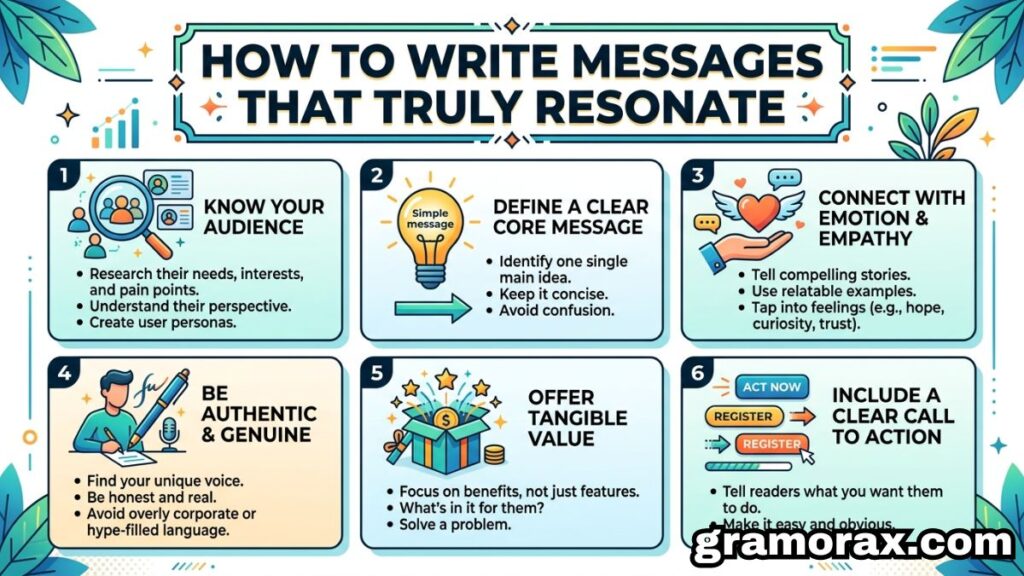
Knowing the right word is step one. Using it to describe something real you’ve actually created — that’s the greater skill. Here’s how to craft communication that genuinely resonates.
Anchor Every Message to Your Audience’s Reality
Before you write a single word, ask: what does this person already feel, fear, or want? Audience awareness is the foundation of resonant communication. A message that speaks to an existing emotion or belief lands instantly. A message that ignores your audience’s reality lands nowhere.
Try a simple empathy map:
- What does your audience think? (Their beliefs and assumptions)
- What do they feel? (Their emotional state)
- What do they fear? (Their anxieties and risks)
- What do they want? (Their goals and desires)
Write into those answers. That’s where emotional connection lives.
Lead with Emotion, Follow with Logic
Aristotle mapped this 2,400 years ago, and nobody’s improved on it since. His model — ethos (credibility), pathos (emotional appeal), logos (logical argument) — still outperforms every modern framework. Feelings open the door. Facts walk through it.
Don’t bury your emotional hook on page three of your proposal. Lead with it. Make your reader feel something before you ask them to think something.
Use Concrete Sensory Language
Abstract language floats. Specific language lands. Compare these two:
- Vague: “Our product creates impactful experiences for users.”
- Specific: “Users spend 40% more time on the platform and come back three days earlier than the industry average.”
Sensory details do the same work in storytelling. “She was sad” tells us nothing. “She sat in the parking lot for twenty minutes before she could drive home” shows us everything.
Build Rhythm into Your Sentences
Read this paragraph out loud. Notice how it moves. Rhythm in writing isn’t accidental — it’s engineered. Short sentences punch. Longer ones, with their dependent clauses and their carefully placed commas, create momentum and texture. The contrast between the two is what makes prose feel alive rather than mechanical.
Vary deliberately. A series of long sentences numbs the reader. A series of short ones feels staccato and choppy. Alternate. Mix. Keep them guessing.
Be Specific, Not Just Sincere-Sounding
“Authentic” has become one of the most overused words in marketing — and ironically, the more you say it, the less authentic you sound. Authenticity in communication isn’t about adjectives. Its details. It’s vulnerability. It’s specific, inconvenient truths told plainly.
Instead of: “We’re passionate about our customers.” Try: “We called every churned customer personally last quarter — 47 conversations. Here’s what we learned.”
The second version resonates. The first one disappears.
What Creates Resonance vs. What Kills It
| ✅ Creates Resonance | ❌ Kills Resonance |
|---|---|
| Specific, grounded details | Vague, abstract generalities |
| Emotional truth told plainly | Corporate jargon and buzzwords |
| Conversational rhythm | Dense, tangled syntax |
| Clear, front-loaded structure | Buried main points |
| Genuine vulnerability | Performative sincerity |
| Concrete examples and data | Unsupported claims |
| Active voice and strong verbs | Passive constructions and hedging |
| Audience awareness throughout | Writer-centered messaging |
Communication Tips to Make Your Messages Resonate
These aren’t soft suggestions. Each one is a practical lever you can pull right now.
Use Storytelling as Your Primary Vehicle
Facts inform. Stories persuade. Research from cognitive psychologist Jerome Bruner suggests that information delivered in narrative form is up to 22 times more memorable than raw data alone. Structure your message with a character, a challenge, and a resolution — even in business contexts. Especially in business contexts.
Replace Jargon with Human Language
Every industry has its own dialect. And every industry’s jargon creates walls between the writer and the reader who doesn’t share it. The best communicators translate — they take complex ideas and render them in language anyone could understand without feeling talked down to. That’s the craft.
Avoid jargon like “synergize,” “leverage as a verb,” “circle back,” and “move the needle.” Use: work together, use, follow up, and make progress.
Use Active Voice — Always
Active voice is more direct, more energetic, and more honest. Compare:
- Passive: “Mistakes were made in the planning phase.”
- Active: “We made mistakes in the planning phase.”
The second one costs you more. And that’s exactly why it resonates more. Owning your language builds trust.
Use Contrast to Create Clarity
Contrast in communication sharpens meaning. Show what something is by showing what it isn’t. “This isn’t a product update — it’s a complete rethinking of how you manage your time.” The contrast creates a frame, and the frame makes the message stick.
Deploy Concrete Examples Relentlessly
Every abstract claim needs a concrete example within two sentences of being made. If you say “our customers love us,” follow immediately with a specific story, a number, or a quote. Use concrete examples, not as decoration but as proof of concept. Resignate or Resonate.
Quick Practice — Lock In the Correct Usage
Theory without practice doesn’t stick. Try these before moving on.
Fill-in-the-Blank Exercises
Fill in the blank with either resonate or resonated:
- The coach’s halftime speech __________ with every player in that locker room.
- We need a brand voice that will __________ with young parents.
- Her poem __________ because it captured something nobody had named before.
- Does this concept __________ with you, or should we rework it?
- The campaign failed because it didn’t __________ with its core audience.
Answer Key: 1. resonated | 2. resonate | 3. resonated | 4. resonate | 5. resonate
Spot the Error — Rewrite the Sentence
Each sentence below contains an error. Rewrite it correctly.
- “The keynote really resignated with the audience.” ✅ “The keynote really resonated with the audience.”
- “We want our messaging to resignate across cultures.” ✅ “We want our messaging to resonate across cultures.”
- “Her vulnerability resignated deeply with viewers.” ✅ “Her vulnerability resonated deeply with viewers.”
- “That scene in the film always resignates with me.” ✅ “That scene in the film always resonates with me.”
Mini Writing Prompt
Write three sentences about a moment — a conversation, a piece of music, a book — that genuinely moved you. Use the word “resonated” correctly in at least one sentence. Read it out loud. If it flows naturally, you’ve got it. Resignate or Resonate.
Conclusion
The resignate or resonate debate ends here. “Resignate” isn’t real. “Resonate” is — and it’s powerful. The right words build trust. Wrong ones quietly erode it. Resignate or Resonate. Choose precision every time.
This ultimate guide to choosing the right word gave you the tools. The etymology. The examples. The practice. Now use them. Resignate or Resonate. Next time something moves you deeply — say it resonated. Resignate or Resonate. Your writing will land harder, sound smarter, and stick longer. Resignate or Resonate. That’s not a small thing. That’s everything.
FAQs
Is “resignate” a real English word?
No. Merriam-Webster, Oxford, and Cambridge all confirm it — “resignate” has zero dictionary entries in 2026.
What does “resonate” mean?
It means to echo deeply — either as a literal sound vibration or as something that emotionally connects with people in a meaningful way.
Why do people say “resignate” instead of “resonate”?
The words sound similar, and “resignate” follows familiar English patterns like “designate” — so the brain accepts it without questioning it.
How do you use “resonate” correctly in a sentence?
Simple: “Her speech resonated with every person in the room.” Past tense is “resonated” — regular verb, no exceptions.
Where did the word “resonate” originate?
It comes from the Latin resonare — meaning “to sound again.” It entered Modern English through Old French in the late 17th century.