
Appreciative of means recognizing a specific quality, effort, or trait someone possesses. Appreciative for expresses broader, more general gratitude — closer in feel to “thankful for.” One tiny preposition. Two distinct meanings. Appreciative of vs Appreciative for. That distinction shapes how polished, credible, and natural your writing actually sounds.
Most people get this wrong daily — in cover letters, professional emails, even heartfelt personal notes — without ever realizing it. One misplaced preposition quietly undermines writing that’s otherwise strong.
This guide cuts through the confusion completely. You’ll walk away knowing exactly which form to use, why it matters in formal writing, and how to sound like someone who truly commands the English language — not just someone guessing at it.
Why This One Little Preposition Trips People Up
Here’s the truth: English prepositions don’t follow perfect logic. They’re learned through exposure, pattern recognition, and — for most ESL learners — painful trial and error.
The confusion between appreciative of and appreciative for comes from one very natural mistake: analogy. People hear “grateful for” and “thankful for” constantly. Both of those phrases are grammatically correct and deeply familiar. So when someone reaches for “appreciative,” the brain borrows the same preposition.
The result? “Appreciative for” — which sounds fine to the ear in casual conversation but raises eyebrows in professional writing and academic writing.
There’s another layer to this. The word appreciative hovers between an adjective and an emotional state. It behaves more like aware, fond, or conscious — all of which take “of.” But emotionally, it feels like grateful or thankful, which takes “for.” That tension is exactly what creates the confusion.
Understanding the grammar isn’t just about being technically correct. It’s about communication clarity and projecting confidence in your writing.
What “Appreciative” Actually Means
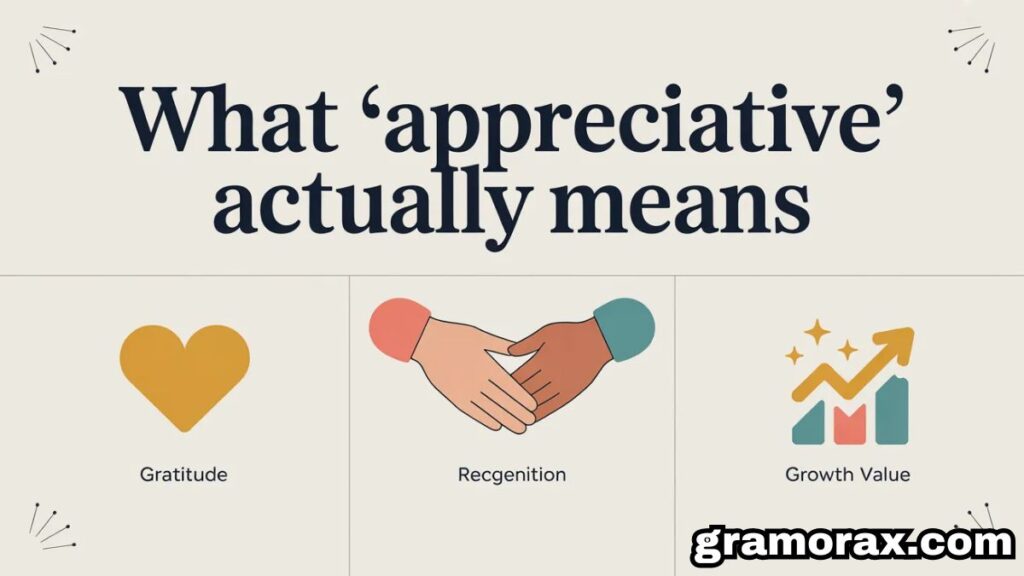
Before picking your preposition, you need to understand what the word itself is doing.
Appreciative comes from the Latin appretiare — meaning to set a price on or to value. At its core, being appreciative means recognizing and acknowledging the worth of something or someone. It’s an adjective describing a state of recognition.
This is subtly different from grateful (an emotional response to receiving a benefit) or thankful (an acknowledgment of a positive outcome). Appreciative leans toward recognition of qualities — it’s more cognitive than purely emotional.
Here’s a quick comparison:
| Word | Preposition | Nuance |
|---|---|---|
| Grateful | for | Emotional response to a benefit received |
| Thankful | for | Acknowledgment of a positive outcome |
| Appreciative | of | Recognition of value, quality, or effort |
Notice the pattern. Grateful point toward a reason — they answer why you feel the way you do. Appreciative, on the other hand, points toward an object — what you’re recognizing. That distinction drives everything that follows.
“Appreciative of” — The Standard, Natural Form
What the Phrase Actually Communicates
When you say you’re appreciative of something, you’re identifying a specific quality, action, gesture, or trait that you recognize and value. The preposition “of” introduces the object of your appreciation.
Grammatically, it works like this:
Subject + [to be] + appreciative + of + noun/gerund
Compare it to similar adjective constructions: aware of, proud of, fond of, conscious of. All of these adjectives describe a mental or emotional orientation toward something, and all of them take “of.” Appreciative of follows the same pattern.
When You Should Absolutely Use “Appreciative of”
Use appreciative of when:
- Writing business emails, cover letters, or professional correspondence
- The object of appreciation is a specific quality, skill, gesture, or effort
- You’re working in academic writing or any polished, formal context
- You’re paraphrasing “grateful for” to avoid repetition and want a slightly more formal tone
- Writing teacher feedback, performance reviews, or professional recommendations
It’s the default. When in doubt, “of” is almost always the safer and more natural choice.
Concrete Use Cases by Context
Business communication: Acknowledging a colleague’s contribution, thanking a client, or recognizing leadership.
Academic writing: Expressing thanks in dissertation acknowledgments or research papers.
Personal relationships: Recognizing a friend’s patience, honesty, or kindness in a heartfelt note.
Creative writing: A character expressing understated, dignified appreciation in dialogue or narration.
Sentence Examples — “Appreciative of” in Action
Here are natural, varied sentence examples across different contexts:
- “She’s deeply appreciative of his honesty during a difficult time.”
- “We are appreciative of the team’s patience throughout this transition.”
- “I’m truly appreciative of the guidance you’ve offered over the years.”
- “The professor was appreciative of the student’s thorough research.”
- “He felt appreciative of every small act of generosity she showed him.”
- “Our organization is appreciative of your continued support and contributions.”
- “She was appreciative of the opportunity to grow within the company.”
- “The community remains appreciative of the leadership shown during the crisis.”
- “I’m genuinely appreciative of your advice — it changed how I approach problems.”
- “They were appreciative of his feedback, even when it was difficult to hear.”
Each of these sentences points toward a specific quality, action, or effort. That’s the key signal for “of.”
The Grammar Behind It — Why “of” Is the Right Fit
According to Merriam-Webster, appreciative is defined as “having or showing appreciation.” It’s an adjective — and in English grammar, adjectives that describe a cognitive or perceptual relationship to something almost always take “of.”
Think of it this way. You’re not appreciative because of something (that would imply a reason). You’re appreciative of something (that identifies the thing you value). The semantic difference is subtle but real.
Bryan Garner, in Garner’s Modern English Usage, notes that preposition choice after adjectives is largely idiomatic — but the pattern of cognition-adjectives + “of” is deeply consistent in Standard English across both American English and British English.
“Appreciative for” — Rare, Contextual, and Often Awkward

What People Mean When They Say It
Nobody who says “appreciative for” is being irrational. They’re blending two perfectly valid constructions:
Grateful for + appreciative of = appreciative for
It’s a natural cross-contamination. In spoken English and informal speech, this blend is increasingly common — particularly in American usage. It usually carries an emotional tone of general gratitude rather than precise recognition.
The Specific Cases Where It Doesn’t Sound Wrong
There are narrow contexts where appreciative for holds up:
- Informal speech and casual conversation: “I’m so appreciative for everything you’ve done.”
- When followed by a reason clause (not a noun phrase): “I’m appreciative for how much you’ve grown.”
- In social media posts or casual personal messages, where the emotional tone matters more than grammatical precision
In these settings, native speakers may not even notice the difference. The emotional tone comes through clearly, and the pragmatics of the situation override strict grammar rules.
When It Sounds Off — and Why
In formal writing, professional writing, or academic writing, “appreciative for” stands out as a grammatical slip. Here’s why:
When “for” introduces a noun phrase — “I am appreciative for your help” — it creates a structural awkwardness. “For” typically signals a reason or purpose (“I did it for you”). But “appreciative” isn’t a reason. It’s describing a recognition. The word calls for an object, not a cause — and “of” delivers that object cleanly.
Grammar awkwardness increases when:
- The phrase appears in a corporate email or formal report
- A hiring manager or professor reads it
- The noun phrase after “for” is abstract (“appreciative for your leadership” vs. “appreciative of your leadership”)
Correct vs Incorrect — Side-by-Side Examples
| Context | Awkward (“for”) | Natural (“of”) |
|---|---|---|
| Cover letter | I am appreciative for the opportunity. | I am appreciative of the opportunity. |
| Performance review | She was appreciative for his mentorship. | She was appreciative of his mentorship. |
| Academic acknowledgments | We are appreciative for the committee’s support. | We are appreciative of the committee’s support. |
| Personal note | I’m appreciative for your kindness. | I’m appreciative of your kindness. |
| Casual text | So appreciative for you! | Acceptable informally |
A Note on Prescriptive vs Descriptive Grammar
Language evolves. Descriptive linguists — those who study language as it’s actually used — note that “appreciative for” is gaining informal ground, especially in American English. It appears in social media captions, casual speech, and even some journalism.
But prescriptive grammar — the rules that govern formal English, professional tone, and academic style — still firmly favors “appreciative of.” The Chicago Manual of Style and most professional style guides don’t list “appreciative for” as an accepted variant in formal contexts.
The takeaway: know your audience. Match your writing context.
How the Meaning Actually Shifts Between the Two
It’s Not Just Grammar — It’s Nuance
The difference isn’t only about correctness. It’s about meaning shift:
- Appreciative of → focuses on what is being valued (the object, the thing itself)
- Appreciative for → implies why (the reason or cause of appreciation)
Compare:
- “I’m appreciative of your patience.” — You’re recognizing patience as a specific quality.
- “I’m appreciative for your patience.” — You’re expressing thanks because of their patience.
The first is a recognition of a specific quality. The second leans toward general gratitude — it’s warmer and less precise. Neither is always wrong. But in professional communication, precision matters.
Head-to-Head Comparison Table
| Phrase | Focus | Formality Level | Best Context |
|---|---|---|---|
| Appreciative of | The object (what is valued) | Formal & informal | Professional emails, feedback, formal writing |
| Appreciative for | The reason (why you feel it) | Mostly informal | Casual texts, social posts, spoken conversation |
How Prepositions Shape Meaning in English
Prepositions are small but mighty. They’re connector words that define the relationship between ideas. Swap a preposition, and you shift the entire sentence-level semantics.
Consider these pairs:
- Responsible for (duty/cause) vs. responsible of (not standard)
- Interested in (engagement) vs. interested by (passive trigger)
- Aware of (cognitive recognition) vs. — there’s no “aware for”
Appreciative of fits neatly into the awareness-recognition category. Prepositional usage is one of the deepest layers of language mastery.
Usage Trends — Then, Now, and Where It’s Heading

Historical Usage (Google Ngram Evidence)
The data is clear. Google Ngram Viewer shows that “appreciative of” has dominated published English literature for well over a century. “Appreciative for” barely registers in formal written corpora before the mid-20th century.
Key historical trends:
- Pre-1900: “appreciative of” was the near-universal standard in literature and journalism
- 1900–1970: “appreciative for” begins appearing, mostly in informal or transcribed speech
- 1970–present: Both forms appear in casual media, but “appreciative of” retains dominance in formal English
What Modern Spoken English Shows
Data from the Corpus of Contemporary American English (COCA) shows a shift. In spoken English transcripts, “appreciative for” appears far more frequently than in written news or academic journals. This mirrors what we see in social media posts and everyday conversation.
The trend line tells an interesting story: informal speech is normalizing the use of “appreciative for,” but formal writing hasn’t budged. For writers, the lesson is clear — know which register you’re writing in.
The Common Mistakes People Keep Making
Mistake #1 — Treating “Appreciative” Like “Grateful”
This is the biggest one. The analogy grateful for → appreciative for feels logical, but it’s grammatically flawed. Grateful are synonyms in feeling but not in syntactic behavior. They belong to a different grammatical category than appreciative.
The fix: Remind yourself that appreciative behaves like aware, not thankful. You’d never say “aware for” — so don’t say “appreciative for” in formal writing either.
Mistake #2 — Overcorrecting in Formal Writing
Some writers get so spooked by this confusion that they avoid “appreciative” entirely — falling back on a clunky “I would like to express my appreciation for…” That’s unnecessary.
The fix: Learn the rule, then use the word confidently. “I am appreciative of your contribution” is clean, polished, and professional.
Mistake #3 — Mixing Registers
This is slipping “appreciative for” into a corporate email or cover letter because it sounded fine in a text message. It’s a register mismatch — and it signals grammatical uncertainty to readers who know better.
The fix: If it’s going in a formal document, use “appreciative of” every single time, no exceptions.
Mistake #4 — Copying Spoken English Into Written English
Informal speech and formal writing follow different rules. What sounds natural in conversation — “So appreciative for everything!” — can read as an error on paper. This is especially common in ESL writing, where learners correctly pick up spoken patterns but don’t always filter them for written contexts.
The fix: Read your writing out loud. Then ask: is this a spoken moment or a written document? Adjust accordingly.
Mistake #5 — Overusing “Appreciative” When Simpler Words Work Better
Sometimes “grateful” or “thankful” is simply the cleaner, more natural choice. Forcing “appreciative” into every expression of thanks can make writing feel stiff or pretentious.
The fix: Use “appreciative of” when you want to specifically highlight a quality or trait. For broader expressions of thanks, “grateful for” is often more natural.
Simple Rules That’ll Stick With You
Rule #1 — Default to “of”
When you’re unsure, choose “of.” It’s correct in formal, informal, spoken, and written contexts. You’ll rarely go wrong with it.
Rule #2 — Use the Substitution Test
Ask yourself: can you replace “appreciative” with “aware” or “fond” and still have the sentence make sense? If yes, “of” is the right preposition.
“I’m aware of your effort.” ✅ → “I’m appreciative of your effort.” ✅
Rule #3 — “Of” Introduces an Object, “For” Introduces a Reason
You’re pointing to what you appreciate, not explaining why you feel appreciation. Use “of” when your next word is the thing being valued. Use “for” only when you’re introducing a reason clause — and even then, consider restructuring.
Rule #4 — Match Your Formality Level
- Formal writing: appreciative of — always
- Professional writing: appreciative of — always
- Academic writing: appreciative of — always
- Informal speech or casual texts: appreciative for may slip by unnoticed
Rule #5 — When It Feels Unstable, Rephrase
“I’m grateful for your help” is always cleaner than a shaky “appreciative for.” Don’t force a construction that doesn’t feel solid. Rephrasing is a sign of writing precision, not weakness.
Rule #6 — Apply the Awareness Test
You’d say “I’m aware of the situation” — never “aware for.” Since appreciative of follows the same grammatical correctness pattern, apply that same instinct.
Real-World Case Studies
Case Study 1 — The Corporate Thank-You Email
Scenario: A junior manager emails a senior executive after a mentorship session.
❌ “I wanted to reach out and say I am so appreciative for your time and guidance this quarter.”
✅ “I wanted to reach out and say I am truly appreciative of your time and guidance this quarter.”
Why it matters: In business reports and professional emails, word choices signal attention to detail. The corrected version reads as polished and credible.
Case Study 2 — The Heartfelt Personal Message
Scenario: A friend writes a birthday card message.
❌ “You’ve always been there for me. I’m so appreciative for your friendship and generosity.”
✅ “You’ve always been there for me. I’m so appreciative of your friendship and generosity.”
Why it matters: Even in personal writing, “appreciative of” sounds more natural and considered. Emotional tone comes through just as warmly — but the language structure is tighter.
Case Study 3 — Teacher Written Feedback to a Student
Scenario: A professor adds a note at the end of a student’s essay.
❌ “The committee is appreciative for the thoroughness of your research.”
✅ “The committee is appreciative of the thoroughness of your research.”
Why it matters: Academic writing demands precision. The corrected version correctly identifies thoroughness as the specific quality being recognized.
Case Study 4 — LinkedIn Post or Social Media Caption
Scenario: A professional shares a gratitude post after a promotion.
❌ “Incredibly appreciative for my team’s support throughout this journey.”
✅ “Incredibly appreciative of my team’s support throughout this journey.”
Why it matters: LinkedIn is a professional communication platform. Even casual posts are read by colleagues and potential employers. Formal English norms apply more here than on personal social platforms.
Case Study 5 — Academic Essay Acknowledgments Section
Scenario: A doctoral student writes the acknowledgments section of their dissertation.
❌ “The author is deeply appreciative for the committee’s insight and direction.”
✅ “The author is deeply appreciative of the committee’s insight and direction.”
Why it matters: Dissertation acknowledgments go through faculty review. A preposition slip in this visible section is an easily avoided distraction from otherwise strong academic writing.
What Grammar and Language Experts Actually Say
“Preposition choice after adjectives in English is largely idiomatic — but patterns exist, and ‘appreciative of’ follows the well-established cognition-adjective + ‘of’ pattern consistently.” — Paraphrased from Garner’s Modern English Usage, 4th Edition
Merriam-Webster’s entry on “appreciative” consistently uses “of” in its definitions and example sentences — never “for.”
The Chicago Manual of Style doesn’t list “appreciative for” as an accepted variant in formal contexts. Its guidance on preposition usage reinforces that formal English should default to established idiomatic patterns.
Corpus linguists studying language usage in tools like COCA and the British National Corpus consistently show “appreciative of” outpacing “appreciative for” in written texts by a wide margin — often 10:1 or more in formal registers. Appreciative of vs Appreciative for.
Quick-Reference Summary
| Question | Answer |
|---|---|
| Which is more correct? | Appreciative of |
| Is “appreciative for” ever acceptable? | Yes — in informal speech and casual contexts |
| Can I use it in formal writing? | No — stick to appreciative of |
| What’s the easiest rule? | Default to “of” — you’ll almost never be wrong |
| Is it interchangeable with “grateful for”? | Similar meaning, different grammar — not interchangeable |
| What does “of” introduce? | The object (the specific quality or thing being valued) |
| What does “for” introduce? | A reason or cause — not what appreciative typically calls for |
Conclusion
The answer is simple. Always use appreciative of in formal and professional writing. Appreciative of vs Appreciative for. It’s precise, natural, and grammatically correct. Appreciative for works occasionally in casual speech — but don’t risk it in polished writing. Appreciative of vs Appreciative for.
This complete guide on appreciative of vs appreciative for gives you everything you need. No more second-guessing. No more awkward preposition mistakes. Appreciative of vs Appreciative for. You now know the rule, the reason, and the exceptions. Appreciative of vs Appreciative for. Use that knowledge confidently — because small grammar wins build big writing credibility. Appreciative of vs Appreciative for.
FAQs
Is “appreciative of” or “appreciative for” correct?
“Appreciative of” is the standard, correct form. Use it in all formal and professional writing without exception.
Can “appreciative for” ever be used correctly?
Yes — but only in casual, informal speech. It’s widely considered non-standard in written English.
Is “appreciative of” the same as “grateful for”?
They’re similar but not identical. “Appreciative of” recognizes a specific quality. “Grateful for” expresses an emotional response to a benefit received.
Which form do grammar guides recommend in 2025?
Merriam-Webster, Garner’s Modern English Usage, and the Chicago Manual of Style all support “appreciative of” as the correct standard form.
Can I use “appreciative for” in a cover letter or email?
No. Always use “appreciative of” in professional writing. “Appreciative for” in a cover letter signals grammatical uncertainty to hiring managers.