“Simpler” and “more simple” both describe something made less complicated or easier to understand, but only one follows standard English comparative rules and sounds natural to native speakers.
Confused about which form to use? This guide clears up the debate once and for all, using real usage patterns instead of dry textbook rules.
You’ll find grammar logic, everyday examples, and simple tips to help you write and speak with total clarity and confidence.
The Main Idea Behind This Article
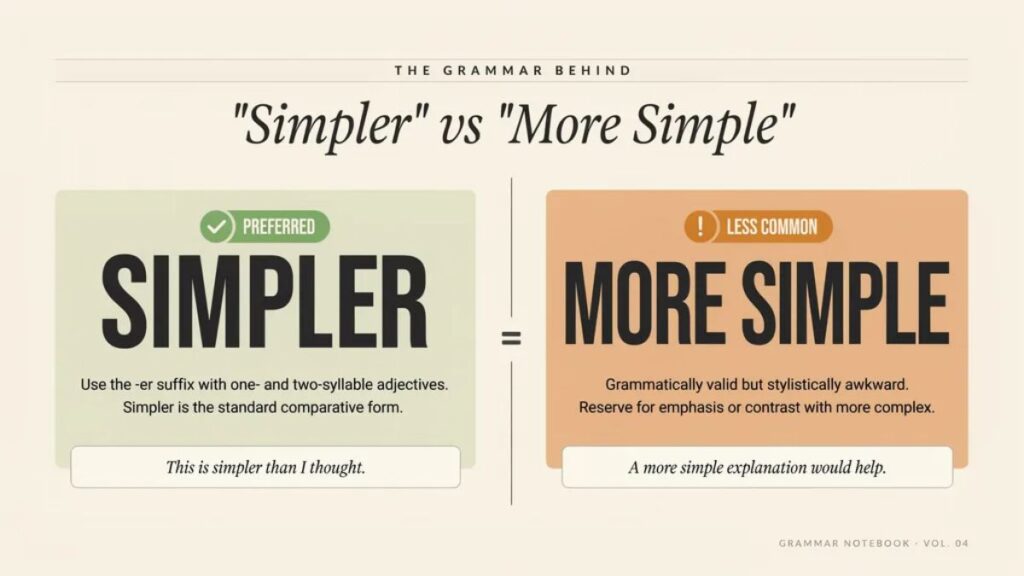
The short answer: “simpler” is the correct and preferred form in almost every situation. “More simple” isn’t technically wrong, but it sounds outdated or overly formal in modern English.
This guide breaks down the grammar rule, shows how real people actually speak and write, and gives you clear examples so you can use “simpler” with total confidence.
The Grammar Behind “Simpler” vs. “More Simple”
English adjectives form comparatives in one of two ways, depending on their length and syllable count.
Short Adjectives Usually Add -er
One and two-syllable adjectives typically take the “-er” ending to form a comparative:
- fast → faster
- small → smaller
- tall → taller
- simple → simpler
“Simple” fits this pattern, which is exactly why “simpler” feels so natural.
Longer Adjectives Use “More”
Adjectives with three or more syllables usually pair with “more” instead of adding a suffix:
- beautiful → more beautiful
- difficult → more difficult
- expensive → more expensive
You wouldn’t say “beautifuler,” and for the same rhythmic reason, many grammar guides argue “more simple” feels equally unnatural.
Where “Simple” Fits
Here’s the twist: “simple” sits in a bit of a gray zone. It’s technically a two-syllable word, but the “-ple” ending behaves almost like a single consonant sound. That places it firmly in the “-er” camp alongside other short, flexible adjectives.
So while “more simple” isn’t grammatically forbidden, “simpler” is the version that matches standard English comparative patterns.
Usage in Real Life: How People Actually Speak
Grammar rules are one thing — real-world usage is another. And in everyday English, “simpler” wins by a wide margin.
Conversation Patterns
In spoken English, people almost always default to “simpler” without thinking twice. It flows better and requires less effort to say. “More simple” tends to show up only when someone is speaking slowly, formally, or deliberately emphasizing a contrast.
Writing Contexts
Across blogs, articles, emails, and academic papers, “simpler” appears far more frequently than “more simple.” Formal or technical writing occasionally leans on “more simple” for stylistic emphasis, but it remains the exception rather than the rule.
Popularity and Trends
Search and usage trends consistently show “simpler” as the dominant choice, especially in American English. “More simple” still appears in older texts, formal essays, and some international English variations, but its use has steadily declined over time.
General Observations About Learner Errors
Many English learners default to “more simple” because it mirrors comparative rules they’ve learned for longer adjectives. This is a completely understandable mistake — it just doesn’t match how native speakers actually talk.
Example: Hypothetical Usage Pattern
Imagine two students editing the same essay. One writes, “This explanation is simpler than the last one.” The other writes, “This explanation is more simple than the last one.” Both sentences are understandable, but only the first reads as natural, polished English.
Side-by-Side Comparison with Examples
| Sentence with “Simpler” | Sentence with “More Simple” | Which Sounds Natural? |
|---|---|---|
| This recipe is simpler than the old one. | This recipe is more simple than the old one. | Simpler ✅ |
| Her explanation was simpler and clearer. | Her explanation was more simple and clearer. | Simpler ✅ |
| We need a simpler solution. | We need a more simple solution. | Simpler ✅ |
| The rules got simpler over time. | The rules got more simple over time. | Simpler ✅ |
Common Mistakes and Misunderstandings
Adding “More” to Short Comparatives
One frequent error is stacking “more” onto a word that already has a comparative form, such as “more simpler” or “more easier.” This is a genuine grammar mistake and should always be avoided.
Mixing Adjectives and Adverbs
Another common mix-up is confusing “simpler” (an adjective) with “more simply” (an adverb). Simpler describes a noun; more simply describes how an action is done.
Wrong vs. Correct Examples
- ❌ This method is more simpler. → ✅ This method is simpler.
- ❌ Can you explain it more simple? → ✅ Can you explain it more simply?
- ❌ Her answer was more simple than mine. → ✅ Her answer was simpler than mine.
Synonyms and Alternatives
Sometimes neither “simpler” nor “more simple” fits the tone you want. Luckily, English offers plenty of alternatives.
Good Synonyms for “Simpler”
- Easier
- Less complicated
- More straightforward
- Clearer
- More basic
Example Sentences
- This app is easier to use than the last version.
- Let’s keep the instructions straightforward.
- We should design a more basic model for testing.
Myths and Style Preferences
- Myth 1: “More simple” is grammatically wrong. Truth: It’s acceptable, just far less common.
- Myth 2: Only careless writers use “more simple.” Truth: Even formal and academic writing has used it historically.
- Myth 3: The two forms mean different things. Truth: They carry the same meaning — the difference is purely style and frequency.
Literature and Real-World Examples
Older texts and formal essays occasionally favor “more simple” to slow down a sentence or add emphasis. Modern journalism, marketing copy, and everyday writing overwhelmingly favor “simpler” for its clean, direct sound.
Clear Guidance for Writers and Learners
Use “simpler” when:
- Writing everyday emails, articles, or conversations
- Aiming for clarity and a natural tone
- Following standard American English conventions
Avoid “more simple” unless:
- You’re writing in a deliberately formal or academic style
- You want to add rhythmic emphasis to a sentence
- You’re quoting or matching an older text’s tone
Practice Sentences
Try rewriting these using the correct form:
- This puzzle is (more simple / simpler) than the last one.
- Can we find a (more simple / simpler) way to explain this?
- Her method was (more simple / simpler) and faster.
(Answer: all three should use “simpler.”)
FAQ’s
What is correct: simpler or more simple?
“Simpler” is the correct and widely preferred form in modern English.
Is “more simple” wrong in English?
No, it’s not wrong, but it sounds less natural and is rarely used today.
When should I use “simpler” instead of “more simple”?
Use “simpler” in everyday speech, writing, and professional communication.
What is the difference between “simpler” and “more simply”?
“Simpler” is an adjective describing things; “more simply” is an adverb describing actions.
Why do some people prefer “more simple”?
Some writers use it for emphasis, formality, or stylistic rhythm in specific contexts.
Conclusion
This Simpler or More Simple? guide shows the answer is easy. Use “simpler” in almost every case. It sounds natural and clear.
Keep this Simpler or More Simple? guide handy for quick checks. Save “more simple” for rare formal moments. Trust “simpler” for everyday writing and speech, and your English will always sound confident.