Few English mix-ups cause as much quiet embarrassment as swapping “to fast” and “too fast.” One extra letter changes a sentence from a comment about speed into a statement about skipping meals. If you’ve ever paused mid-sentence wondering which one belongs, you’re not alone. To Fast or Too Fast.
This guide breaks down the grammar behind both phrases in plain language. You’ll see exactly when each form applies, why the confusion happens in the first place, and how to catch the mistake before it reaches your reader. By the end, choosing correctly will feel automatic rather than uncertain.
Whether you’re writing an email, a school assignment, or content for work, getting “to fast” and “too fast” right signals attention to detail. Let’s clear up the confusion for good.
The Real Difference Between “To” and “Too”
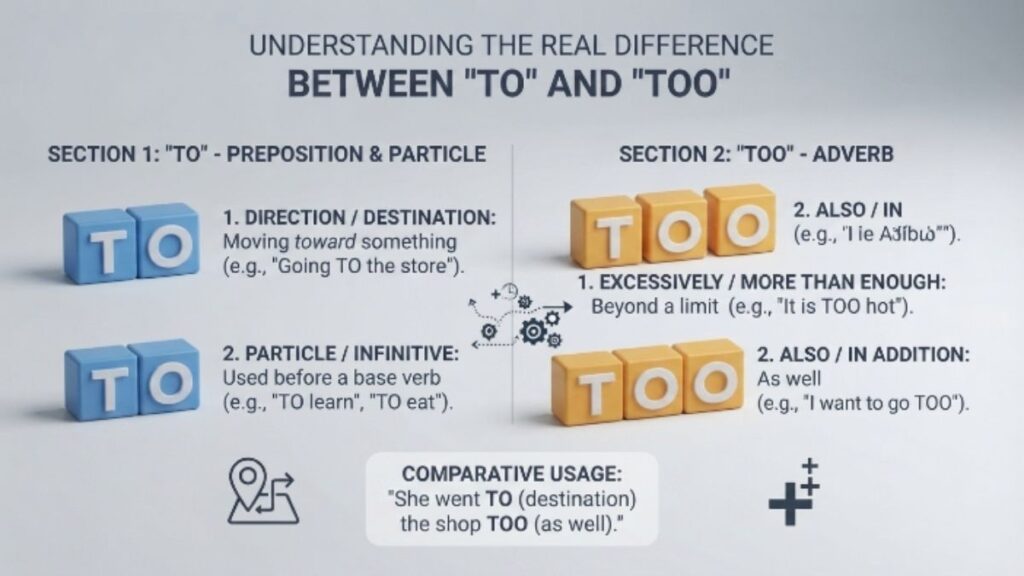
“To” and “too” are homophones — they sound identical but serve completely different grammatical roles. Confusing them is one of the most common English writing errors, even among fluent speakers, because spoken language doesn’t reveal the spelling difference.
What “To” Means
“To” usually functions in one of two ways:
- As a preposition, showing direction, destination, or relationship: She walked to the station.
- As an infinitive marker, pairing with the base form of a verb to express purpose or intention: He wants to learn Spanish.
In both cases, “to” points toward something — a place, a goal, or an action.
What “Too” Means
“Too” is an adverb with two main jobs:
- Meaning “excessively” or “more than needed,” modifying an adjective or adverb: The soup is too spicy.
- Meaning “also,” usually placed at the end of a sentence: I’m coming too.
A simple memory cue: “too” carries an extra “o,” and that extra letter stands for “extra” or “excess.”
What Does “Fast” Mean in Grammar?
“Fast” is a flexible word that changes meaning depending on its part of speech. This flexibility is exactly why “to fast” and “too fast” aren’t interchangeable typos — they describe different concepts entirely.
Fast as an Adjective
Used before a noun, “fast” describes speed: a fast car, a fast runner.
Fast as an Adverb
Used after a verb, “fast” describes how an action happens: She types fast. He drives fast.
Fast as a Verb
Here’s the twist: “fast” can also mean to abstain from eating or drinking for a set period. Used this way, it pairs naturally with the infinitive marker “to,” producing the phrase “to fast.”
When “To Fast” is Correct
“To fast” is correct only when “fast” is functioning as a verb — meaning to go without food. Since infinitives are formed with “to” plus a base verb, this phrase follows standard grammar rules.
Examples:
- She plans to fast for 24 hours before the procedure.
- Many people choose to fast during religious observances.
Religious and Health Contexts
Fasting appears across many traditions and health practices, which is where “to fast” shows up most often in real writing:
- Ramadan observance in Islam
- Lent in Christianity
- Yom Kippur in Judaism
- Medical fasting before blood tests or surgery
- Voluntary fasting for personal wellness goals
Case Study: Intermittent Fasting
Intermittent fasting has become a mainstream health topic, and it’s a good real-world test of this grammar rule. People following structured eating windows often say things like “I decided to fast for 16 hours” — never “too fast,” since the meaning has nothing to do with speed.
Common intermittent fasting patterns include:
| Method | Structure |
|---|---|
| 16:8 | Fast for 16 hours, eat within an 8-hour window |
| 5:2 | Eat normally 5 days a week, restrict calories on 2 |
| Alternate-day | Alternate between normal eating and fasting days |
In every one of these descriptions, “to fast” refers to the practice itself — a verb form, not a measure of speed.
When “Too Fast” is Correct
“Too fast” is correct whenever you’re describing excessive or unsafe speed. Here, “too” intensifies the adjective or adverb “fast,” signaling that something exceeds a comfortable or acceptable limit.
Examples:
- He was driving too fast for the icy road.
- You’re talking too fast for me to follow.
- The project moved too fast, and details got missed.
Real-World Application: Traffic Safety
Traffic enforcement is one of the clearest everyday examples of “too fast” in action. Speeding tickets exist specifically because driving too fast increases the risk of accidents. Road signs, safety campaigns, and driver’s education materials all rely on this exact phrase to warn against excessive speed. The same logic extends beyond driving — coaches warn athletes against training too fast, and managers caution teams against rushing too fast through a project.
Common Mistakes and How to Avoid Them
Common Errors
- ❌ He drives to fast. → ✅ He drives too fast.
- ❌ I will too fast today. → ✅ I will fast today or I plan to fast today.
- ❌ We’re moving to fast on this deal. → ✅ We’re moving too fast on this deal.
Why Confusion Happens
Because “to” and “too” sound exactly alike when spoken, writers often default to the shorter, more familiar spelling without pausing to check the intended meaning. Autocorrect and quick typing make the error even easier to miss.
Tips to Catch Mistakes
- Read the sentence aloud — does it mean “also” or “excessively”? Then it’s “too.”
- Check whether “fast” refers to eating. If so, “to fast” is likely correct.
- Try replacing “too” with “also” or “very.” If the sentence still makes sense, “too” is right.
- Proofread a second time, focusing only on short connector words like “to,” “too,” and “two.”
Quick Reference Tools
- Grammar checkers like Grammarly or ProWritingAid flag most to/too errors automatically.
- Text-to-speech tools can help you hear awkward phrasing you might otherwise skim past.
- Keeping a simple style sheet of commonly confused words speeds up self-editing.
Simple Trick to Remember
Think of the extra “o” in “too” as standing for “extra.” Excess speed, excess emphasis, excess of anything — that’s “too.” If the sentence has nothing to do with excess and instead involves skipping meals, direction, or purpose, “to” is your word.
Comparison Table: To vs Too vs Fast
| Word | Part of Speech | Meaning | Example |
|---|---|---|---|
| To | Preposition / infinitive marker | Direction, purpose, or links to a verb | I want to travel. |
| Too | Adverb | Excess or “also” | It’s too loud in here. |
| Fast | Adjective | Describes speed | a fast car |
| Fast | Adverb | Describes how an action is done | She runs fast. |
| Fast | Verb | To abstain from food | He chose to fast. |
Mini Quiz
Fill in the blank with “to” or “too”:
- She drives ___ fast for this neighborhood.
- He plans ___ fast before his surgery.
- I’d like to come ___.
- The music is ___ loud for a library.
Answers: 1. too, 2. to, 3. too, 4. too
Advanced Usage: When Both Appear in Same Sentence
Occasionally, both words show up together, which can trip up even careful writers: He tried to fast, but he moved too fast through the process and gave up early. Notice how each word retains its own distinct role — one refers to the act of fasting, the other to excessive speed. Reading the sentence in two separate parts makes the meaning clear.
Related Confusing Word Pairs
- Its vs. It’s
- Your vs. You’re
- Their vs. There vs. They’re
- Effect vs. Affect
- Too Early vs. To Early
FAQ’s
When should I use “to fast”?
Use “to fast” only when “fast” means to abstain from food, typically in health, medical, or religious contexts.
What does “fast” mean in grammar?
“Fast” can be an adjective (describing speed), an adverb (describing how something is done), or a verb (meaning to abstain from eating).
Is “to fast” ever wrong?
Yes — it’s incorrect whenever the sentence is describing speed. In that case, “too fast” is the correct phrase.
Which is correct: “I love you to” or “I love you too”?
“I love you too” is correct. Here, “too” means “also,” so the extra “o” is required.
Can I use “fast” to describe not eating?
Yes. As a verb, “fast” means to go without food or drink for a period of time, as in “to fast for 24 hours.”
Conclusion
Getting “to fast” and “too fast” right comes down to one question: does the sentence involve speed, or does it involve abstaining from food? Once you identify which meaning you intend, the correct word follows naturally. “Too fast” signals excess or danger in movement, while “to fast” points to a deliberate choice tied to health, faith, or personal discipline. To Fast or Too Fast.
Keep the extra-“o” trick in mind, read your sentences aloud when in doubt, and proofread short connector words carefully. With a little practice, distinguishing “to fast” from “too fast” becomes second nature, helping your writing stay clear, accurate, and professional every time.