
You’re texting a friend: “I’ll call you when I land — I’m currently ___ the plane.” You pause. Is it on or in? It feels like it should be obvious, but for millions of English learners — and even some native speakers — this tiny preposition trips people up every single time.
Here’s the short answer: “On the plane” is correct for everyday use. But the full story is more nuanced, and understanding why will make you sound naturally fluent — not just technically correct.
Let’s break it all down.
🛫 Understanding “On the Plane” vs. “In the Plane”
Both phrases are grammatically defensible. The preposition “on” signals contact with a surface or platform, while “in” signals being enclosed within a space. Since you’re literally sitting inside an airplane’s cabin, “in the plane” feels logical — and it is logically sound.
But English doesn’t always follow logic. It follows idiomatic conventions, and for transportation, those conventions strongly favor “on.”
“On the Plane”: The Natural, Idiomatic Choice
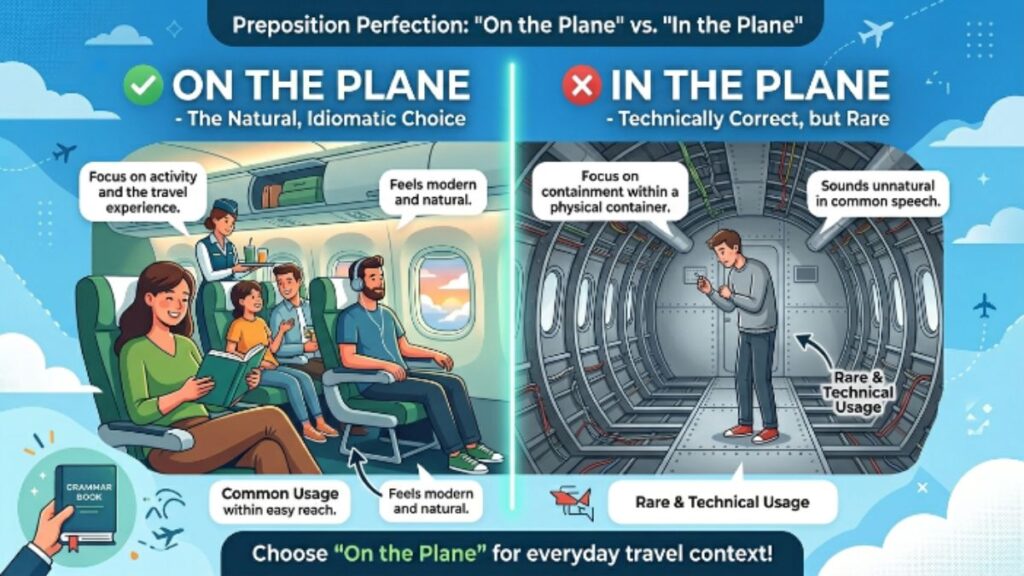
“On the plane” is by far the most widely used phrase in everyday English. You’ll hear it from airport lounges to office conversations:
- “I finished the report on the plane.”
- “She met her future husband on the plane.”
- “I can’t talk — I’m on the plane.”
It feels natural because it’s what native speakers have said for generations. It’s also the phrase you’ll find in textbooks, travel writing, and professional communication worldwide.
Why does English use “on” with airplanes?
The key rule: use “on” for large, public vehicles where passengers can stand up and walk around. Think planes, trains, buses, ships, and ferries. These vehicles function more like mobile platforms than sealed containers. Because you can get out of your seat, walk to the restroom, or stretch in the aisle, English treats the airplane as a surface you occupy — not just an enclosure you’re trapped inside.
Compare this to smaller, private vehicles:
- “I’m in the car.”
- “I’m in the taxi.”
- “I’m in the helicopter.”
In these cases, you’re seated and constrained — hence, “in.”
When does “on the plane” sound wrong?
Rarely — but it can occasionally raise eyebrows when the context is clearly about the aircraft’s physical structure. For example, saying “There’s a crack on the plane” sounds like you’re describing a surface defect, not your location inside the cabin.
“In the Plane”: Less Common, But Not Wrong
“In the plane” isn’t incorrect — it’s just unusual in casual speech. You might encounter it in specific contexts, especially when emphasizing physical enclosure, technical interior details, or when a speaker’s first language treats vehicles as enclosed containers. Some non-native speakers use it naturally, and while it may sound slightly formal or stilted to native ears, listeners understand it perfectly.
🛩️ The Core Rule: Prepositions for Transportation
Here’s the clearest summary of how English prepositions map to vehicles:
| Vehicle Type | Preposition | Examples |
|---|---|---|
| Large/public — can walk around | on | plane, train, bus, ship, ferry |
| Small/private — must sit down | in | car, taxi, canoe, helicopter |
| General mode of travel | by | by plane, by car, by train |
This table captures the dominant pattern in standard English. When in doubt, ask yourself: Can passengers stand and walk around inside this vehicle? If yes → on. If no → in.
🚀 Special Cases & Meaning Shifts
Language is never perfectly clean. Here are the exceptions worth knowing:
When “In the Plane” Is the Correct Phrase
1. Aviation Mechanics or Pilots Talking Literally
When aviation professionals discuss the aircraft’s interior systems, “in the plane” is precise and appropriate:
- “There’s a wiring fault in the plane’s fuselage.”
- “The hydraulic system in the plane needs servicing.”
Here, you’re describing the aircraft as a technical object, not as a vehicle transporting passengers.
2. You Are Describing the Interior as a Space
If you’re specifically highlighting the enclosed cabin environment:
- “The temperature in the plane was unbearably cold.”
- “The noise level in the plane made it impossible to sleep.”
Both “on” and “in” work here, but “in” feels more precise when emphasizing the interior conditions.
3. External Observation
If someone outside is watching and describing what’s happening inside:
- “You can see the passengers seated in the plane through the windows.”
When “On the Plane” Can Mean Something Unusual

Mechanical or Exterior Work
“The engineers worked on the plane for three hours” — here, “on” describes exterior maintenance, not passenger travel. Context makes the meaning clear.
Boarding or Being Listed
“Your name is on the plane’s manifest” uses “on” in a completely different, non-physical sense — meaning listed or registered.
🧭 Why “On the Plane” Dominates in Everyday English
Native speakers follow subconscious patterns:
- Habit and repetition: Generations of speakers have used “on the plane,” and new learners absorb this pattern naturally.
- Transport idioms solidify early: Children learn “on the bus,” “on the train,” and “on the plane” together as a set — reinforcing the pattern before logic even enters the picture.
- Cultural media: Songs (“Leaving on a Jet Plane”), movies, and books consistently use “on,” cementing it as the default.
- Flight announcements: Airlines universally say “passengers on board” or “on the aircraft” — never “in the aircraft” in passenger-facing language.
📝 Grammar & Linguistic Nuances Behind the Phrases
1. Prepositions Follow Patterns, Not Logic
English prepositions are notoriously irregular. They evolved over centuries through usage, not design. Expecting them to be logically consistent is like expecting all plurals to end in “-s” — it mostly works until it doesn’t.
2. Airplanes Are Treated Like Platforms
Linguistically, English categorizes planes alongside ships and trains — all large vessels that serve as platforms for movement. You ride on them the same way you stand on a stage or on a platform.
3. Movement Verbs Influence Prepositions
Notice: we get on a plane and get off a plane — not “get in” and “get out.” These movement verbs reinforce the platform concept and make “on the plane” feel consistent throughout the entire travel experience.
4. Idioms Freeze Over Time
Once a phrase becomes idiomatic — used naturally by millions of speakers — it resists change. “On the plane” is now frozen in the language, regardless of whether “in” might be equally logical.
🕰️ Historical Usage & Evolution of the Expression
Early aviation (1900s–1940s) borrowed its language from naval terminology, where “on board the ship” was a standard term. Sailors were always on a vessel, not in one. As commercial flight grew, it inherited this maritime language tradition. By the time flying became a mass-market activity in the 1950s and 60s, “on the plane” was already the established norm — and it’s never been seriously challenged since.
🔍 Related Phrases You Should Know
“By Plane”
Used for the general mode of travel: “We traveled by plane.” No article needed. Describes the method, not the specific vehicle.
“Aboard the Plane”
More formal and often used in official or written contexts: “All passengers aboard the plane are requested to fasten their seatbelts.” Interchangeable with “on the plane” but carries a slightly more official tone.
“On Board”
A set phrase derived from nautical English: “Welcome on board.” Used without an article when it follows welcome or refers to a general state.
“Get On / Get Off” vs. “Get In / Get Out”
- Boarding a plane → get on the plane
- Leaving a plane → get off the plane
- Entering a car → get in the car
- Leaving a car → get out of the car
These pairs are consistent and non-negotiable in natural English.
🌍 Cultural & Contextual Influences on How We Use These Phrases
Why “on the plane” won culturally:
Language isn’t just grammar — it’s culture. Commercial aviation grew most rapidly in English-speaking countries (USA, UK, Australia), which set the linguistic standards. As English became the international language of aviation, its prepositional conventions went global. Air traffic control, pilot training, and international travel all operate in English — and they all say “on the plane.”
Do native speakers ever say “in the plane”?
Yes — occasionally. You’ll hear it from:
- Speakers whose first language (French, Spanish, Arabic, Urdu, etc.) uses an equivalent of “in” for all vehicles
- Engineers and mechanics discussing interior systems
- Writers deliberately emphasize enclosed, claustrophobic settings
But outside these contexts, it sounds noticeably non-native to most English ears.
📌 Practical Cheat Sheet (Bookmark This!)
| Situation | Correct Phrase |
|---|---|
| Traveling as a passenger | on the plane |
| Describing cabin conditions | in the plane (or on) |
| Aviation/technical context | in the plane |
| General mode of travel | by plane |
| Formal/official tone | aboard the plane |
| Boarding | get on the plane |
| Exiting | get off the plane |
Memory trick: Think of “on” as your boarding pass. If you have a ticket and you’re traveling, you’re on the plane. Think of “in” as a toolkit — use it only when discussing the interior mechanics or conditions of the aircraft.
🧪 Real Case Studies
Case Study 1: The Frequent Flyer
Marcus travels for work every week. He texts his manager: “Just landed — finished the presentation on the plane.”
This is perfect. Marcus is describing his experience as a passenger during a flight. “On the plane” is the natural, idiomatic choice here, and any native speaker would use the same phrase.
Case Study 2: The Aviation Technician
Sandra is an aircraft engineer reviewing a maintenance report: “The hydraulic fluid leak originates in the plane’s rear actuator housing.”
Here, “in the plane” is absolutely correct. Sandra isn’t a passenger — she’s describing a technical location within the aircraft’s interior structure. This is the professional, precise phrasing for aviation mechanics and engineers.
Case Study 3: The Traveler Explaining Comfort
Derek calls his wife after landing: “The AC in the plane was freezing — I should have brought a jacket.”
Both “in the plane” and “on the plane” work here. “In the plane” feels slightly more specific because Derek is emphasizing the enclosed cabin environment and its temperature. Either version sounds natural in context.
Case Study 4: The Passenger Describing a Lost Item
At the lost baggage counter: “I think I left my jacket on the plane.”
Classic passenger context — “on the plane” is the only phrase you’d naturally use here. It refers to a specific flight (the one the passenger just traveled on) and follows the standard idiomatic pattern perfectly.
💬 Quotes From Linguists & Aviation Experts
“English prepositions encode relationships rather than physical descriptions — ‘on the plane’ reflects how speakers conceptualize air travel as a shared platform experience, not merely physical containment.” — Perspective from cognitive linguistics research on spatial prepositions
“In aviation language globally, the standard is ‘on board the aircraft’ — inherited from maritime English and reinforced through decades of international flight operations.” — Consistent with ICAO (International Civil Aviation Organization) communication standards
FAQs
What is correct: “On the plane” or “In the plane”?
“On the plane” is the standard, idiomatic phrase for everyday use. Both are grammatically acceptable, but “on” is strongly preferred by native speakers in all casual and professional contexts involving passenger travel.
Why do native speakers say “on the plane”?
Because English treats large, public vehicles — where passengers can stand and move around — as platforms. The same rule applies to trains, buses, and ships. This convention comes from maritime English and became standard through widespread usage.
Is “in the plane” wrong?
No — it’s not wrong, just uncommon in everyday speech. It’s appropriate in technical aviation contexts, when describing interior conditions, or when emphasizing physical enclosure. In casual conversation, however, it can sound non-native.
Can I say “I’m in the plane” while boarding?
Technically yes, since you are physically inside the aircraft. But most native speakers would still say “I’m on the plane” the moment they’ve boarded, regardless of whether the plane is moving.
Which is more formal: on the plane or aboard the plane?
“Aboard the plane” carries a more formal or official tone and is often used in announcements, written documents, and professional aviation contexts. “On the plane” is standard for everyday spoken and written English.
Conclusion
So — “on the plane” or “in the plane”?
For virtually every everyday situation, the answer is “on the plane.” It’s idiomatic, it’s natural, it’s what native speakers say instinctively — and it’s backed by a consistent grammatical rule: large, public vehicles where passengers can move around take “on.”
Reserve “in the plane” for the specific cases outlined in this guide: technical aviation contexts, describing interior conditions, or situations where physical enclosure is the point you’re making.
Master this one rule, and you’ll sound naturally fluent in every travel conversation — from airport small talk to professional trip reports. And next time someone texts you from 30,000 feet, you’ll know exactly what they should be saying. ✈️