If you have ever typed “you are so sweat” instead of “you are so sweet,” you are not alone. This is one of the most common spelling mistakes English learners make. The words sweet and sweat look almost identical, but their meanings are completely different. One letter changes everything. Sweet vs Sweat.
In this complete guide, you will learn the exact meaning, pronunciation, grammar, idioms, and memory tricks for both words — so you never confuse them again.
Understanding the Basics of Sweet vs Sweat
At a glance, both words share the letters “s,” “w,” “e,” “a,” and “t.” That shared “ea” combination is what fools most learners. However, their vowel sounds, meanings, and grammatical roles are entirely different.
Here is the simplest way to think about it:
- Sweet = something pleasant, kind, or sugary
- Sweat = moisture your body produces during heat, effort, or stress
One lives in the world of emotions and taste. The other lives in the world of physical activity and the human body.
What Does Sweet Mean?
Sweet is primarily an adjective in English. It describes a pleasant taste, a kind personality, or a touching experience.
Definition: Something that tastes like sugar, or someone kind and gentle.
Examples:
- This mango is very sweet.
- She left me a sweet note on my desk.
- That was such a sweet moment between them.
Sweet can also function as a noun, especially in British English, where “sweets” means candy or sugary snacks.
What Does Sweat Mean?
Sweat works as both a noun and a verb. As a noun, it refers to the salty liquid your body releases through the skin during physical activity or heat. As a verb, it means to produce that moisture.
Definition (noun): The fluid released from sweat glands when the body overheats or when a person is nervous or working hard.
Definition (verb): To perspire; to work intensely.
Examples:
- His shirt was soaked in sweat after the match.
- She started to sweat during the presentation.
- He sweated through two hours of training.
Sweet vs Sweat — Pronunciation Guide
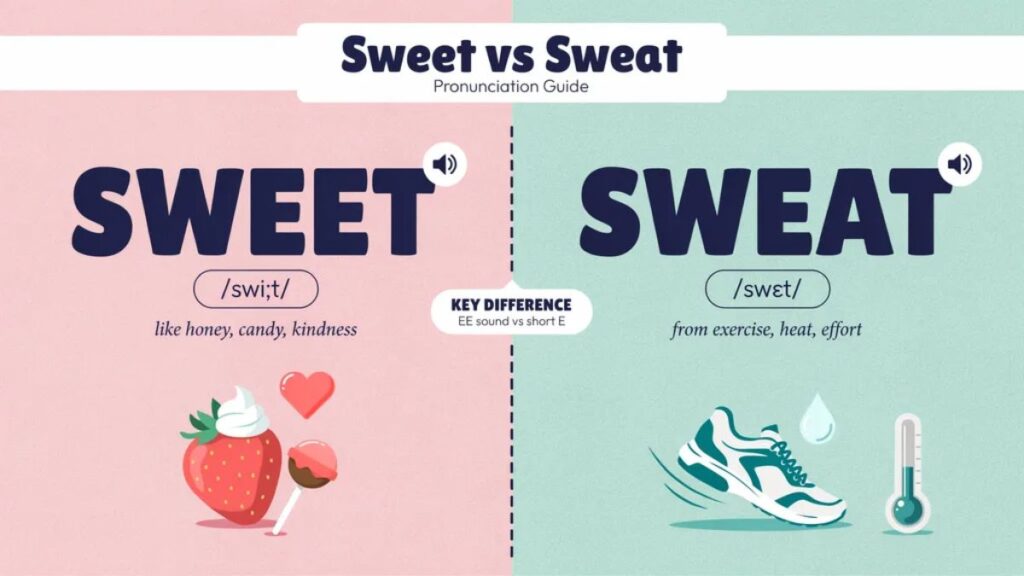
This is where most confusion begins. Both words use the “ea” spelling, but they sound completely different.
Sound Difference
| Word | Phonetic Symbol | Sounds Like | Example Rhyme |
|---|---|---|---|
| Sweet | /swiːt/ | “sweet” (long EE sound) | treat, heat, beat |
| Sweat | /swɛt/ | “swet” (short E sound) | wet, bet, net |
Quick tip: The “ee” in sweet is long — stretch it out. The “e” in sweat is short and sharp, like in the word “bed.”
Say this out loud: “Sweet treat. Sweat wet.” Practice this a few times, and the difference will click naturally.
Grammar and Word Forms of Sweet and Sweat
Sweet — Grammar Usage
Sweet is most commonly an adjective, but it can shift roles depending on the sentence.
| Form | Example |
|---|---|
| Adjective | The cake tastes sweet. |
| Noun (British English) | She bought sweets from the shop. |
| Adverb form | She smiled sweetly at him. |
| Noun form | The sweetness of the fruit was perfect. |
| Comparative | This apple is sweeter than that one. |
| Superlative | This is the sweetest dessert I have ever had. |
Sweat — Grammar Usage
Sweat functions as both a noun and a verb with several tense forms.
| Form | Example |
|---|---|
| Noun | There were drops of sweat on his face. |
| Verb (present) | I sweat a lot in summer. |
| Verb (past) | He sweated through the whole exam. |
| Adjective form | His sweaty hands gripped the bar. |
| Noun (plural) | Night sweats can signal health issues. |
Usage in Everyday Contexts
Sweet in Daily Life
You will hear and use “sweet” in many common situations:
- Describing food: “This tea is too sweet for me.”
- Complimenting someone: “That was really sweet of you to help.”
- Expressing emotion: “They shared a sweet goodbye.”
- Describing sound: “The music has a sweet, gentle tone.”
- Slang approval (American English): “We got the tickets — sweet!”
Sweat in Daily Life
Sweat appears in contexts involving the body, hard work, or stress:
- After exercise: “He wiped the sweat from his forehead.”
- In nervousness: “Cold sweat ran down her back before the interview.”
- Describing effort: “Years of sweat went into building this company.”
- Weather: “It is so humid that I start to sweat the moment I step outside.”
Idioms and Expressions with Sweet vs Sweat
Sweet Idioms
English is full of rich expressions using “sweet.” Here are the most common ones:
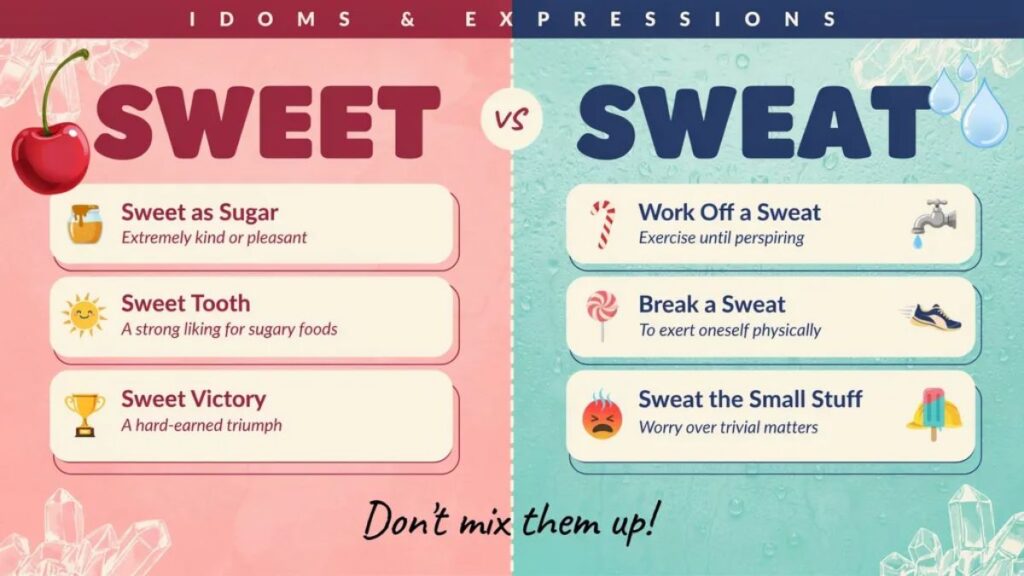
- Sweet spot — the perfect position or ideal moment (“She found the sweet spot in negotiations.”)
- Sweet talk — to flatter someone to get what you want (“He sweet-talked his way into the event.”)
- Sweet tooth — a strong love for sugary foods (“My grandmother has a serious sweet tooth.”)
- Sweet nothings — romantic but meaningless words (“He whispered sweet nothings in her ear.”)
- Home sweet home — a warm expression for returning home
Sweat Idioms
- Break a sweat — to exert effort (“He didn’t even break a sweat during the test.”)
- No sweat — no problem, easy (“Can you help me carry this?” — “No sweat!”)
- Don’t sweat the small stuff — don’t stress over minor issues
- Blood, sweat, and tears — enormous effort and sacrifice
- Sweat it out — to endure a difficult situation until it passes
Common Mistakes Learners Make
Here are the most frequent errors English learners make with these two words:
- “You are so sweat” ❌ — should be “You are so sweet” ✅
- “I sweet a lot in summer” ❌ — should be “I sweat a lot in summer” ✅
- “She gave me a sweat smile” ❌ — should be “She gave me a sweet smile” ✅
- “He was covered in sweet” ❌ — should be “He was covered in sweat” ✅
Why do these mistakes happen?
- Similar spelling confuses the eye, especially when typing fast
- Autocorrect sometimes makes the wrong suggestion
- ESL learners mix up the vowel sounds because “ea” behaves differently in each word
Tips to Remember the Difference
Trick 1: Emotional Connection
Sweet connects to feelings — kindness, love, happiness, and taste. If the sentence involves emotion, affection, or flavor, the answer is almost always sweet.
“She was sweet to remember my birthday.”
Trick 2: Physical Connection
Sweat connects to the body — exercise, heat, nervousness, and hard work. If the sentence involves physical activity or effort, use sweat.
“He was dripping with sweat after the run.”
Trick 3: Letter Meaning Idea
- Sweet has two E’s — think of extra enjoyment
- Sweat has an A — think of Activity or Action
You can also use a visual cue: picture a cupcake for sweet, and a gym towel for sweat. When in doubt, close your eyes and see the image.
Sweet vs Sweat in Figurative Language
Using Sweet Figuratively
“Sweet” frequently appears in figurative language to describe non-physical pleasantness:
- “Sweet victory” — a deeply satisfying win
- “Sweet revenge” — satisfaction from getting even
- “Life is sweet” — life is going well
Using Sweat Figuratively
“Sweat” is often used metaphorically to describe intense effort or stress:
- “She sweated over every line of the proposal.” (worked very hard)
- “Years of sweat built this business from nothing.”
- “Don’t sweat it” — don’t worry about it
Real-Life Case Study: Student Language Learning
Consider Amir, a university student from Karachi studying English as a second language. In an email to his professor, he wrote: “Thank you for being so sweat to me this semester.”
His professor was confused. Amir meant to say “sweet” — kind and considerate. But the wrong word created an awkward, unclear message.
After learning the pronunciation difference (/swiːt/ vs /swɛt/) and the memory tricks above, Amir stopped making this mistake. He began using sweet for emotional contexts and sweat for physical ones. Within two weeks, it became automatic.
This is exactly how most learners fix this confusion — through clear rules, repeated practice, and real-life context.
Comparison Table: Sweet vs Sweat
| Feature | Sweet | Sweat |
|---|---|---|
| Pronunciation | /swiːt/ (long EE) | /swɛt/ (short E) |
| Part of Speech | Adjective, Noun | Noun, Verb |
| Primary Meaning | Pleasant, sugary, kind | Perspiration, effort |
| Used for emotions? | Yes | Rarely |
| Used for the body? | No | Yes |
| Adjective form | Sweet | Sweaty |
| Adverb form | Sweetly | — |
| Common idiom | Sweet tooth | No sweat |
| British English note | “Sweets” = candy | — |
Advanced Usage Notes
- In American slang, “sweet” is used as an exclamation of approval: “We got front-row seats — sweet!”
- “Sweat” in the plural form (“night sweats”) refers to episodes of heavy perspiration during sleep, often linked to health conditions.
- “Bittersweet” is a compound adjective combining opposing ideas — “Graduation was a bittersweet moment.”
- “Sweatshop” is a compound noun describing a factory with very poor working conditions, derived directly from “sweat” as labor.
Fun Fact Section
🍬 The word sweet traces back to Old English swēte, connected to the Proto-Germanic root swōtijaz, which originally meant “pleasing to the senses.”
💧 The word sweat comes from Old English swātan, meaning “to perspire or work hard.” It shares roots with German, Dutch, and Danish words for perspiration.
🧠 Despite looking almost identical today, these two words evolved from completely different Old English roots and have always carried distinct meanings. Their similar spelling is simply a coincidence of how English orthography developed over centuries.
Everyday Conversation Examples
Using Sweet
- “That was really sweet of you to bring flowers.”
- “This orange juice is too sweet for me.”
- “They had such a sweet first date.”
- “Good night — sweet dreams!”
Using Sweat
- “I need a shower. I’m covered in sweat.”
- “Don’t sweat it — everything will work out.”
- “She sweated for months to finish her thesis.”
- “His palms were sweaty before the speech.”
FAQs
Is “sweet” a compliment?
Yes, absolutely. Calling someone “sweet” means they are kind, thoughtful, and considerate — it is a warm and positive compliment in everyday English.
Can “sweat” be used figuratively?
Yes. “Sweat” often describes intense effort or stress, as in “Don’t sweat it” (don’t worry) or “She sweated over the project” (she worked very hard on it).
What is “sweetie” and “sweaty”?
“Sweetie” is an affectionate term for someone you love or care about. “Sweaty” is an adjective describing something or someone damp with sweat — for example, “sweaty palms” or “a sweaty gym.”
Why do sweet and sweat look similar?
Both words share the “sw” and “ea” letter combinations and trace back to Old English. The similar spelling is a result of historical language patterns, even though their sounds and meanings diverged over time.
Is sweat ever plural?
In specific medical contexts, yes — “night sweats” refers to repeated episodes of heavy perspiration during sleep. In British English, “sweets” (plural of sweet) means candies or sugary treats.
Conclusion
Mastering sweet vs sweat comes down to two things: meaning and sound. Sweet connects to pleasure, kindness, and taste — it uses a long /iː/ vowel sound. Sweat connects to physical effort, the body, and hard work — it uses a short /ɛ/ vowel sound.
Remember: Sugar is sweet. Hard work makes you sweat.
Use the memory tricks, practice the pronunciation out loud, and read the example sentences regularly. A small confusion like this is easy to fix once you understand the logic behind it. With consistent practice, you will choose the right word automatically — and your English will sound more natural, accurate, and confident every single day.