Dammit and damn it mean the same thing but work differently. Dammit is a one-word interjection — raw, fast, and informal. Damn, it is a two-word verb phrase — structured, deliberate, and slightly more formal. Dammit vs. Damn It.
That tiny space between two words changes everything about tone, grammar, and emotional punch in your writing.
Both forms share the same Latin root and express frustration, yet writers who know the difference consistently produce sharper dialogue, more authentic characters, and cleaner copy — whether crafting fiction, casual content, or everyday conversation.
Dammit vs. Damn It: The Real Difference
You’ve typed it a hundred times. Maybe in a frustrated text, in a character’s dialogue, or in a journal entry after a bad day. But have you ever paused and wondered — should it be dammit or damn it?
Most people use both without thinking. And while they sound identical when spoken, they serve different grammatical purposes, carry different tones, and belong in different writing contexts. This guide cuts through the confusion and gives you clear, practical answers.
The Core Difference: One Word vs. Two
At the most basic level, the difference between dammit and damn it comes down to structure:
| Feature | Dammit | Damn It |
|---|---|---|
| Form | One word (compound) | Two words (verb + pronoun) |
| Function | Interjection / exclamation | Verb phrase |
| Tone | Casual, punchy, raw | Formal, deliberate, emphatic |
| Best use | Dialogue, texting, fiction | Serious writing, literary emphasis |
| Register | Informal | Neutral to formal |
| Dictionary status | Accepted | Accepted |
Both are correct. Neither is a misspelling of the other. But they work differently — and knowing that difference improves your writing immediately.
What “dammit” actually means
Dammit is a phonetic contraction — a single exclamatory word that expresses frustration, irritation, or sudden shock. It functions as a pure interjection. It doesn’t require a subject, verb, or object to make sense. You can drop it at the beginning, middle, or end of a sentence, and it delivers emotional force without explanation.
Examples:
- Dammit, I left my keys inside.
- I can’t do this right, dammit.
- “Dammit!” she muttered under her breath.
What “damn it” actually means
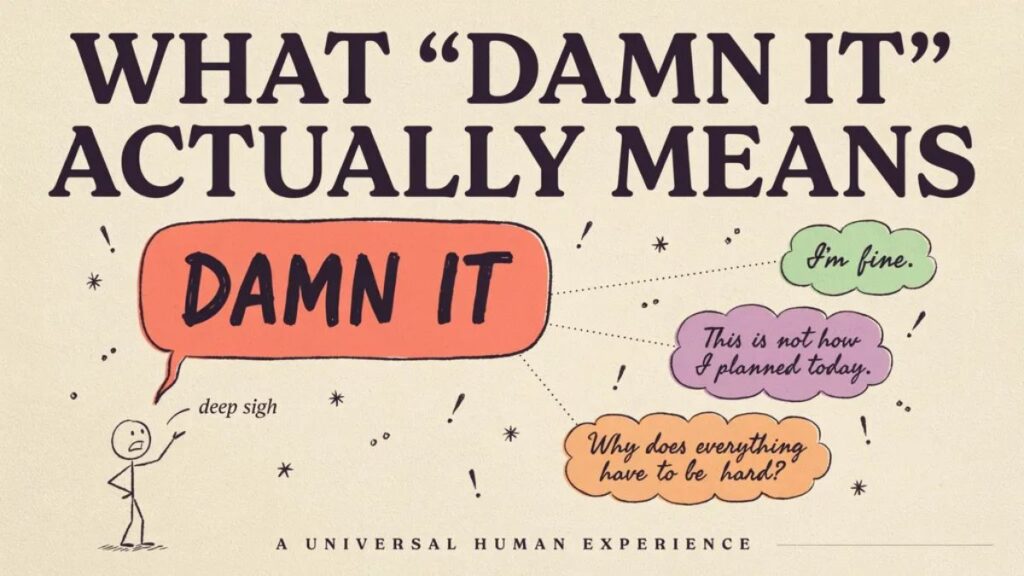
Damn it is a two-word verb phrase. Damn acts as the verb, and it acts as the object being cursed or condemned. Grammatically, it mirrors the original expression — wishing condemnation upon something. It’s more structured, more deliberate, and carries a slightly heavier emotional weight when written out in full.
Examples:
- Damn it all — nothing is working today.
- Damn it, I told you to call me first.
- He threw the wrench and said, “Damn it!”
The two-word form invites the reader to slow down slightly, which makes it useful in literary writing when you want the character’s frustration to feel calculated rather than reflexive.
Etymology and Evolution of Both Forms
Origins of “damn”
The word damn traces back to Middle English dampnen, which came from Old French damner, derived from the Latin damnare — meaning “to adjudge guilty, to doom, to condemn, blame, or reject.” The Latin root damnum meant “damage, hurt, harm; loss, injury.”
When damn first appeared in Middle English in the 14th century, it was used as a verb meaning to condemn. It wasn’t until the 16th century that the word began to be used as a profane exclamation.
How “damn it” shifted into an emotional outburst
Originally, damn it was literal — a direct command to condemn something. Over centuries, as religious language became more casual in everyday speech, the phrase shed its theological weight. By the 18th and 19th centuries, it had evolved into a general exclamation of irritation. The word and its derivatives were generally avoided in print from the 18th century to the 1930s — the famous line in the film version of Gone with the Wind was considered a breakthrough and required significant effort by the studio to include.
Why “dammit” emerged as a phonetic spelling
When people say damn it quickly, the space between the two words disappears entirely. The n in damn softens against the short i in it, and the whole phrase collapses into one beat: DAM-it. Merriam-Webster, Oxford, and Cambridge all recognize dammit as a flattened, informal version of damn it, used to express frustration.
The double m in dammit (rather than damnit) reflects how the word actually sounds. The n is dropped entirely in casual speech, making dammit the more phonetically accurate spelling.
Dictionary Recognition and Accepted Usage
Usage trends show dammit gaining significant ground in fiction, social media, and casual dialogue. Though still casual, it is considered milder than full-blown profanity.
Dammit is the correct and widely accepted spelling in modern American English. Damnit exists but is considered nonstandard and informal — most editors, teachers, and dictionaries prefer dammit.
Is “Dammit” a Bad Word? Levels of Offensiveness
Mild Offensiveness in Modern English
Dammit and damn it both sit in the category of mild profanity. They’re nowhere near as strong as major expletives, and most people in English-speaking cultures wouldn’t flinch at hearing either one in casual conversation.
What determines offensiveness?
Several factors shape how offensive the word feels in context:
- Audience: Friends vs. colleagues vs. elderly relatives
- Medium: A novel vs. a work email vs. a text message
- Tone: Muttered quietly vs. shouted during an argument
- Cultural background: In North America, dammit is generally viewed as a mild swear word used to express frustration, anger, or annoyance — and compared to stronger expletives, it is often seen as less offensive.
Where it’s usually acceptable
- Casual text messages and direct messages
- Fiction and creative writing (especially dialogue)
- Informal blog posts and personal essays
- Conversation among friends
Where it’s usually avoided
- Formal reports, academic writing, or legal documents
- Workplace communications
- Content for children or general audiences
- Public speeches and presentations
Why “Dammit” Exists: The Linguistic Mechanics
Phonetic spelling and American simplification
English has a long tradition of writing words the way they’re actually pronounced — especially in American English. Think of gonna for going to, wanna for want to, or kinda for kind of. Dammit follows the same pattern.
Why phonetics matter more in swear words
Expletives are emotional words. They’re not carefully enunciated — they’re expelled. When you stub your toe, you don’t stop to articulate the n in damn before adding it. You say it as one compressed burst. The phonetic spelling dammit captures that compressed, instinctive quality that damn it can’t fully replicate on the page.
Why “dammit” hits faster than “damn it”
Compare these two lines from a novel:
- “Damn it,” he said, slamming the door.
- “Dammit,” he said, slamming the door.
The second version feels faster, harder, more visceral. A single word reads as one emotional unit. The two-word version creates a tiny pause — a breath — between damn and it. That pause can feel deliberate and powerful in the right context, but in fast-paced dialogue, dammit wins every time.
Cultural Variations: American vs. British English
American English
Americans use dammit frequently in informal writing, dialogue, and casual speech. Editors swapped damn it for darn it through most of the 20th century, but over time, the real deal was embraced — dammit became everyday relief when things go sideways.
British English
British writers and speakers slightly favor the two-word damn it, especially in literary contexts. The contracted form exists in British usage but is less dominant than in American English.
Global Influence
American media — films, TV shows, social media — has pushed dammit into global awareness. Non-native English speakers in Pakistan, India, Australia, and beyond encounter it regularly through pop culture.
Grammar Guide: When to Use Each Form
Use “dammit” when:
- Writing casual dialogue in fiction or screenplays
- Expressing raw, spontaneous frustration
- Writing informal content like social media captions or blog posts
- You want the word to land as a single emotional punch
- The context is fast-paced and conversational
Use “damn it” when:
- Writing literary prose with a slower, more deliberate rhythm
- You want the phrase to carry structured grammatical weight
- The character or narrator is expressing controlled anger
- The writing is semi-formal and a single compound word feels too casual
- You want to emphasize both words separately for dramatic effect
Common Mistakes to Avoid
Mistake 1: Using “dammit” in formal writing
Dammit belongs in dialogue, creative writing, and casual content — not in reports, emails, or academic essays. If you’re writing professionally, replace it with neutral phrasing like “This is frustrating” or “Unfortunately, this didn’t work as planned.”
Mistake 2: Using “dammit” when the verb is meant literally
If you’re trying to say that someone is actually condemning something — as in a theological or literary sense — you need the two-word form: “Damn it to oblivion” uses damn as an active verb. Dammit can’t do that job.
Mistake 3: Using “damn it” when trying to capture emotional dialogue
In fast, heated dialogue, two words slow the reader down. If your character is reacting in a split second, dammit feels more authentic. Using damn it in rapid-fire exchanges can make the dialogue feel stiff.
Mistake 4: Confusing the meaning entirely
Neither dammit nor damn it means anything close to “I don’t care” or “forget it.” Both express frustration or condemnation. Don’t confuse them with similar-sounding phrases or use them as neutral filler words.
Real-Life Examples of Dammit vs. Damn It
Correct Use of “Dammit” (Interjection)
| Context | Example |
|---|---|
| Missed appointment | Dammit, the meeting started five minutes ago. |
| Spilled drink | She knocked over her coffee. “Dammit!” she said. |
| Forgot something | Dammit — I left my phone at home again. |
| Text message | Dammit, he cancelled again. |
Correct Use of “Damn It” (Verb + Object)
| Context | Example |
|---|---|
| Literary frustration | Damn it all — not a single thing went right today. |
| Emphatic command | Damn it, I need you to listen. |
| Deliberate anger | “Damn it,” she said slowly, staring at the broken vase. |
| Strong emphasis | Damn it to hell — this project has been cursed from day one. |
Case Study: Emotional Impact in Writing
Scenario: A character in a novel drops a glass of water.
Version A: The glass slipped from her fingers and shattered across the tile. “Dammit!” she snapped, already reaching for a towel.
Version B: The glass slipped from her fingers and shattered across the tile. “Damn it,” she said slowly, staring at the mess.
Version A reads as reflexive, instinctive. The single-word exclamation suggests she didn’t pause to think — the word just came out. Version B, with the two-word form and the slower action that follows, implies controlled irritation. She’s frustrated but composed. Same phrase. Entirely different emotional fingerprint.
Pop Culture Influence: Why “Dammit” Became Mainstream
Iconic moments using “dammit”
- Jack Bauer in 24 made “Dammit!” practically his catchphrase, using it as a high-intensity verbal signature across multiple seasons.
- In Spider-Man (2002), Peter Parker exclaims “Dammit!” after failing to stop a robbery.
- Countless song lyrics, sitcom scripts, and social media captions use dammit to communicate authentic, unfiltered human frustration.
Why pop culture chooses “dammit”
The single-word spelling is visually punchy. On screen, in subtitles, and in printed scripts, dammit takes up less space and reads faster — perfectly matching the urgency of the emotion it represents. Dammit vs. Damn It.
Alternatives to Dammit (Mild to Strong)
Mild
- Dang it — friendly and almost entirely inoffensive
- Shoot — a popular substitute in family-friendly contexts
- Rats — old-fashioned but effective
Medium
- Blast it — slightly British in flavor
- Ugh — modern, widely used
- For crying out loud — expressive without being crude
Strong
- Hell — short, sharp, still widely used
- Damn it all — stronger and more emphatic than either standard form
- Goddammit — considered more offensive than dammit because some religions view it as using the Lord’s name in vain
FAQs
What’s the real difference between “dammit” and “damn it”?
Dammit is a one-word interjection used informally; damn it is a two-word verb phrase that’s slightly more structured and deliberate. Same meaning, different grammatical roles and tones.
Is “dammit” considered offensive?
It’s classified as mild profanity. Most adults in English-speaking countries find it only slightly offensive — far less so than stronger expletives.
Can I use “dammit” in professional writing?
No. Keep it out of formal reports, business emails, and academic papers. Use neutral language in professional contexts.
Why is “dammit” spelled without a space?
Because it reflects how the phrase actually sounds when spoken quickly — the two words collapse into one phonetic unit: DAM-it.
Is one version more American than the other?
Americans use dammit more often, while Brits use damn it slightly more — though both forms appear everywhere.
Conclusion
Dammit and damn it are two faces of the same frustration. They come from the same linguistic root, carry the same core meaning, and often appear in the same heated moments. But they’re not identical. Dammit is fast, informal, and emotionally raw — a single-word punch built for dialogue and casual writing. Damn it is structured, deliberate, and slightly more formal — a two-word verb phrase that adds weight and control. Dammit vs. Damn It.
Knowing the difference won’t just improve your grammar. It’ll sharpen your writing, make your dialogue more authentic, and ensure you always land the emotional note you’re actually going for. Dammit vs. Damn It. Use the right one at the right moment — and your readers will feel it. Dammit vs. Damn It.