✨ Soo vs So: The Real Difference, Correct Usage, and Common Mistakes Explained Clearly 😊 means understanding which spelling is grammatically correct and when each form belongs in your writing. So is standard English. Soo is informal slang used online for emotional emphasis.
Most people write soo without realizing it is wrong. One small spelling mistake can damage your credibility instantly.
Knowing ✨ Soo vs So: The Real Difference, Correct Usage, and Common Mistakes Explained Clearly 😊 helps you write with confidence. So works in every context. Soo does not. This guide makes the difference simple, clear, and easy to remember.
Introduction: Why Soo vs So Confuses So Many People
Open any social media app right now and you’ll find sentences like “I am soo tired” or “That was soo good.” It looks normal. It feels natural. But is it actually correct English?
That question trips up thousands of learners every day — and even fluent speakers occasionally second-guess themselves. The confusion doesn’t come from grammar books. It comes from phones, group chats, Instagram captions, and comment sections where emotional expression often wins over grammatical accuracy.
This article gives you a direct, clear answer. You’ll learn what so really means, why soo exists, where each one belongs, and how choosing the right form instantly improves your writing. No vague explanations — just honest, practical guidance.
The Core Difference Between Soo and So
Here’s the clearest way to understand this:
| Feature | So | Soo |
|---|---|---|
| Standard English? | ✅ Yes | ❌ No |
| Found in dictionaries? | ✅ Yes (Oxford, Merriam-Webster, Cambridge) | ❌ Not in formal dictionaries |
| Used in formal writing? | ✅ Always acceptable | ❌ Never appropriate |
| Used informally? | ✅ Yes | ✅ Common in texts and social media |
| Purpose | Grammar + emphasis | Emotional exaggeration only |
The bottom line: so is correct English. Soo is an informal, nonstandard spelling created by digital culture to mirror spoken emphasis. One belongs in every writing context. The other belongs only in casual digital spaces — and even then, with full awareness that it isn’t grammatically correct.
What “So” Means in Standard English
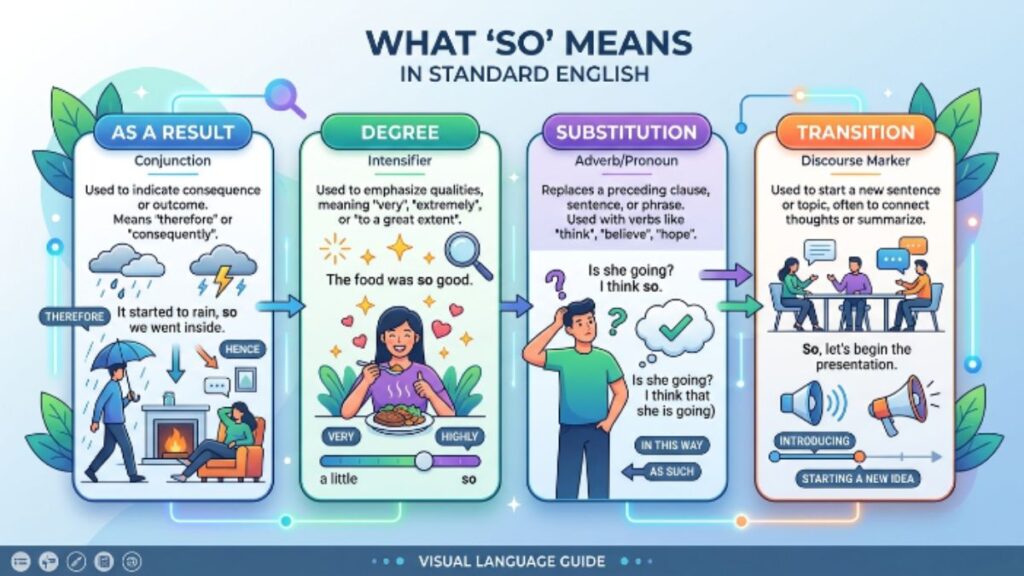
So is one of the most flexible and frequently used words in the English language. According to the Cambridge Dictionary, it functions as a degree adverb, a coordinating conjunction, and an intensifier — sometimes all three in the same paragraph. Its core job is to connect ideas, show results, and add weight to statements.
Merriam-Webster defines it as meaning “to such a great extent” when used as an adverb, and “and for this reason” when used as a conjunction. That dual role makes it so unusually powerful for a two-letter word.
Grammatical Roles of “So”
“So” as an Adverb
As an adverb, so modifies adjectives and other adverbs to indicate degree or extent. It answers the question: how much or to what extent?
- She is so talented.
- He runs so fast.
- I’m so tired today.
In each sentence, so tells you the level or intensity of the quality described. This is probably the most common role it plays in everyday English.
“So” as a Conjunction
As a conjunction, so connects two independent clauses where the second is the result or consequence of the first. This is the cause-and-effect function — and it appears constantly in both spoken and written English.
- It was raining, so we stayed inside.
- He studied hard, so he passed the exam.
- The meeting ran long, so they skipped lunch.
Notice the comma before so when it joins two full clauses. That’s standard punctuation practice in formal writing.
“So” as an Intensifier
Sometimes, so doesn’t just modify meaning — it amplifies emotional weight. This use sits between the adverb and pure emphasis functions:
- I’m so proud of you.
- That’s so unfair.
- The film was so unexpected.
The grammar stays perfectly correct here, even when the emotion behind the sentence runs high. This intensifier role is actually why people started writing soo — they wanted something that felt even stronger. But grammatically, so already does the job.
Common and Correct Uses of “So”
Showing Cause and Effect
This is so at its most logical. When one event leads directly to another, so makes the connection clean and clear:
- The server crashed, so the website went offline.
- She missed the bus, so she called a cab.
Showing Degree or Emphasis
When you want to highlight how much something is true:
- The exam was so difficult that nobody finished on time.
- He was so nervous before the speech.
Linking Ideas Naturally
In natural conversation and smooth writing, so acts as a bridge — moving one idea into the next without feeling forced or mechanical.
Everyday Examples of “So” in Context
Spoken English
Spoken English uses so constantly in all three roles:
- “Traffic was bad, so I left early.” (conjunction)
- “She’s so good at this.” (adverb/intensifier)
- “So, what happened next?” (discourse marker)
Written English
In essays, articles, and reports, so provides logical flow:
- “Sales declined in Q3, so the team revised its strategy.”
- “The results were so significant that further testing was ordered.”
Professional Writing
In emails, proposals, and business documents, so remains appropriate — especially in its conjunction role:
- “The deadline was moved forward, so all deliverables have been adjusted accordingly.”
Is “Soo” a Real Word? The Honest Answer
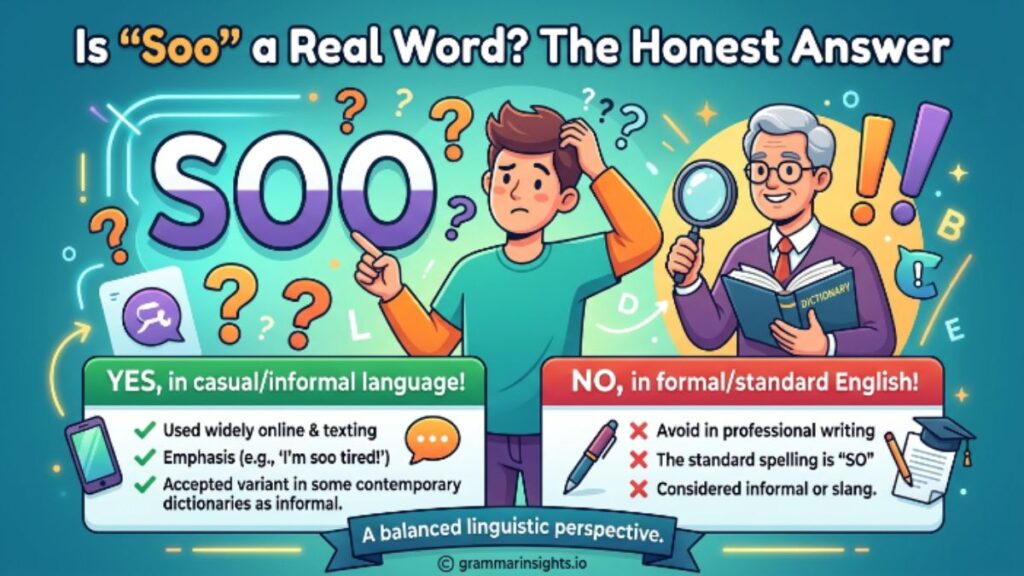
No. Soo is not a real English word in the standard grammatical sense. It does not appear in Oxford, Merriam-Webster, or Cambridge dictionaries as a valid spelling of so. Urban Dictionary acknowledges it as internet slang, which tells you exactly what category it belongs in.
There is one exception worth noting: Soo exists as a Korean given name, and it appears as a place name in certain regions. But as a replacement for the English word so? No dictionary supports it.
Some linguists note that if soo gains widespread enough use over time, it could eventually earn a dictionary entry — just as LOL and selfie did. But as of now, it has no grammatical standing.
Why People Write “Soo” Instead of “So”
Emotional Emphasis
When people speak, their voice rises, stretches, or speeds up to show emotion. Typing doesn’t offer those tools. So people compensate by stretching letters:
“I’m sooooo excited!”
That extra o is doing what a higher pitch or louder voice would do in a real conversation. It’s a written attempt at vocal expression.
Influence of Digital Culture
Platforms like Twitter, TikTok, and WhatsApp reward expressive, personality-driven language. In these spaces, soo signals informality, enthusiasm, and authenticity. It became part of internet dialect — normalized through repetition, not through grammar rules.
Speed Over Precision
Fast typing naturally invites creative spelling. When the goal is tone and speed rather than accuracy, nonstandard forms slip in without much thought. Most writers who use soo know it’s informal — they’re simply prioritizing feel over correctness in that moment.
Where “Soo” Actually Appears in Writing
Common Places Soo Appears
- Social media captions and comments
- Text messages between friends
- Online forums and Reddit threads
- Casual blog comments
- Fan fiction and creative online writing
- TikTok and Instagram captions
In all of these spaces, expressive tone takes priority. Readers in these contexts understand soo as intentional emphasis — not as a spelling error. But the moment the audience changes, the rules change too.
Soo vs So in Formal and Informal English
Formal Writing and Professional Communication
In any formal context, so is the only correct choice. This includes:
- Academic essays and research papers
- Business emails and reports
- Job applications and cover letters
- News articles and journalism
- Legal documents
Using soo in any of these settings signals either carelessness or a lack of awareness about register. It undermines credibility immediately.
Informal Writing and Casual Conversation
In casual texting, social media, and friendly emails, soo is widely understood and commonly used. However, even in these contexts, it’s still technically nonstandard. Writers who use it are making a deliberate stylistic choice — not following grammar rules.
The safe rule: if you wouldn’t write it in a work email, don’t write it in a context where your writing will be judged or evaluated.
When You Should Always Use “So” Instead of “Soo”
Use so — without question — in these situations:
- Any academic or professional writing
- Articles, blog posts, and web content
- Formal emails and business communication
- School or university assignments
- Grammar tests or language exams
- Any context where credibility matters
When “Soo” Might Be Acceptable (With Caution)
Acceptable Situations
Soo can appear without major consequences in:
- Text messages to close friends
- Personal social media posts
- Humorous or deliberately casual captions
- Creative writing that intentionally mimics online speech
Even here, you’re bending the rules — not following them. Always do so consciously.
Common Mistakes and Misunderstandings
Mistake: Thinking “soo” is an alternative spelling
It isn’t. There is no grammar rule that makes soo an acceptable alternate form of so. Native speakers who use it online know it’s informal — learners who use it in formal writing usually don’t realize the difference.
Mistake: Using “soo” in professional writing
This is the most damaging error. A single soo in a job application, business email, or published article signals poor proofreading and weak language awareness. It’s an easy fix with a high impact.
Mistake: Confusing emphasis with correctness
More letters don’t mean more correctness. Soo feels stronger expressively, but so is always grammatically superior. If you need extra emphasis in formal writing, use adverbs like extremely, incredibly, or remarkably instead.
Real Examples: Soo vs So Side by Side
| Context | ❌ Avoid | ✅ Use Instead |
|---|---|---|
| Professional email | “I am soo sorry for the delay.” | “I am so sorry for the delay.” |
| Academic writing | “The results were soo surprising.” | “The results were remarkably surprising.” |
| Social media post | “I’m soo excited for this!” | Acceptable in casual posts |
| Text to a friend | “That was soo funny!” | Understood, but still informal |
| Blog article | “This tip is soo useful.” | “This tip is incredibly useful.” |
Why Choosing “So” Over “Soo” Improves Your Writing
Every word choice sends a signal about the writer. Choosing so over soo consistently communicates three things:
- You understand register — you know when formal language is required.
- You follow grammar standards — your writing is reliable and accurate.
- You respect your reader — you’re not sacrificing clarity for casual flair.
Strong writing isn’t about sounding stiff. It’s about making the right choices for the right context. So gives you that flexibility. Soo doesn’t.
FAQs
Is “soo” a real English word?
No. Soo is not recognized as a standard English word by major dictionaries like Oxford, Cambridge, or Merriam-Webster. It is informal internet slang used for emotional emphasis in casual digital writing.
What does “so” mean in English?
So is a standard English word that functions as an adverb, conjunction, and intensifier. It shows degree (“so tired”), cause and effect (“It rained, so we stayed in”), and emotional emphasis (“I’m so proud of you”).
When should I use “so” instead of “soo”?
Always use so in formal, professional, and academic writing. Use so any time grammatical accuracy matters — which includes blog articles, business emails, essays, and official communication of any kind.
Why do people spell “so” as “soo”?
People write soo to mimic the way they’d stretch the word in spoken conversation when expressing strong emotion. Digital culture — especially social media and texting — normalized this expressive spelling as a way to convey tone in writing.
Can “soo” ever be used in formal writing?
No. Soo has no place in formal, professional, or academic writing under any circumstances. It signals informality and, in a formal context, reads as a spelling mistake that reflects poorly on the writer.
Conclusion
✨ Soo vs So: The Real Difference, Correct Usage, and Common Mistakes Explained Clearly 😊 comes down to one simple truth. So is correct English. Soo is informal slang. Always use so in formal, professional, and academic writing. Soo vs So.
✨ Soo vs So: The Real Difference, Correct Usage, and Common Mistakes Explained Clearly 😊 shows that small word choices matter. So works everywhere. Soo works only in casual texts. Choose so to sound confident, credible, and grammatically correct every time.