If you’ve ever paused mid-sentence and wondered whether to write disloyal or unloyal, you’re in good company. Both words appear to describe the same thing — a lack of loyalty — yet only one belongs in standard English writing. Disloyal vs Unloyal. The confusion is understandable, but the answer is clear. This guide breaks down the real difference between disloyal and unloyal, explains the grammar behind each, and helps you choose the right word every time.
Why Confusion Between Disloyal and Unloyal Exists
English loves prefixes. We say unhappy, unkind, unfair — so the brain naturally extends that pattern to unloyal. It feels logical. The problem is that English doesn’t run on pure logic; it runs on history, habit, and usage patterns that have solidified over centuries.
The prefix un- works beautifully with hundreds of adjectives. But loyal is one of those words that took a different path. It bonded with dis- instead, and that pairing became so dominant that unloyal never gained a foothold in mainstream English. Learners and even native speakers get caught in this trap because the pattern looks familiar — it just doesn’t apply here.
What Disloyal and Unloyal Actually Mean
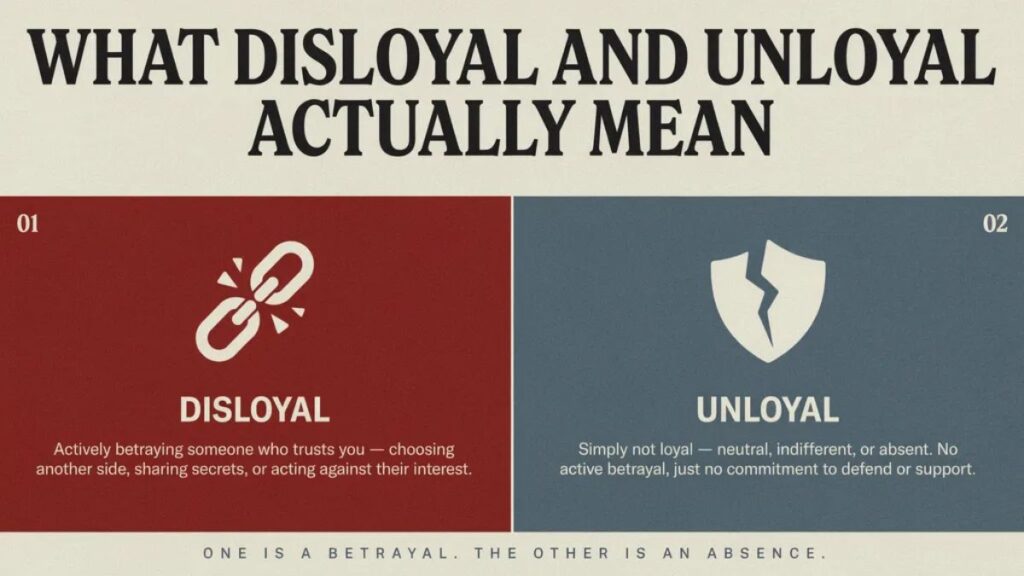
At their core, both words describe a person or behavior that lacks loyalty. But there is a meaningful difference in emotional weight and connotation.
Disloyal — Meaning and Emotional Weight
Disloyal means actively betraying trust, allegiance, or duty. The word carries moral weight. When you call someone disloyal, you’re not simply noting an absence — you’re making a judgment about intentional behavior. The word originates from Middle English, derived from the Old French desloial, meaning faithless or treacherous. That heritage gives it a sharp, serious edge.
Common contexts include:
- A soldier who shares classified information with the enemy
- A business partner who secretly works with a competitor
- A friend who spreads private information behind your back
- An employee who undermines their organization from within
In each case, the disloyalty involves a deliberate action against trust — not just a passive lack of commitment.
Unloyal — Meaning and Linguistic Status
Unloyal uses the prefix un-, which simply means “not.” In theory, it translates to “not loyal,” but without the active, morally charged implication that disloyal carries. It reads as descriptive rather than accusatory.
The Oxford English Dictionary does list unloyal with the earliest recorded use dating back to 1576 — so it has a real history. However, it has been classified as rare and nonstandard in modern usage. You will rarely encounter it in professional writing, journalism, academic papers, or even everyday conversation.
Disloyal vs Unloyal at a Glance
| Feature | Disloyal | Unloyal |
|---|---|---|
| Standard English? | ✅ Yes | ❌ Nonstandard |
| In major dictionaries? | ✅ Yes | ⚠️ Rare/archaic |
| Implies active betrayal? | ✅ Yes | ❌ No |
| Emotional weight | High | Low |
| Used in formal writing? | ✅ Always | ❌ Almost never |
| Prefix origin | dis- (Latin/French) | un- (Old English) |
| Google search frequency | Very high | Very low |
Why Disloyal Works and Unloyal Doesn’t
The answer comes down to how English prefixes function — and which ones have historically bonded with specific words.
How the Prefix “Dis-” Functions
The prefix dis- comes from Latin and Old French. It doesn’t just mean “not” — it implies opposition, reversal, or active separation from something. Consider how it works in other common words:
- Dishonest — not just lacking honesty, but actively deceiving
- Disobedient — not just lacking obedience, but actively refusing
- Disloyal — not just lacking loyalty, but actively betraying it
This prefix pairs naturally with words that carry ethical or moral content. Loyalty is a moral quality, which is why dis- fits it so well. The word conveys action and intent — not passive absence.
Why “Un-” Falls Short With Loyal
The prefix un- is a neutral negation tool. It works well with adjectives that describe qualities or states:
- Unhappy → not in a state of happiness
- Uncertain → not in a state of certainty
- Unkind → not exhibiting kindness
When you apply un- to loyal, the word technically forms — but it produces a softer, emptier meaning. It says “not loyal” without saying why or how. That emotional flatness makes it feel incomplete when describing something as serious as betrayal of trust.
More importantly, English speakers historically chose disloyal and repetition over centuries, which is how words become standard. Unloyal simply never got that traction.
How Native Speakers Actually Use These Words
If you analyzed millions of books, articles, and news sources, you would find an overwhelming imbalance. Disloyal appears constantly — in courtroom reports, political commentary, business disputes, and personal essays. Unloyal is nearly invisible.
Why Disloyal Dominates Modern English
Native speakers instinctively reach for disloyal because:
- They’ve encountered it repeatedly since childhood
- It appears in every major dictionary as the primary entry
- It carries exactly the emotional tone needed to describe betrayal
- Editors and writing guides consistently use and recommend it
Language is learned through exposure, and exposure to disloyal is exponentially greater than exposure to unloyal.
Why Unloyal Rarely Appears
Pop culture offers a few exceptions. Singer Summer Walker released a song titled Unloyal in 2021, which introduced the word to a new audience. In casual social media speech, unloyal occasionally surfaces — usually as an emphatic synonym for “they betrayed me.” But these informal uses don’t elevate the word to standard status. They simply reflect how digital communication bends grammar in creative directions.
Outside of casual or artistic contexts, unloyal remains largely absent from professional, editorial, or academic English.
Is Unloyal Grammatically Incorrect?
This is where many sources get it wrong. Unloyal is not technically a grammatical error — the prefix un- is valid, and the construction follows standard word-formation rules. However, grammar and usage are two different things.
A word can be grammatically constructed and still be considered nonstandard, awkward, or inappropriate for formal writing. Unloyal passes the grammar test but fails the usage test. Most major dictionaries either exclude it entirely or label it as rare. Style guides and editorial standards consistently prefer disloyal.
So while unloyal won’t get a red underline from every grammar checker, it will mark your writing as informal, unusual, or imprecise in professional contexts.
Nuance Matters More Than Rules
Language isn’t just about what’s technically allowed — it’s about what communicates most clearly and naturally to your reader.
When Disloyal Is the Only Correct Choice
Use disloyal any time you want to:
- Describe deliberate betrayal of trust
- Write professionally, formally, or academically
- Convey moral judgment about someone’s behavior
- Ensure your reader immediately understands what you mean
- Avoid sounding unnatural or archaic
Why Unloyal Rarely Fits
Even in casual speech, unloyal sounds off to most native English ears. It lacks authority. It communicates uncertainty rather than conviction. In a sentence where you mean to express betrayal, disappointment, or broken trust, the word simply doesn’t carry the weight the situation demands.
Disloyal vs Unloyal in Real Sentences
Seeing both words in context makes the difference obvious.
Natural Examples Using Disloyal
- “The general was court-martialed for his disloyal conduct during the mission.”
- “She felt deeply hurt when her closest friend proved to be disloyal.”
- “The company terminated the contract after discovering disloyal behavior from the vendor.”
- “In politics, being labeled disloyal can end a career overnight.”
Why Unloyal Feels Wrong in Context
Now compare:
- “The general was court-martialed for his unloyal conduct.” — sounds vague and awkward
- “She felt hurt when her friend proved to be unloyal.” — reads as informal and imprecise
The meaning is technically present, but the tone fails. Unloyal doesn’t carry the weight these sentences require. Native readers will notice something feels off, even if they can’t pinpoint the exact reason.
Cultural Influence on Loyalty Language
Loyalty is a concept loaded with cultural meaning. In American English, disloyal resonates because it implies active violation — a decisive, judgmental word for a decisive moral failing. British English shares this preference equally. The word crosses regional dialects without losing its power.
Across literature, politics, military history, and business writing, disloyal appears as the standard term because it reflects how these cultures define and discuss betrayal. Trust violations are seen as active choices, not passive states. The language mirrors that worldview.
Professional Writing and Editorial Standards
What Style Guides Implicitly Prefer
No major style guide — not AP, Chicago, MLA, or APA — endorses unloyal as a preferred term. While they don’t always explicitly address this comparison, their usage examples and recommended vocabulary consistently feature disloyal. Editors in publishing, journalism, and corporate communications follow this implicit consensus without exception.
If you submit professional content using unloyal, expect a revision. Not because it’s grammatically illegal, but because it signals a gap in standard usage knowledge — and professional writing demands precision.
SEO Reality: Why “Unloyal” Still Gets Searched
Despite being nonstandard, unloyal generates genuine search volume. Why? Because millions of English learners and even native speakers have the same doubt you had. They hear or read unloyal in a casual context — a social media post, a song, a conversation — and want to verify whether it’s correct.
This search behavior is legitimate, and answering it clearly is valuable. The answer remains: use disloyal. It is the correct, accepted, and professional choice in every context.
Spellcheckers Can Mislead You
Here’s a warning worth noting: not all spellcheckers will flag unloyal as an error. Some tools accept it without comment, which can give the false impression that both words are equally valid. This is a limitation of automated tools, not evidence that unloyal is standard.
Grammar tools like Grammarly may or may not highlight it depending on context and settings. Always rely on your understanding of standard usage rather than assuming that a passed spellcheck means a word is professionally appropriate.
Quick Decision Guide for Writers
Use Disloyal When:
- Describing someone who has betrayed trust or broken allegiance
- Writing in a formal, professional, or academic context
- You want your message to carry emotional and moral weight
- You’re writing for publication, business, or official communication
- You want language that every reader will immediately recognize
Avoid Unloyal When:
- Writing anything that will be published, graded, or professionally reviewed
- Your audience expects standard English usage
- The context involves serious accusations, legal matters, or formal documentation
- You want to sound fluent and confident in English
FAQ’s
What is the difference between disloyal and unloyal?
Both words mean “not loyal,” but disloyal implies active betrayal and is the standard form in modern English, while unloyal is a rare, nonstandard alternative with softer connotations and almost no usage in formal writing.
Is unloyal a real English word?
Technically, yes — the Oxford English Dictionary records it from as early as 1576. However, it is classified as rare and nonstandard in modern usage, which means it is not appropriate for formal or professional writing.
Why is disloyal more common than unloyal?
Disloyal became standard because the prefix dis- naturally combines with morally charged words like loyal, and centuries of consistent usage cemented it as the accepted form. Unloyal simply never gained the same traction.
Can unloyal be used in professional writing?
No. Professional and editorial standards consistently prefer disloyal. Using unloyal in a formal document, publication, or business communication is considered nonstandard and may signal imprecise language use.
Is disloyal a stronger word than unloyal?
Yes. Disloyal carries stronger emotional and moral weight because the dis- prefix implies active opposition or betrayal — not just absence. Unloyal reads as more neutral and descriptive, making it feel weaker in contexts where betrayal is the actual concern.
Conclusion
The debate between disloyal and unloyal has a clear winner: disloyal. It is the standard, widely accepted, emotionally precise term for describing a failure of loyalty. Disloyal vs Unloyal. It has centuries of usage behind it, appears in every major dictionary, and is the word every editor, teacher, and professional writer will reach for without hesitation. Disloyal vs Unloyal.
Unloyal exists — but it lives on the edges of the language. You may encounter it in casual speech or creative contexts, but it doesn’t belong in formal writing. Disloyal vs Unloyal. When loyalty is broken, English reaches for disloyal. So should you. Disloyal vs Unloyal.