If you’ve ever typed the phrase to early without a second thought, you’re in good company. It’s one of the most common spelling slip-ups in everyday English — from casual texts to professional emails. Too Early vs To Early. Both versions sound the same when spoken, so the mistake often slips right past us. But in writing, only one is correct. This guide breaks down the grammar behind “too early” vs “to early,” explains why the confusion happens, and gives you practical tools to get it right every single time.
Why “To” vs “Too” Causes So Much Confusion
English is full of homophones — words that sound identical but have completely different meanings and grammatical roles. “To” and “too” are among the most frequently confused pairs in the language.
Here’s why this specific mix-up is so persistent:
- They sound the same. In spoken English, both words are often reduced to a quick “tuh” sound, giving listeners no clue which spelling is intended.
- Visual habit. Because “to” appears far more often in writing than “too,” our fingers tend to default to the shorter form.
- Fast typing. In an age of texting and quick emails, proofreading often takes a back seat.
- Autocorrect blind spots. Spellcheckers flag misspelled words but rarely catch misused homophones since both forms are real English words.
Understanding the distinct jobs these two words perform in a sentence is the key to eliminating the error permanently.
What “To” Really Means in English Grammar
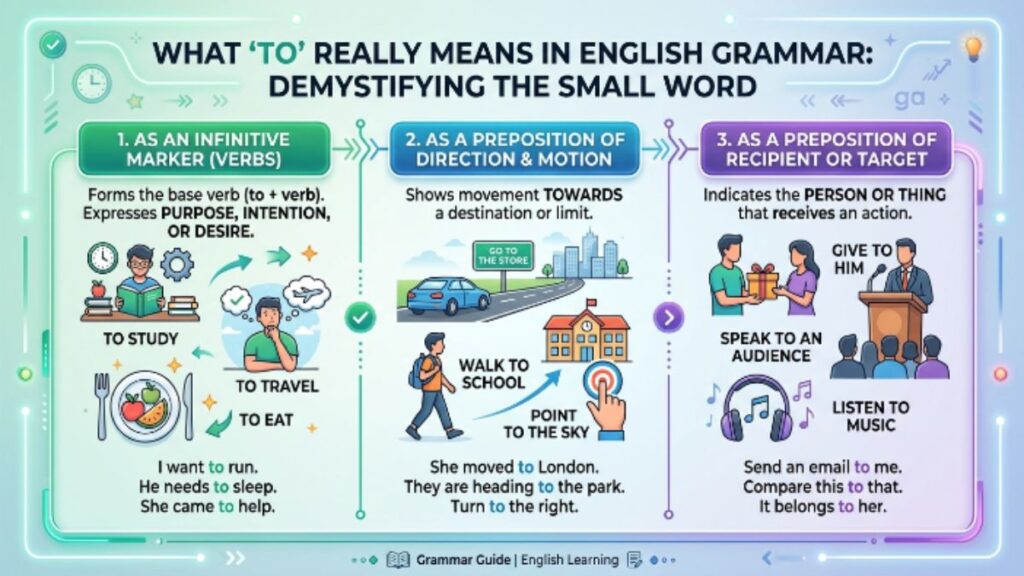
The word “to” is one of the most versatile words in English. It wears two major hats:
“To” as a Preposition
As a preposition, “to” shows direction, destination, or relationship between words.
- She walked to the store.
- Hand the report to your manager.
- We drove to the airport.
In every case, “to” connects a verb or noun to something else. It doesn’t describe degree or intensity — it simply points.
“To” as Part of an Infinitive Verb
The second role of “to” is as an infinitive marker — the word that comes before the base form of a verb.
- I need to sleep.
- She wants to leave early.
- They decided to cancel the meeting.
Notice what follows “to” in every example: a verb. That’s the rule. When “to” precedes an adjective or adverb (like “early”) with no verb attached, it breaks the grammatical structure entirely.
What “Too” Really Means (And Why It Changes Everything)
“Too” is a completely different word with a completely different job. It functions as an adverb of degree — meaning it modifies adjectives and other adverbs to show excess or intensity.
“Too” as an Adverb of Degree
Think of “too” as a way of saying more than necessary or beyond what is acceptable.
- The coffee is too hot to drink. (excessively hot)
- He drives too fast. (more than is safe)
- You arrived too late. (later than was appropriate)
In each case, “too” adds a layer of judgment — it signals that a threshold has been crossed.
“Too” to Show Agreement
“Too” also has a second meaning: it can mean “also” or “as well.”
- I want to come too.
- She enjoyed the movie, and I did too.
This meaning is distinct from the degree sense, but both confirm that “too” is always an adverb — never a preposition, and never an infinitive marker.
The Core Idea
| Word | Part of Speech | Primary Function | Example |
|---|---|---|---|
| to | Preposition / Infinitive marker | Shows direction or precedes a verb | She went to the office. |
| too | Adverb | Shows excess/degree or means “also” | She left too early. |
The moment you need to modify an adjective or adverb — including “early” — “too” is the only option.
Breaking Down the Phrase “Too Early”
Literal Meaning of “Too Early”
“Too early” is a simple two-word phrase in which “too” modifies the adverb/adjective “early.” Together, they mean earlier than is necessary, suitable, or expected.
- We arrived too early — the doors were still locked.
- She called too early in the morning.
- The product launched too early, before testing was complete.
In every case, “too” strengthens “early” and signals that the timing went past an acceptable limit.
Figurative Meaning of “Too Early”
“Too early” isn’t always about the clock. English also uses it in abstract, figurative contexts to mean premature or before the right conditions exist.
- It’s too early to make a decision.
- The data shows it’s too early to declare a winner.
- She felt it was too early in their relationship to talk about that.
Here, “early” doesn’t refer to morning or a specific hour — it refers to a state of readiness or completeness. The grammar rule is the same: “too” modifies “early,” and the phrase conveys excessiveness.
Why “To Early” Is Incorrect in Standard Grammar
Why “To Early” Fails Grammatically
Let’s be direct: “too early” is always a grammatical error in standard English. Here’s the structural reason:
- “To” (as a preposition) needs a noun or pronoun as its object: to the store, to him, to work.
- “To” (as an infinitive marker) needs a verb: to run, to decide, to leave.
- “Early” is neither a noun nor a verb. It’s an adverb/adjective.
Therefore, “to” has no valid grammatical role when placed directly before “early.” The construction collapses. You wouldn’t write “to hot” or “to tall” — and the same logic applies here.
Sentence Breakdown Example
Let’s compare both versions side by side using the same sentence:
❌ It’s to early to go to bed.
In this version, “to” has no grammatical function before “early.” The sentence is broken.
✅ It’s too early to go to bed.
Here, “too” modifies “early” (signaling excess), and the second “to” is an infinitive marker before “go.” Two different words, two different jobs — both working correctly.
Common Slip-Ups Writers Actually Make
Even experienced writers fall into these traps. Too Early vs To Early. Here are the most frequent errors seen in blogs, social posts, and emails:
- ❌ Sorry I’m to early.
- ❌ It’s to early to make that call.
- ❌ We got there to early.
- ❌ To early for this conversation.
All of these need “too” — because in each case, the word signals excess or premature timing.
Practical Examples: “Too Early” vs “To Early”
Correct Uses of “Too Early”
| ✅ Correct | ❌ Incorrect |
|---|---|
| It’s too early to judge. | It’s to early to judge. |
| He woke up too early. | He woke up to early. |
| We arrived too early for the event. | We arrived to early for the event. |
| It’s too early in the season. | It’s to early in the season. |
| Too early to celebrate. | To early to celebrate. |
When “To” Appears Near “Early” (Correctly)
Confusion deepens when “to” legitimately appears in the same sentence as “early” — but as an infinitive marker before a verb, not before “early” itself.
- ✅ She woke up early to study for the exam.
- ✅ He arrived early to get a good seat.
- ✅ They left early to beat traffic.
In each example, “to” connects to the verb that follows (study, get, beat), not to “early.” The structure is completely correct.
Advanced Cases: When “Too” and “To” Appear Together
“Too Early to + Verb” Explained
One of the most common and useful constructions in English combines both words in the same phrase:
- ✅ It’s too early to tell.
- ✅ It’s too early to know the results.
- ✅ It was too early to make any promises.
The structure is: too + adjective/adverb + to + verb. This is a standard English pattern that expresses the idea that a degree of something prevents an action. “Too” does its job (modifying “early”), and “to” does its job (introducing the infinitive verb that follows).
Insights from Grammar Experts and Style Guides
There is zero disagreement among grammar authorities on this point. Major English style guides — including The Chicago Manual of Style, Garner’s Modern English Usage, and Merriam-Webster’s usage guides — consistently classify “to” and “too” as distinct parts of speech with non-interchangeable functions.
The rule is universal: “too” modifies adjectives and adverbs; “to” never does. No dialect, register, or context changes this in standard written English. Too Early vs To Early.
Quick Reference Table: “To” vs “Too” with “Early”
| Scenario | Correct Word | Example |
|---|---|---|
| Describing excess timing | too | It’s too early for this. |
| Modifying an adjective | too | Too early to decide. |
| Before a verb (infinitive) | to | She left early to beat traffic. |
| Combined structure | too…to | Too early to tell. |
| Showing direction/destination | to | I walked to the office. |
Memory Tricks That Actually Work
The “Extra O” Rule
Think of the extra “O” in “too” as standing for “over” — over the limit, over the acceptable amount, excessive.
- too = over the limit → too much, too hot, too early
- to = direction or verb connector only
The Verb Test
Ask yourself: Is there a verb immediately following this word?
- I want to go. → ✅ Verb follows → use “to”
- It’s ___ early. → No verb follows “early” → use “too“
Replace Test
Swap the word with “very” or “excessively.” If the sentence still makes sense, you need “too.”
- It’s very early. → ✅ Makes sense → use “too early” ✅
- She walked very the store. → ❌ Makes no sense → use “to” ✅
Common Errors and How to Avoid Them
| Common Mistake | Correction | Explanation |
|---|---|---|
| It’s to early. | It’s too early. | “Too” modifies “early” |
| I woke up to early. | I woke up too early. | Excess degree, not direction |
| To early to say. | Too early to say. | “Too” signals prematurity |
| We’re to early. | We’re too early. | Describing excess timing |
Pro tip: Before publishing any piece of writing, do a quick search for “to early” and replace every instance with “too early.” Your writing will instantly look more polished.
FAQ’s
What is the correct phrase: “to early” or “too early”?
“Too early” is always correct. “To early” is a grammatical error in standard English because “to” cannot modify an adjective or adverb.
Why is “too early” correct in English grammar?
Because “too” is an adverb of degree that modifies adjectives and adverbs — including “early.” It signals that something is beyond the appropriate or expected limit.
Can “to” ever be used before “early”?
Not directly. However, “to” can appear in the same sentence as “early” when it introduces an infinitive verb: She arrived early to prepare the room. Here, “to” connects to “prepare,” not “early.”
Are “to” and “too” homophones?
Yes. Both words are pronounced identically (like “two”), which is the main reason the confusion persists in writing. Context and grammar function — not sound — determine which one to use.
Is it “too early to tell” or “to early to tell”?
It is always “too early to tell.” Here, “too” modifies “early” (showing prematurity), and the second “to” is an infinitive marker before “tell.” Both words appear in the phrase, but each has a distinct and different role.
Final Thoughts
The difference between “too early” and “to early” isn’t just a minor spelling quirk — it’s a fundamental grammar distinction that affects the clarity and credibility of your writing. “Too” is an adverb that signals excess; “to” is a preposition or infinitive marker. Too Early vs To Early. Only “too” can modify “early,” making “too early” the only correct form in standard English.
The next time you’re tempted to write “to early,” pause and ask: Am I describing excess timing? If yes — and when talking about this phrase, the answer is always yes — reach for “too.” Too Early vs To Early. One extra letter makes all the difference. Too Early vs To Early.