“Me too,” “me as well,” and “I as well” are three English expressions used to show agreement, but they are not equal. Me Too vs Me as Well vs I as Well. Each carries a different tone, level of formality, and grammatical rule that distinguishes correct usage from common mistakes.
Most people say “me too” without a second thought, yet switch to “I as well” when trying to sound educated — and that’s exactly where the error happens. One small pronoun swap can make fluent English sound broken.
Understanding the difference unlocks smoother, more confident communication in every setting — from casual texts to professional emails — because choosing the right phrase signals true command of the English language.
Introduction — Why “Me Too vs Me as Well vs I as Well” Confuses People
You’ve probably said “Me too” hundreds of times without thinking twice. But then someone says, “Me as well,” and suddenly you wonder — are they the same? And what about “I as well”? Should that even be used at all?
These three expressions all seem to convey agreement, but they are not interchangeable. They differ in tone, formality, and — most importantly — grammatical correctness. English learners and even native speakers often mix them up, especially because casual spoken English tends to drop words that strict grammar would require.
Here’s the short answer: “Me too” is casual and correct. “Me as well” is slightly more formal and also correct. “I as well” on its own is grammatically incorrect and should be avoided — unless a verb is added after “I.”
This guide breaks down each expression with real examples, side-by-side comparisons, and practical case studies so you can use the right phrase every time.
“Me Too”: Meaning, Tone & Correct Usage
What “Me too” Actually Means
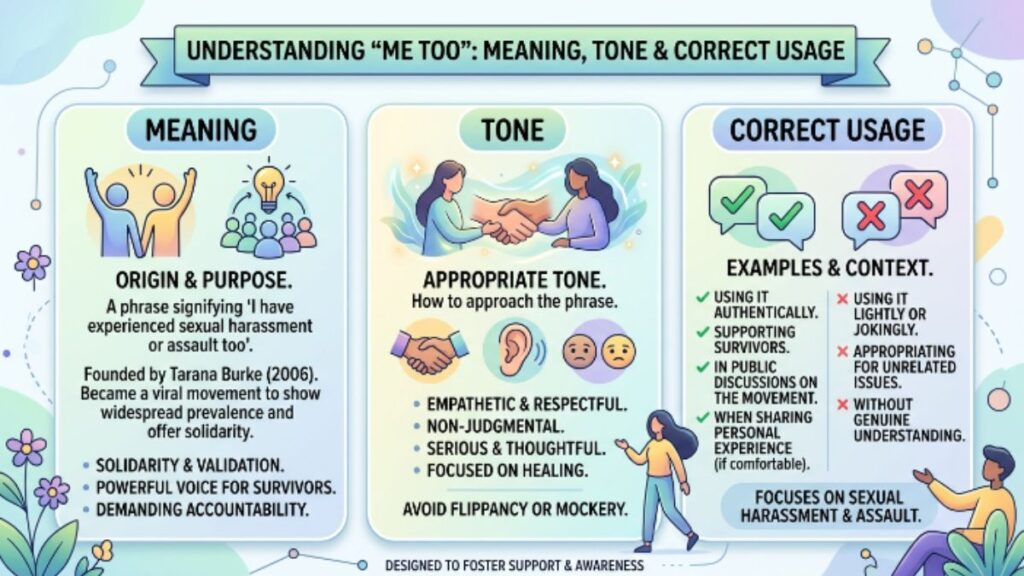
“Me too” is a short, punchy expression used to show that you share the same feeling, opinion, or experience as someone else. Linguists refer to it as an elliptical expression — meaning it’s a shortened version of a fuller sentence where the implied words are dropped because the meaning is already clear.
For example:
- Full sentence: “I feel the same way too.”
- Shortened: “Me too.”
Even though “me” is technically an object pronoun (and some strict grammarians would prefer “I do too”), the phrase is universally accepted in everyday English because the meaning is perfectly obvious.
One important rule: “Me too” only works with positive statements. For negative ones, you need “Me neither.”
- ❌ “I don’t enjoy working late.” → “Me too.” (Wrong)
- ✔ “I don’t enjoy working late.” → “Me neither.” (Correct)
Why “Me too” Works as a Standalone Response
The reason “Me too” functions as a complete reply on its own comes down to how spoken English works. Native speakers routinely drop repeated or obvious information to keep conversations flowing naturally. This is called ellipsis, and it’s a normal feature of everyday speech.
When someone says “I love hiking,” and you respond “Me too,” everyone understands you mean “I love hiking too.” The full meaning is preserved even without spelling it all out. That’s why “Me too” feels instant, natural, and effortless — because it is.
Examples of “Me too” in Real Conversations
Here are practical examples of “Me too” used correctly:
- “I’m starving.” → “Me too!”
- “I love that new Netflix show.” → “Me too!”
- “I’m nervous about the presentation.” → “Me too.”
- “I wish it were Friday already.” → “Me too.”
- “I’ve been thinking about the same thing.” → “Me too.”
Short. Natural. Direct. No extra words needed.
Formality Level of “Me too”
“Me too” is considered informal or casual. It’s perfectly fine in:
- Text messages and social media comments
- Everyday conversations with friends or family
- Casual workplace chats
- Classroom discussions
In very formal writing — like a business report or an academic paper — you’d want to opt for a more complete sentence such as “I agree,” “I share that view,” or “I do as well.”
“Me as Well”: Meaning, Tone & Correct Usage
What “Me as well” Means
“Me as well” carries essentially the same meaning as “Me too” — it expresses agreement or shared experience. The key difference is tone. “Me as well” sounds slightly more polished, calmer, and more formal, making it a better fit for professional or semi-formal situations.
Like “Me too,” it uses the object pronoun “me,” which is grammatically appropriate because the verb typically comes before it in a full sentence (e.g., “It helped me as well”). As a standalone response, it functions similarly to “Me too” but with a smoother, more neutral register.
When “Me as Well” Is the Better Choice
Situations Where It Fits Perfectly
Choose “Me as well” when:
- You’re in a professional or semi-formal setting (meetings, emails, work calls)
- You want to sound polite but not stiff
- The conversation calls for a slightly elevated tone without going full formal
- You’re responding to something that has an emotional or calm weight to it
It’s common in British English but widely understood and used in American English too.
Examples of “Me as well” in Polite Sentences
- “I’d love to attend that conference.” → “Me as well.”
- “I think we need more time to review this.” → “Me as well.”
- “I enjoyed working with your team.” → “Me as well, it was a great experience.”
- “She plans to join the project.” → “Me as well.”
- “I found the training session very helpful.” → “Me as well.”
Notice how these responses feel more measured and professional compared to “Me too.”
Comparison: “Me too” vs “Me as well”
| Feature | Me too | Me as well |
|---|---|---|
| Formality | Informal / Casual | Semi-formal / Polite |
| Common Setting | Friends, social media, texts | Work, emails, polite conversation |
| Tone | Energetic, spontaneous | Calm, measured |
| Grammatical correctness | Accepted (elliptical) | Correct (object pronoun) |
| Used in British English? | Yes | Yes (more common) |
| Used in American English? | Yes (very common) | Yes |
| Can stand alone? | Yes | Yes |
Both are correct. The choice comes down to context and the level of formality you want.
“I as Well”: Why It’s Grammatically Incorrect
The Grammar Problem Behind “I as well”
Here’s where many learners stumble. “I as well” feels correct — after all, “I” sounds more formal and proper, right? But that intuition leads to a grammatical error.
The problem is this: “I” is a subject pronoun. When used with “as well,” it must be followed by a verb. Without a verb, the sentence is structurally incomplete.
Compare:
- ✔ “I do as well.” (subject + verb + “as well” — correct)
- ✔ “I am as well.” (subject + verb + “as well” — correct)
- ❌ “I as well.” (subject + “as well,” no verb — incorrect)
“Me,” on the other hand, is an object pronoun. It doesn’t need a verb directly attached to it in the same way, which is why “Me too” and “Me as well” work as standalone phrases.
Think of it this way: “I” and “as well” can never stand side by side without a verb between them. The moment you try, the sentence breaks.
Common Incorrect Learner Mistakes
Many English learners (and sometimes native speakers) make these errors:
- Using “I as well” as a standalone reply: ❌ “I as well.”
- Using “Me too” with negative sentences: ❌ “I don’t like it.” → “Me too.”
- Thinking “I as well” sounds more educated or correct when it’s actually wrong
- Confusing “as well” with “also” and placing it incorrectly in a sentence
The core mistake with “I as well” comes from overgeneralizing the rule that “I” is always the correct pronoun for the first person. That’s true for subjects — but agreement phrases like these use object pronouns when standing alone.
Correct Alternatives to “I as Well”
If you feel the urge to say “I as well,” here are the grammatically sound ways to express the same idea:
❌ Wrong: “I as well.”
This construction has no verb connecting the subject to the phrase. It’s incomplete and sounds broken.
✔ Correct: “I do as well.”
Use this when the original sentence uses a simple present or general action verb.
- “She works from home.” → “I do as well.”
✔ Correct: “I am as well.”
Use this when the original sentence uses “am,” “is,” or “are.”
- “He is excited about the trip.” → “I am as well.”
✔ Correct: “I will as well.”
Use this for future-tense statements.
- “She will present tomorrow.” → “I will as well.”
✔ Correct: “I have as well.”
Use this when the original statement uses the present perfect tense.
- “They have reviewed the document.” → “I have as well.”
Comparison: “Me as well” vs “I as well”
| Feature | Me as well | I as well |
|---|---|---|
| Grammatically correct? | Yes | No (without a verb) |
| Can stand alone? | Yes | No |
| Pronoun type | Object pronoun | Subject pronoun |
| Fix required? | None needed | Must add a verb (e.g., “I do as well”) |
| Sounds natural? | Yes | No — sounds incomplete or awkward |
Quick Comparison Table: Me Too vs Me as Well vs I as Well
| Expression | Correct? | Formality | Can Stand Alone? | Best Used When |
|---|---|---|---|---|
| Me too | ✔ Yes | Casual | Yes | Friends, texts, social media |
| Me as well | ✔ Yes | Semi-formal | Yes | Work emails, polite conversation |
| I as well | ❌ No | N/A | No | Never use alone — add a verb |
| I do as well | ✔ Yes | Formal | Yes | Professional, academic writing |
| I also | ✔ Yes | Neutral–formal | Yes | Any formal context |
Case Studies: How Native Speakers Choose the Right Expression
Case Study 1: Workplace Email
Scenario: Your manager sends an email saying, “I’m planning to review the proposal before our Thursday meeting.”
Your reply: “I will as well — I’ll have my notes ready by Wednesday.”
Why this works: A workplace email calls for a complete, professional sentence. “Me too” would feel too casual here. “I will as well” matches the future tense of the original and maintains a professional tone.
Case Study 2: Family Conversation
Scenario: Your sibling says, “I’m so tired after that long drive.”
Your reply: “Me too!”
Why this works: This is an emotionally close, casual conversation. “Me too” is the natural, spontaneous reply. “Me as well” would feel oddly formal for a family setting.
Case Study 3: Classroom Setting
Scenario: A teacher asks the class, “Who enjoyed today’s lesson?” A classmate says, “I did — it was really clear.”
Your response: “Me too, I finally understand the concept.”
Why this works: A classroom discussion is semi-informal. “Me too” keeps the response natural and adds room for elaboration.
Case Study 4: Customer Support
Scenario: A customer service representative says, “I appreciate your patience while we resolved this issue.”
Your reply: “Thank you — I appreciate your help as well.”
Why this works: This is a polished, service-oriented interaction. Instead of a bare “Me too” or “Me as well,” using a complete sentence with “as well” at the end sounds professional and warm.
Case Study 5: Group Discussion
Scenario: In a team meeting, a colleague says, “I think we should extend the deadline by one week.”
Your response: “I agree — I feel that way as well.”
Why this works: Group professional discussions benefit from complete sentences. Using “as well” in a full sentence — rather than as a standalone — reinforces your position clearly and formally.
FAQ’s
What does “Me too” actually mean?
“Me too” means you share the same feeling, opinion, or experience as the previous speaker. It’s a shortened form of a longer agreement, accepted in everyday English conversation.
Is “Me as well” more formal than “Me too”?
Yes — “Me as well” carries a slightly more polished, calm tone compared to “Me too,” making it better suited for professional or polite contexts.
Why is “I as well” incorrect?
“I” is a subject pronoun and requires a verb directly after it. Without a verb (e.g., “I do as well”), the phrase is grammatically incomplete and sounds broken in standard English.
Can I use “Me too” in school essays or professional emails?
It’s best to avoid it in formal writing. Use complete alternatives like “I agree,” “I do as well,” or “I share that view” for essays or professional emails.
What’s another correct alternative to “I as well”?
You can use “I also”, which is grammatically clean and works in both formal and informal contexts — for example, “I also think this is a great idea.”
Conclusion
The difference between “Me too,” “Me as well,” and “I as well” comes down to three things: grammar, tone, and context.
- Use “Me too” when you want a quick, natural, casual agreement — it’s universally understood and always correct in conversation.
- Use “Me as well” when you need something slightly more polished, such as in semi-formal or professional settings.
- Avoid “I as well” as a standalone phrase. Instead, complete it with a matching verb: “I do as well,” “I am as well,” or “I will as well.”
Once you know the rules behind each expression, choosing the right one becomes second nature. Small grammar choices like these are what separate fluent, confident English from uncertain, hesitant speech. Me Too vs Me as Well vs I as Well. Keep practicing, pay attention to how native speakers use these phrases, and you’ll get it right every time.