Appreciate it and appreciated it are two gratitude expressions in English that differ by tense — one lives in the present moment, the other reflects on the past. Appreciate It vs Appreciated It.
That single tense shift changes everything: your tone, your timing, and how natural you sound to native ears.
Mastering this difference unlocks more confident communication — in emails, conversations, and professional writing. Knowing exactly which phrase fits which moment is what separates fluent English from merely functional English.
Understanding “Appreciate It” in Modern English
What “Appreciate It” Really Means
The verb appreciate means to recognize the value of something or to feel genuine gratitude toward someone’s effort or kindness. When you attach it to form the phrase appreciate it, you’re pointing to a specific action, gesture, or favor — and acknowledging it with warmth.
In modern English, especially American English, appreciate it functions as a shorthand expression of thanks. It’s clean, direct, and feels naturally human in both spoken and written contexts.
“Thanks for covering my shift — I appreciate it.”
That it refers to the favor being done. The gratitude is live, present, and immediate.
When to Use “Appreciate It” Correctly
Present-Tense Gratitude
Use appreciate it when your thankfulness exists in the present moment — when someone is helping you right now, or when you’re acknowledging something that just happened seconds or minutes ago.
- “You stayed late to finish the report. I appreciate it.”
- “Appreciate it, man — that really helped.”
- “I appreciate it whenever you take the time to explain things clearly.”
The tense here is present simple, which in English conveys actions that are ongoing, habitual, or immediately relevant.
Near-Future Gratitude
One of the most common uses of appreciate it is in polite requests — where you’re thanking someone in advance for something they haven’t done yet but are expected to do.
- “If you could send over the report by Friday, I’d appreciate it.”
- “I would appreciate it if you could review this before the meeting.”
- “Let me know when it’s ready — I’d really appreciate it.”
Notice that appreciate stays in present form here (often paired with would for politeness). Switching to appreciated in these sentences would break the grammar entirely.
❌ “I would appreciated it if you replied soon.” — Incorrect ✅ “I would appreciate it if you replied soon.” — Correct
“Appreciate It” as a Polite Response
In everyday conversation, appreciate it also works as a standalone reply — a socially smooth way to acknowledge help or kindness without over-explaining.
- Someone holds the door open → “Appreciate it!”
- A colleague forwards a file → “Got it — appreciate it.”
- A customer service rep resolves an issue → “Appreciate it. Have a good one.”
This casual drop of I is totally acceptable in spoken American English. It keeps communication efficient without losing sincerity.
Grammar Breakdown of “Appreciate It”
| Element | Detail |
|---|---|
| Verb form | Present simple (appreciate) |
| Subject (often dropped) | I (implied in casual speech) |
| Object | it (refers to a specific action or favor) |
| Time reference | Now, ongoing, or near-future |
| Tone | Warm, immediate, conversational |
| Register | Casual to semi-formal |
Why “Appreciate It” Sounds So Natural in American English
American English has a strong preference for efficiency in speech. Dropping the subject I is common in casual conversation — it speeds things up and keeps the tone relaxed. Phrases like “Appreciate it,” “Got it,” and “Love it” are culturally baked into everyday exchanges. This is why you’ll hear appreciate it constantly — in coffee shops, offices, customer service calls, and text messages. It’s the go-to phrase for real-time gratitude.
What “Appreciated It” Actually Means
Core Meaning of “Appreciated It”
Appreciated it is the past tense form. The verb has shifted from appreciate to appreciated, which signals that the feeling of gratitude belongs to a moment that has already passed. The action you’re thankful for is complete. The experience has ended.
“I appreciated it when you came to check on me last month.”
Here, the help happened in the past. Your gratitude also belongs to that past moment. Both are closed.
When to Use “Appreciated It” Correctly
Completed Past Situations
Use appreciated it when you’re looking back — either briefly or at length — on a kindness or effort that’s already behind you.
- “I appreciated it when you mentored me during my first year.”
- “She really appreciated it when he remembered her birthday.”
- “The team appreciated it after the manager covered for them.”
The key signal: time markers like last week, back then, after, once, when confirm you’re in past territory.
Writing and Storytelling Contexts
Appreciated it shows up naturally in narratives, reflections, and professional writing — anywhere you’re recounting a past event rather than reacting to a present one.
- “The client appreciated it once the issue was fully resolved.”
- “Years later, she appreciated it more than she did at the time.”
- “Management appreciated it after reviewing the quarterly results.”
In written English — think follow-up reports, case studies, thank-you letters describing past interactions — appreciated it carries the right tone of formal reflection.
Why “Appreciated It” Sounds Wrong in Live Conversations
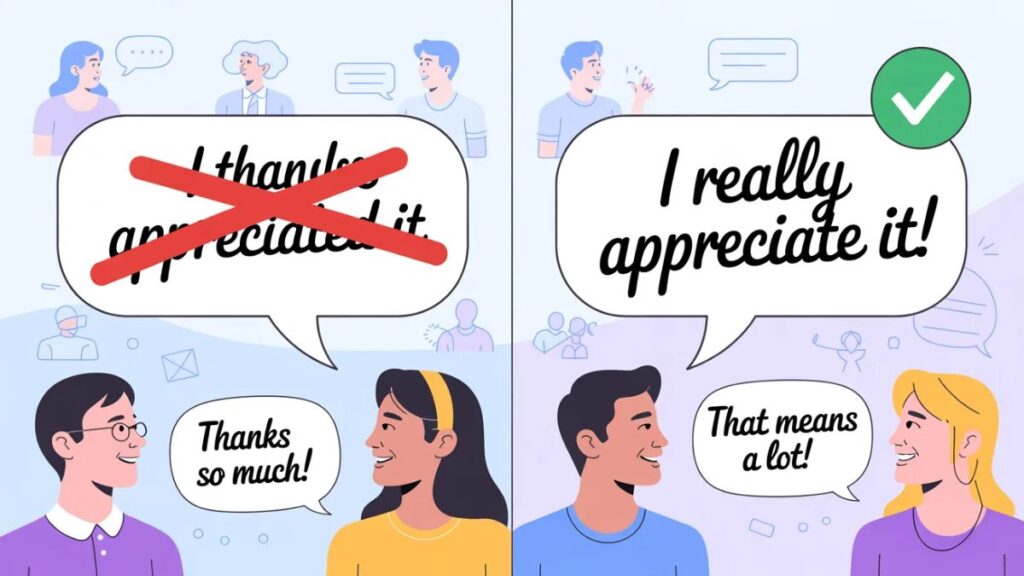
Imagine someone just helped you move a heavy box. You turn to them and say:
❌ “I appreciated it.”
That sounds off — almost cold. It implies the moment of gratitude has already passed, like you’re reflecting on a distant memory rather than responding to something happening right now. In live conversation, appreciated creates unintended emotional distance. Always use appreciate it when the moment is fresh.
Appreciate It vs Appreciated It: Side-by-Side Grammar Comparison
| Feature | Appreciate It | Appreciated It |
|---|---|---|
| Verb tense | Present simple | Past simple |
| Time reference | Now / near future | Already completed |
| Common context | Live conversation, polite requests | Reflection, storytelling, formal writing |
| Tone | Warm and immediate | Reflective and formal |
| With “I would…” | ✅ Correct | ❌ Incorrect |
| In live dialogue | ✅ Natural | ❌ Can sound distant |
| In written narratives | ⚠️ Less common | ✅ Natural |
| Subject often dropped? | Yes (casual speech) | Rarely |
The Real Contextual Difference Between Appreciate It and Appreciated It
The grammar is simple. The real nuance is emotional timing.
Appreciate It Signals:
- The gratitude is alive right now
- You’re in the middle of the situation
- The favor is happening or just happened
- You want to sound warm and present
Appreciated It Signals:
- The gratitude existed in the past
- You’re looking back at a completed experience
- The moment has closed
- You’re telling a story or writing a reflection
Think of it this way: appreciate it is live television, appreciated it is a recorded memory.
Real-Life Examples of “Appreciate It” in Context
Workplace Examples
- “You sent that update before the deadline — appreciate it.”
- “I appreciate it when you flag issues early rather than letting them build up.”
- “If you could loop me in before the call, I’d really appreciate it.”
Customer Service Examples
- “Your issue has been escalated to our team.” → “Appreciate it.”
- “We appreciate it when customers share detailed feedback.”
- “We’ll follow up within 24 hours.” → “Appreciate it — thank you.”
Casual Conversation Examples
- “I grabbed you a coffee.” → “Appreciate it!”
- “I covered for you at practice.” → “Really appreciate it.”
- “Let me know if you need anything.” → “Appreciate it, seriously.”
Real-Life Examples of “Appreciated It” in Context
Professional Writing
- “The client appreciated it once the contract terms were clarified.”
- “Our team appreciated it when leadership acknowledged the effort publicly.”
- “He appreciated it after reading the full performance review.”
Personal Reflection
- “I didn’t say much at the time, but I appreciated it deeply.”
- “She appreciated it more and more as the years went by.”
- “Looking back, I really appreciated it when my mentor pushed me harder.”
How Native Speakers Choose Between These Phrases
Native speakers don’t consciously run a grammar checklist. They rely on emotional and temporal instinct. If the situation feels current and active, appreciate it comes out automatically. If they’re recalling something from the past, appreciated it surfaces naturally.
The fastest way to train this instinct: ask yourself one question before speaking or writing — “Is this happening now, or has it already passed?” That single question solves 95% of the confusion.
Common Mistakes Learners Make
Using “Appreciated It” Too Early
This is the most common error. Someone receives help in the moment and responds with:
❌ “Thank you. I appreciated it.”
The phrase signals that the moment is over, even when it’s still unfolding. It creates subtle emotional distance that native speakers pick up on immediately.
✅ “Thank you. I appreciate it.” — This is the correct response in live situations.
Overusing “Appreciate It” in Formal Writing
In written documents, formal reports, or narrative pieces, appreciate it can sound too casual or vague. Switching to appreciated it — or better yet, a full sentence like “The team appreciated the initiative taken during Q3” — sounds more professional and complete.
Confusing Gratitude With Completion
Some learners assume that saying “thank you” should always trigger the past tense. It shouldn’t. Gratitude can be fully present. When someone does something for you right now, your thanks is a present-tense reaction, not a past-tense review.
Simple Memory Rules to Never Mix Them Up
Time Rule
Present moment = appreciate it | Past moment = appreciated it
Conversation Rule
If you’re in a live conversation, default to appreciate it. It’s always safe and natural.
Writing Rule
If you’re writing about something that already happened, use appreciated it — it matches the past-tense tone of your narrative.
Case Study: One Phrase, Two Outcomes
Situation
A manager asks their team for help preparing an urgent presentation. A colleague steps up and finishes the slides. Appreciate It vs Appreciated It.
In the meeting (live moment):
✅ “You pulled that together so fast — I really appreciate it.”
In the follow-up email the next week:
✅ “I wanted to say again that I appreciated it when you stepped up on short notice last Tuesday.”
Same situation. Same feeling. Two different tenses — because the time has changed.
Using appreciated it in the first scenario would feel distant. Using appreciate it in the follow-up email would feel slightly off-tense. The phrase that fits depends entirely on when you’re saying it. Appreciate It vs Appreciated It.
Why Tense Accuracy Shapes Professional Image
In workplace communication — emails, Slack messages, performance reviews, client correspondence — tense accuracy signals fluency and attention to detail. Saying “I would appreciated it” in a professional email raises an immediate red flag. It signals either careless writing or limited grammar awareness, even if the intent was polite. Appreciate It vs Appreciated It.
Getting the tense right is one of those small things that separates proficient English users from truly fluent ones. It’s a minor detail with a significant impact on how you’re perceived.
FAQs
What’s the main difference between appreciate it and appreciated it?
Appreciate it is present tense — used for current or near-future gratitude. Appreciated it is past tense — used when reflecting on a kindness or action that has already been completed.
Can I use appreciate it in professional emails?
Yes, absolutely. It’s polite and appropriate in emails, especially in phrases like “I appreciate your quick response” or “I would appreciate it if you could confirm by Thursday.”
Is appreciated it grammatically correct?
Yes, it’s grammatically correct when referring to a past action — for example, “I appreciated it when you sent over those notes last week.” It becomes incorrect if used in place of present-tense gratitude.
Why do Americans say appreciate it so often?
American conversational English favors short, warm expressions. Appreciate it is efficient, genuine-sounding, and versatile — it works in formal and casual settings alike, which makes it a cultural default for expressing thanks quickly.
Can appreciated it sound cold?
Yes. In live conversation, using appreciated it in response to a current favor can unintentionally signal emotional distance — as though the moment has already passed before it’s finished. Stick to appreciate it in real-time exchanges.
Final Takeaway
Here’s the simplest way to remember it all:
- Appreciate it = right now, happening, live, immediate, polite request
- Appreciated it = already done, past, reflection, narrative
Both phrases are correct English. Both express genuine gratitude. The only thing that changes is time — and in English, time changes everything. Appreciate It vs Appreciated It.
When in doubt in a live conversation, go with appreciate it. It’s always safe, always warm, and always natural. Save appreciated it for looking back. Use appreciate it for showing up in the moment. Appreciate It vs Appreciated It.