Smooth vs. Smoothe: The Only Guide You’ll Ever Need ✨ comes down to one simple truth — “smooth” is correct, and “smoothe” is a misspelling with no place in standard English.
One extra letter. One big mistake. Writers lose credibility over errors this small — and readers notice.
“Smooth” works as both an adjective and a verb, covering texture, motion, charm, and more. This guide covers spelling rules, real examples, and comparisons — everything needed to write with confidence.
Smooth vs. Smoothe — What’s the Difference?
At a glance:
| Word | Status | Part of Speech | Correct? |
|---|---|---|---|
| Smooth | Standard English | Adjective, Verb, Noun | ✅ Yes |
| Smoothe | Misspelling | — | ❌ No |
The difference comes down to one extra letter — an “e” that doesn’t belong. “Smooth” functions as both an adjective and a verb in modern English. “Smoothe” has no entry in major dictionaries like Merriam-Webster, Oxford, or Collins, and it never has. It is not a variant spelling, not a regional dialect form, and not an accepted alternate. It is simply wrong.
The Correct Spelling: Why “Smooth” Is the Only Standard Form
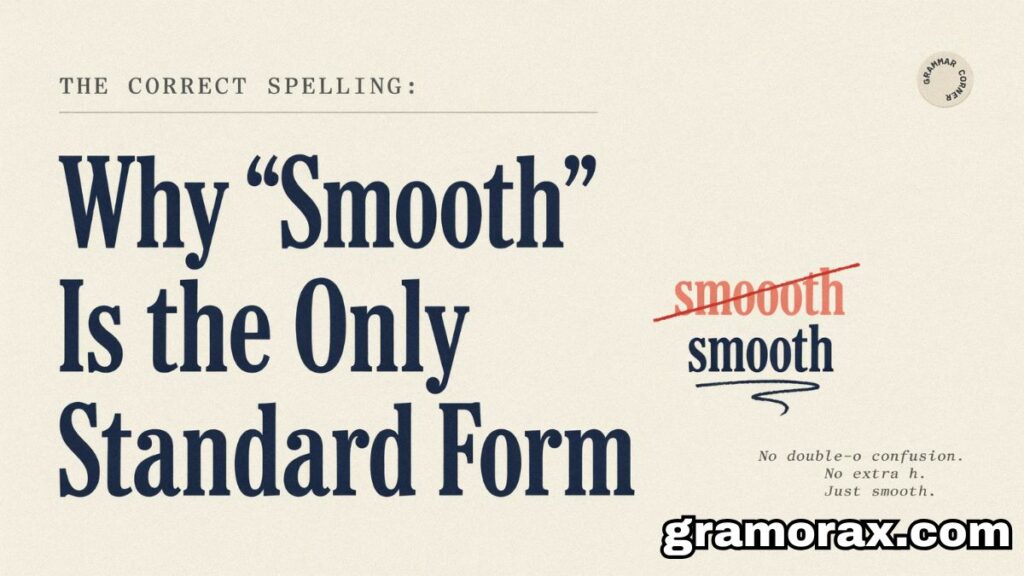
Every major style guide — APA, Chicago, and Oxford — confirms the same thing: smooth is the correct and complete form of this word, used as both an adjective and a verb without any modification.
When “smooth” functions as a verb, it follows regular conjugation patterns just like any standard English verb. It does not require an added “e” to signal its verbal function. The word is complete as it stands.
Why English Doesn’t Add a Silent E Here
English has a long history of silent “e” endings, but they follow specific phonetic rules. A silent “e” typically:
- Lengthens the preceding vowel (e.g., cap → cape)
- Signals a phonetic shift in related word forms (e.g., breath → breathe, cloth → clothe)
“Smooth” doesn’t fit either pattern. Its vowel sound is already fixed, and its pronunciation as /smuːð/ doesn’t change whether or not an “e” is added. There is no phonetic justification for “smoothe” — the word simply doesn’t need it.
Where the Confusion Comes From
English learners (and even native speakers) often overthink this one. The confusion usually traces back to a handful of patterns:
- Rhyming words with silent E: “Smooth” rhymes with “soothe,” and the simple past of “soothe” is “soothed.” It’s intuitive to assume “smooth” must have a hidden “e” somewhere.
- Pairs like breathe/breath and clothe/cloth: These words shift between noun and verb forms with an added “e.” Writers assume “smooth” works the same way — but it doesn’t.
- Branding and marketing: Companies sometimes use stylized spellings like “SmootheSkin” for visual effect. These are trademarked names, not proper English, and they don’t validate the spelling.
Once you understand that “smooth” doesn’t follow those phonetic patterns, the misspelling becomes easy to avoid.
Smooth as an Adjective
When used as an adjective, “smooth” describes something that is even, consistent, free from roughness, or effortlessly graceful. It covers a surprisingly wide range of meanings.
1. Physical Texture
This is the most literal use. A smooth surface has no bumps, bristles, or irregularities.
The marble countertop had a perfectly smooth finish. Her skin felt smooth and cool to the touch.
2. Effortless or Flowing Motion
“Smooth” describes movement that flows without interruption or jerkiness.
The train glided along the track in a smooth, unbroken motion. It was the smoothest takeoff I’d ever experienced.
3. Polished, Refined, or Impressive
In a more abstract sense, “smooth” signals a high level of quality or execution.
The presentation was smooth from start to finish. He delivered a smooth performance under pressure.
4. Social Charm
This usage is informal but widely understood — a “smooth” person is confident, charming, and socially fluid.
He was so smooth at the networking event that everyone remembered him.
In short:
- Texture: even, silky, glossy, flat
- Motion: fluid, effortless, uninterrupted
- Performance: polished, refined, well-executed
- Personality: charming, suave, socially confident
Smooth as a Verb
“Smooth” works as a regular transitive verb meaning to make something flat, even, or free of problems.
Common uses:
- To physically flatten or level a surface
- To resolve a conflict or reduce tension
- To improve the flow of a piece of writing or a process
She smoothed the wrinkles out of the tablecloth. The manager smoothed things over after the misunderstanding. He smoothed his hair back before the interview.
Conjugation of “Smooth” (Verb)
“Smooth” follows perfectly standard English verb conjugation. No surprises, no silent “e” needed.
| Tense | Form | Example |
|---|---|---|
| Base / Infinitive | smooth | I smooth the surface. |
| Simple Present (3rd person) | smooths | She smooths the fabric. |
| Simple Past | smoothed | He smoothed the path. |
| Past Participle | smoothed | It has been smoothed. |
| Present Participle | smoothing | They are smoothing things over. |
Notice: the past tense is “smoothed” — not “smoothed” from “smoothe.” The base form is “smooth,” and “-ed” is added directly.
Is “Smoothe” a Word?
No. “Smoothe” is not recognized in any major English dictionary and has never had widespread standard usage in the history of the language. Here’s why people keep writing it anyway:
1. People assume it follows “breathe” and “clothe.”
Words like breathe and clothe are verb forms of nouns (breath, cloth) that gained an “e” to signal a phonetic shift. “Smooth” has no corresponding noun that works the same way. The analogy doesn’t hold.
2. Misleading marketing or branding.
Brand names like “Smoothe Radio” or “SmootheSkin” use creative spelling for aesthetic appeal. That’s a branding choice — it carries zero grammatical authority.
3. Users think adding an “e” makes it more “verb-like.”
In some English words, the “e” ending does signal a verb (e.g., bathe, graze). But “smooth” doesn’t need that signal — it already functions as a verb in its base form.
Bottom line: “Smoothe” is a spelling mistake in every context — formal, informal, academic, or creative.
Smooth vs. Smoothen vs. Smoothe
Writers sometimes encounter three versions of this word. Here’s how they stack up:
“Smoothe” → Incorrect
Not a word. Not found in standard dictionaries. Avoid in all writing.
“Smoothen” → Rare but Real
“Smoothen” (meaning to make or become smooth) has made its way into a few modern dictionaries and appears occasionally in South Asian English and older British usage. It is grammatically constructed — “-en” is a suffix that creates verbs (like brighten, flatten) — but it is considered awkward and superfluous by most style guides.
The tailor will smoothen the fabric before cutting. (Rare, but technically acceptable in some dialects)
In modern standard American or British English, simply use smooth instead. It’s shorter, cleaner, and universally understood.
| Word | Status | Recommended? |
|---|---|---|
| Smooth | Correct and standard | ✅ Always |
| Smoothen | Rare, dialectal | ⚠️ Avoid in formal writing |
| Smoothe | Misspelling | ❌ Never |
When Writers Invent Words Like “Smoothe”
Language evolves. New words enter dictionaries every year. But there’s a difference between organic language evolution and simple spelling errors.
“Smoothe” has no etymological basis, no dialectal roots, and no entry in major reference works. It doesn’t solve any communication problem that “smooth” doesn’t already solve. In writing, invented or misspelled words introduce friction — readers pause, trust erodes, and your message loses clarity.
Good writers follow usage standards not because language is rigid, but because shared rules enable shared understanding.
Smooth vs. Sleek
These two words are close in meaning but not identical. Here’s how to tell them apart.
Smooth
Focuses on the absence of roughness or irregularity — a tactile or functional quality. Can describe surfaces, motion, processes, and personality.
Sleek
Suggests visual elegance and streamlined design. Often implies a polished, stylish appearance — especially in design, fashion, and technology contexts.
Quick Comparison Table
| Feature | Smooth | Sleek |
|---|---|---|
| Primary Sense | Even, free of bumps | Stylishly streamlined |
| Touch vs. Sight | Often tactile | Primarily visual |
| Example | The road was smooth. | The car had a sleek profile. |
| Verb Form | ✅ Yes | ❌ No |
| Tone | Neutral/functional | Modern/aesthetic |
Smooth vs. Polished
Smooth
Describes a basic physical or experiential quality — something that is even, flowing, or without interruption.
Polished
Implies a higher level of refinement and finish. “Polished” often suggests deliberate effort and expertise — something that has been worked on and perfected.
The table is smooth (it has no rough patches). The table is polished (it has been refined to a high-gloss finish).
In figurative use: a smooth speaker is charming and fluent; a polished speaker is highly trained and refined.
Examples of Correct Usage
Smooth as an Adjective
- The baby’s skin was unbelievably smooth.
- We had a smooth transition between the two teams.
- He impressed everyone with his smooth, confident delivery.
Smooth as a Verb
- She smoothed the bedsheets before the guests arrived.
- They worked hard to smooth out the disagreements.
- He smoothed his tie and walked into the boardroom.
smooth in Idioms
- smooth sailing — progress without difficulty
- smooth over — to resolve tension or conflict
- smooth operator — a charming, skilled person
- take the rough with the smooth — accept both good and bad situations
Incorrect Examples
❌ She tried to smoothe the situation over. ❌ The app has a very smoothe interface. ❌ Can you smoothe out this paragraph?
Corrected
✅ She tried to smooth the situation over. ✅ The app has a very smooth interface. ✅ Can you smooth out this paragraph?
Why Correct Spelling Matters
It might seem like a small thing — one extra letter. But in writing, the details count.
1. Clarity
Misspellings slow readers down. They interrupt the flow of your message and force the reader to interpret what you meant.
2. Credibility
Correct spelling signals that you know your material. Errors — even minor ones — can make readers question your expertise on other matters.
3. Professionalism
In formal writing — job applications, business communications, academic work — spelling errors leave a lasting impression. “Smoothe” in a cover letter would stand out for the wrong reasons.
4. Reader Trust
People trust writers who get the details right. Every correctly spelled word is a small signal that you care about accuracy. Smooth vs. Smoothe.
FAQs
What’s the difference between “smooth” and “smoothe”?
“Smooth” is the correct, standard spelling used as both an adjective and a verb. “Smoothe” is a misspelling with no place in correct English — avoid it entirely.
When should I use “smooth” as a verb?
Use “smooth” as a verb when you mean to flatten, level, or ease something — for example, smooth the wrinkles, smooth over a conflict, or smooth the path forward.
Can “smoothe” be used in modern English?
No. “Smoothe” is not recognized in any major modern dictionary and is universally considered a spelling error in standard writing.
Is “smoothen” a real word?
Technically, “smoothen” appears in some dictionaries and is occasionally used in certain regional dialects. However, most style guides consider it unnecessary and awkward — simply use “smooth” instead.
What does “smooth” mean as an adjective?
As an adjective, “smooth” means free from roughness or irregularity. It also describes effortless motion, polished performance, and socially charming behavior depending on context.
Conclusion
Here’s the short version: smooth is correct. Smoothe is not a word. Not in dictionaries, not in style guides, not in any regional dialect that matters for standard writing.
“smooth” does everything it needs to do — as an adjective describing texture, motion, or charm, and as a verb meaning to flatten or ease. Smooth vs. Smoothe. It conjugates cleanly, reads clearly, and has never needed an extra “e.”
Next time you’re tempted to write “smoothe,” remember: the word is already complete. Clean, correct, and effortless — just like smooth itself. Smooth vs. Smoothe.