Have you ever stopped mid-sentence and second-guessed yourself — should it be myself or my self? You’re not alone. This confusion trips up English learners, native speakers, and even professional writers every single day. The difference is subtle but important: one belongs to grammar, the other belongs to identity. Myself vs My Self. In this complete guide, you’ll understand exactly when, how, and why to use each form — with real examples, a quick decision chart, and answers to the most common questions.
Myself vs My Self: What’s the Real Difference?
At a glance, the two forms look almost identical. Spoken aloud, they sound the same. But on the page — and in meaning — they serve entirely different purposes.
| Feature | Myself (one word) | My Self (two words) |
|---|---|---|
| Part of speech | Reflexive/intensive pronoun | Noun phrase (possessive + noun) |
| Used in | Everyday grammar | Philosophy, psychology, literature |
| Example | I hurt myself. | I am rediscovering my self. |
| Standard English? | Yes | Rarely — context-specific only |
| Relates to | Action or emphasis | Identity and inner consciousness |
The core rule: “Myself” is grammar. “My self” is identity.
What “Myself” Really Means in English
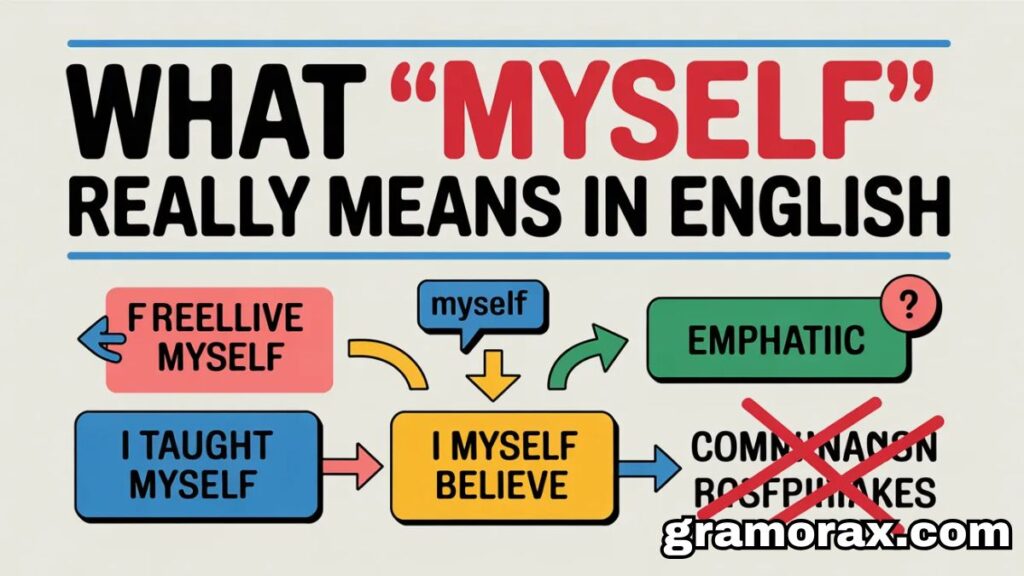
“Myself” is a reflexive pronoun — the first-person singular form in a family that includes yourself, himself, herself, themselves, and ourselves. It has two clearly defined grammatical jobs.
“Myself” as a Reflexive & Intensive Pronoun
Two main functions of “myself”:
- Reflexive use — when the subject and object of a sentence are the same person. The action loops back to the doer.
- Intensive use — when you add “myself” purely for emphasis, to stress that you (and no one else) acted.
Correct Examples in Everyday Sentences
Reflexive Use
- I burned myself on the stove. (Subject “I” performs and receives the action)
- She taught herself to code. (Direct parallel: she → herself)
- I need to push myself harder this week.
- I prepared myself for the worst-case scenario.
Intensive Use
- I fixed the car myself. (Nobody helped me — emphatic)
- I, myself, wrote every word of this report.
- I cleaned the entire office myself.
Quick tip: For intensive use, try removing “myself” from the sentence. If the sentence still makes perfect grammatical sense, the word is being used for emphasis — and that’s correct.
Incorrect Uses of “Myself” (Very Common!)
One of the most widespread grammar mistakes in professional English is using “myself” where “I” or “me” belongs. It tends to happen when people want to sound more formal or polished — but the result is actually a grammatical error.
Wrong: Please send the report to Sarah and myself. Right: Please send the report to Sarah and me.
Wrong: Myself and John attended the meeting. Right: John and I attended the meeting.
Wrong: If you have questions, contact myself. Right: If you have questions, contact me.
The substitution test: Remove the other person from the sentence and try replacing “myself” with “I” or “me.” If one of those words works, use it — not “myself.”
Understanding “My Self” (Two Separate Words)
What “My Self” Actually Means
When you write “my self” as two separate words, you step outside standard grammar and into the domain of identity, consciousness, and personal being. Here, “my” is a possessive determiner and “self” is a standalone noun — referring to your inner being, your true essence, or your psychological identity.
This is not a reflexive pronoun. It cannot replace “myself” in everyday sentences.
Examples
- I am learning to accept my self.
- Meditation helps me reconnect with my self.
- There is a difference between the role I play at work and my self.
- I feel disconnected from my self lately.
Note how each example is introspective. The focus is not on an action — it’s on an inner state of being.
Where “My Self” Is Commonly Used
Psychology
In clinical and therapeutic contexts, “the self” is a recognized psychological concept. Thinkers like Carl Jung and Sigmund Freud explored the self as the center of consciousness and identity. Therapists and counselors routinely use phrases like true self, core self, and authentic self to describe psychological wholeness. Writing “my self” (two words) can emphasize the self as a distinct concept being examined or nurtured.
Philosophy
Philosophers from Descartes to Hume have debated the nature of the self. In academic philosophical writing, separating “my” from “self” treats the self as a philosophical object — something you possess, explore, or lose. “Who am I?” is a question about my self in this sense.
Literature
Writers and poets use “my self” to slow the reader down, signal introspection, or draw a deliberate line between the outer “me” and the inner “self.” Walt Whitman’s famous Song of Myself is a landmark literary exploration of identity. Shakespeare also wrote “my self” as two words in several plays and sonnets — a reflection of how the language was still evolving in Early Modern English.
Why “Myselves” Is Incorrect — Always
Some learners, when referring to multiple people or trying to pluralize the reflexive, attempt to write or say “myselves.” This word does not exist in English.
English reflexive pronouns have fixed, non-negotiable plural forms:
- I → myself
- We → ourselves
- You (plural) → yourselves
- They → themselves
There is no “myselves.” The logic is simple: “I” is already first-person singular. When the subject changes to “we,” the pronoun shifts to ourselves — not a modified version of myself. Reflexive pronouns are tied to their subject pronouns, not built by adding suffixes.
How “Myself” Functions in Grammar
Reflexive Structure: Subject = Object
In a reflexive sentence, the subject and object refer to the same person:
I [subject] hurt myself [object] → same person → reflexive ✓
Compare: I hurt him — two different people; no reflexive pronoun needed.
The reflexive structure is one of the most important patterns in English grammar. It appears frequently with verbs like prepare, blame, teach, introduce, hurt, push, find, and consider.
Intensive Structure: Adding Emphasis
An intensive (or emphatic) pronoun adds force to a statement. It is never grammatically required, but it changes the tone:
The CEO herself approved the budget. I fixed the engine myself.
Remove the reflexive pronoun and the sentence still works — but loses its emphasis. That’s the test.
Identity & Philosophy: The Non-Reflexive “Self”
“Self” as a Concept
When “self” operates as a noun — especially in psychology, philosophy, and self-help writing — it carries enormous conceptual weight. It refers to the totality of who you are: your values, consciousness, memories, and identity. In this context, “my self” is meaningful and correct.
Psychological dimensions of “the self” include:
- Self-concept — how you perceive and define yourself
- Self-esteem — how much you value yourself
- Self-awareness — how clearly you understand your own emotions and behaviors
- True self vs. social self — the inner authentic identity vs. the persona shown to the world
How Spacing Changes Meaning
A single space transforms a grammatical tool into a philosophical subject:
- I prepared myself for the interview. → Reflexive pronoun, grammar-correct
- I am working to understand my self. → Identity language, introspective context
Same pronunciation. Entirely different meaning.
Common Errors and How to Avoid Them
Using “Myself” Instead of “Me” or “I”
This is the most frequent mistake in workplace communication. People reach for “myself” thinking it sounds more professional. It doesn’t — it just sounds incorrect to a trained reader.
- ❌ The invitation was sent to Ahmed and myself.
- ✅ The invitation was sent to Ahmed and me.
Using “My Self” When “Myself” Is Correct
The two-word form rarely belongs in standard writing. If you are describing an action that reflects back to you, use the single-word form.
- ❌ I hurt my self.
- ✅ I hurt myself.
Adding “Myself” to Sound Formal
Over-formality is a real problem in professional emails. Using “myself” where “me” belongs is called hypercorrection — an attempt to sound refined that creates a grammatical error instead.
Confusing Identity With Grammar
If you’re writing about your inner being or psychological journey, “my self” may be appropriate. If you’re writing about an action you performed on yourself or are emphasizing personal responsibility, use “myself.” Myself vs My Self.
Quick Decision Guide to Remember the Difference
Ask yourself: Is it about grammar or identity?
| Situation | Use |
|---|---|
| Action returns to you (reflexive) | myself |
| Adding personal emphasis | myself |
| Compound subject: “John and ___” | I (not myself) |
| Compound object: “to John and ___” | me (not myself) |
| Referring to the inner being/identity | my self |
| Philosophical or psychological writing | my self |
Fast Test
- Can you replace it with “me” or “I”? → Use “me” or “I” — not “myself.”
- Is the subject acting for themselves? → Use “myself.”
- Are you discussing your inner identity, consciousness, or true being? → Use “myself.”
One-Line Rule
If the subject and action loop back to you, use myself. If you’re talking about who you are inside, use my self.
Real-Life Examples & Micro Case Studies
Case Study 1: Email at Work
Please direct any questions to Mark or myself.
This is a textbook workplace error. “Myself” is used here to sound polite and formal — but it isn’t correct. The email is a compound object construction. The right word is “me.”
✅ Please direct any questions to Mark or me.
Case Study 2: Personal Journal Entry
I don’t recognize my self in the mirror anymore.
Here, the writer uses “my self” as an identity term — their inner sense of who they are. This is philosophically and stylistically appropriate. “Myself” would change the meaning entirely.
Case Study 3: Classroom Grammar
A teacher writes on the board: I taught myself English alongside I taught my self English.
The first is a reflexive pronoun — you were both teacher and student in one person. The second sentence suggests a philosophical journey of self-discovery through language — a different idea. Both can be correct, but they mean different things.
Case Study 4: Meditation Coaching
A wellness coach writes in a course guide:
Through daily practice, you will learn to return to your self — the quiet center beneath all thought.
Here, “your self” echoes “my self.” The self is treated as a destination, a concept, an identity to rediscover. This is a legitimate and intentional use in a psychological/philosophical context.
FAQ’s
What is the difference between “myself” and “my self”?
“Myself” is a reflexive or intensive pronoun used in standard grammar. “My self” is a noun phrase used in philosophical, psychological, or literary contexts to refer to personal identity.
When should I use “myself”?
Use “myself” when you are both the subject and object of an action (reflexive) or when adding personal emphasis to a statement (intensive).
When is “my self” correct?
Use “my self” when discussing your inner identity, consciousness, or true being — particularly in psychology, philosophy, meditation, or introspective writing.
Is “myself” ever incorrect?
Yes. Using “myself” in place of “I” (as a subject) or “me” (as an object) is incorrect, even if it feels more formal.
Why is “myselves” incorrect?
“Myselves” is not an English word. Reflexive pronouns have fixed plural forms: ourselves (for “we”), yourselves (for “you all”), and themselves (for “they”). “Myself” does not pluralize.
Conclusion
The difference between myself and my self comes down to one fundamental question: are you talking about grammar or identity? In the vast majority of everyday writing — emails, essays, conversations, and reports — you need “myself” as a reflexive or intensive pronoun. In the narrow but meaningful world of philosophical writing, therapy language, and introspective literature, “my self” emerges as a legitimate way to distinguish your inner being from the grammatical subject. Myself vs My Self.
Master this distinction, and you’ll avoid one of the most common hypercorrections in professional English, write with greater precision, and even think more clearly about the difference between what you do and who you are. Myself vs My Self.