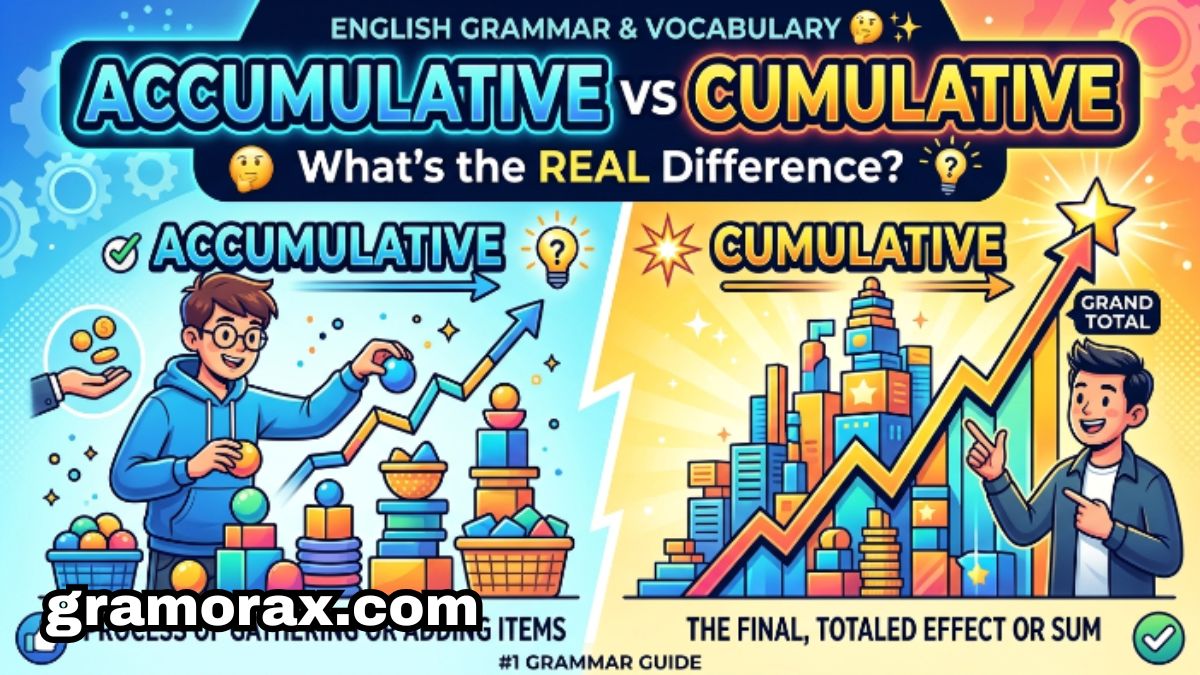
Accumulative describes an active, ongoing process of gathering — a behavioral tendency to collect or build up over time. Cumulative, by contrast, refers to a measurable total formed through step-by-step addition. Accumulative vs Cumulative. One captures the act of collecting; the other captures the result.
Here’s the truth most grammar guides won’t tell you: picking the wrong word in a financial report, academic paper, or professional email quietly signals carelessness — and smart readers notice instantly.
Both words share Latin roots, look nearly identical, and fool even seasoned writers daily. Master this single distinction and your writing gains precision that sets it apart.
The Quick Answer
Accumulative describes a process or tendency — the act of gathering or collecting over time. It often refers to behavior, habit, or organic growth.
Cumulative describes a measurable total — the result of additions stacking up progressively. It’s the dominant term in science, finance, law, and formal academic writing.
Think of it this way: you accumulate experience (a process), but your cumulative score reflects the total (a measurement). One is the journey. The other is the mileage counter.
The Core Difference at a Glance
| Feature | Accumulative | Cumulative |
|---|---|---|
| Core meaning | Tendency or process of gathering | Progressive measurable total |
| Common usage | Behavior, habits, informal growth | Data, statistics, formal totals |
| Register | Informal to neutral | Formal, academic, professional |
| Appears in science? | Rarely | Constantly |
| Appears in finance? | Occasionally (behavioral) | Always (standard term) |
| Interchangeable? | No — rarely appropriate as a swap | Preferred in most formal contexts |
| Adverb form | accumulatively | cumulatively |
Core Definitions — What Do These Words Actually Mean?

What “Accumulative” Means
Accumulative comes from the Latin accumulare, meaning “to heap up.” But what sets it apart is the active, intentional quality it carries. When something is accumulative, there’s usually an agent — a person, organism, or system — doing the gathering.
It describes a tendency or inclination to collect. A person with accumulative habits hoards knowledge, savings, or experience through deliberate or habitual action. The word implies agency.
Examples of accumulative in a sentence:
- Her accumulative approach to learning — one podcast, one book, one conversation at a time — built genuine expertise over a decade.
- The investor’s accumulative strategy focused on reinvesting every dividend without exception.
- Dust on a shelf is the result of an accumulative process; nobody put it there, but conditions allowed it to gather.
Notice how each example describes a process in motion, not a finished number.
What “Cumulative” Means
Cumulative comes from the Latin cumulus, meaning “a heap or mass” — the same root that gives us the fluffy cumulus cloud. But in modern usage, it almost always refers to measurable totals built through step-by-step addition.
It’s the word science, medicine, finance, and law reach for automatically. When researchers track cumulative interest, cumulative GPA, or cumulative CO₂ emissions, they’re measuring a total that grows with each addition. The process matters less than the number you end up with.
Examples of cumulative in a sentence:
- The cumulative rainfall for the year hit 48 inches by November — a record for the region.
- Her cumulative GPA improved each semester, ending at 3.87 after four years.
- Cumulative stress from small daily irritants can trigger burnout just as effectively as a single catastrophic event.
Shared Latin Ancestry — Why They’re So Easily Confused
Both words descend from cumulus. The prefix “ac-” in “accumulative” derives from “ad-” (toward), suggesting movement toward a heap, implying action. Cumulative describes the heap that results.
Here’s the linguistic fork in the road:
Accumulative = the act of heaping → process, behavior, tendency
Cumulative = the heap itself as a total → measurement, result, aggregate
That distinction — process vs. result — is the single most useful test you can apply when choosing between them. Ask yourself: am I describing what someone does, or what the numbers show?
Most major style guides — including the Chicago Manual of Style — treat “cumulative” as the default in formal writing and reserve “accumulative” for contexts emphasizing behavior or tendency. The Oxford English Dictionary acknowledges both but marks cumulative as far more frequent in contemporary usage.
Google’s Ngram Viewer confirms it starkly: “cumulative” appears roughly 10 to 15 times more often than “accumulative” in published English text since 1900, with the gap widening in scientific and academic literature.
Side-by-Side Linguistic Analysis
Part of Speech Breakdown
Both words function primarily as adjectives. Both also produce valid adverbs:
- The effects compounded cumulatively over three decades.
- She built her skills accumulatively, never rushing the process.
The noun forms tell an interesting story, too. Accumulation is common and widely used — you’ll see it everywhere. Cumulation, while technically valid, is rare. Most writers default to “accumulative total” or “cumulative effect” rather than reaching for “cumulation.” That asymmetry itself hints at each word’s natural habitat.
Connotation Differences
Accumulative carries a sense of intentional agency — something a person or system does. Running is active. Accumulative is active.
Cumulative describes a result or state — something that is. Distance covered is a result. Cumulative is a result.
That analogy isn’t just cute. It’s practically useful every time you draft a sentence.
Formality and Register
| Context | Preferred Word |
|---|---|
| Peer-reviewed research | Cumulative |
| Legal documents | Cumulative |
| Financial reports | Cumulative |
| Self-help / personal development | Accumulative |
| Behavioral psychology descriptions | Accumulative |
| General conversational writing | Either (with care) |
Real-World Usage Across Key Contexts
Finance and Economics
In finance, cumulative is the standard. Full stop. You’ll encounter it in:
- Cumulative interest — the total interest accrued over a loan’s or investment’s lifetime
- Cumulative preferred stock — shares where unpaid dividends stack up and must be paid before common shareholders receive anything
- Cumulative returns — the total percentage gain or loss over a defined period
“The fund delivered a cumulative return of 112% over ten years.” That’s precise, measurable, and exactly right.
Accumulative does appear in finance, but in a behavioral context. A financial advisor might describe a client’s accumulative savings habit — the disciplined tendency to add to savings consistently. Here, the word describes behavior rather than a calculated total.
Quick Rule for Finance Writers:
- Reporting a number → cumulative
- Describing an investor’s behavior or strategy → accumulative
Education and Academia
This is where the most common mistake in English usage hides.
Cumulative GPA is always correct. No accredited university uses the phrase “accumulative GPA.” Your GPA is a mathematically calculated total — a weighted average of grades across all semesters. That’s a measurement, not a tendency. Cumulative wins here every single time.
Cumulative exams test all material covered from the start of a course — not just the most recent unit. The keyword is total coverage. Again, cumulative is right.
Accumulative learning, however, is a legitimate pedagogical concept. It describes the process of building knowledge organically, layer by layer, through repeated exposure and experience. A student who learns French by watching films, reading menus, chatting with native speakers, and absorbing vocabulary gradually is engaged in accumulative knowledge acquisition. The process is informal, experiential, and ongoing.
Science and Medicine
Science almost exclusively uses cumulative.
- Cumulative radiation exposure in medical imaging
- Cumulative drug dosage in pharmacology
- Cumulative CO₂ emissions in climate science
- Cumulative incidence in epidemiology
The precision that cumulative implies — a specific, trackable, growing total — is exactly what researchers need. Swap in “accumulative” and a peer reviewer will flag it immediately.
“Cumulative CO₂ emissions since the Industrial Revolution have exceeded 1.5 trillion metric tons, according to Our World in Data.”
Law and Policy
Courts use cumulative evidence to describe additional evidence that reinforces something already proven — it adds to the pile without introducing anything new. Cumulative sentencing refers to consecutive sentences that add together rather than running simultaneously.
In both cases, the measurable, additive quality of “cumulative” does the legal heavy lifting. “Accumulative evidence” would raise eyebrows in any courtroom.
Personal Development and Psychology
Here’s where accumulative earns its place. James Clear’s bestselling Atomic Habits is built entirely on the concept of accumulative behavior change — small actions compounding over time through consistent repetition. He never uses the word explicitly, but the concept is textbook accumulative.
Cumulative stress and cumulative trauma are clinical terms in psychology. Psychologists use “cumulative” because they’re measuring a total load — the aggregate weight of stressors that, together, overwhelm a person’s coping capacity. The measurement framing fits perfectly.
Accumulative habits describe the tendency to repeat behaviors. Cumulative stress describes the measurable result of those repeated stressors. Both words are right in their own lane.
Technology and Data Science
Data scientists work with cumulative constantly:
- Cumulative distribution functions (CDFs) map the probability that a variable falls below a given value
- Cumulative sum (CUSUM) detects shifts in process performance over time
- Cumulative website visitors track total unique visits across a period
A dashboard showing cumulative user logs from January through June is standard. Calling that metric “accumulative” would be unusual and mildly confusing to any data analyst reading the report.
Accumulative does occasionally appear in UX writing — describing a feature that “accumulatively improves” with use — but it’s the exception, not the rule.
Common Misconceptions and Quick Correction Tips
The 5 Most Frequent Misuses
- “Accumulative GPA” — Always wrong. Your GPA is a calculated number. Use cumulative GPA.
- “Cumulative investor” — Awkward. A person’s investing style is a behavior. Use accumulative investor or a simple disciplined investor.
- Using them interchangeably in formal writing — Context matters. In a research paper, always verify what fits.
- Avoiding “accumulative” entirely — Overcorrection. The word exists, it’s valid, and it’s the better choice when describing behavioral tendencies.
- “Accumulative effect” in science writing — Almost always wrong. Effects in science are measured totals. Use cumulative effect.
Why These Errors Happen
- Identical spell-check behavior — neither word triggers a red underline, so writers don’t pause
- Shared etymology — the Latin root makes both feel correct in almost any context
- Style guide silence — many writing guides barely address “accumulative” at all, leaving writers to guess
- Autocomplete — typing “acc…” in many text editors autocompletes to “accumulative” regardless of context
Quick Correction Tips
Apply these three tests before you commit to either word:
Test 1 — Process or Result?
If you’re describing an ongoing process or behavior → accumulative
If you’re describing a measurable total → cumulative
Test 2 — Person or Number?
If the subject is a person doing something consistently → accumulative
If the subject is a statistic or data point → cumulative
Test 3 — Can you replace it with “total”?
If “total” makes sense in its place (total GPA, total rainfall, total returns) → cumulative
If “total” sounds wrong → accumulative is probably right
Grammar Deep-Dive — Forms, Adverbs, and Nouns
Cumulatively vs. Accumulatively
Both adverbs are grammatically valid. In practice, cumulatively dominates formal writing by a wide margin.
- The policy’s costs grew cumulatively over five years, ultimately exceeding the original budget by 340%. ✅
- She built her confidence accumulatively — one small win at a time. ✅
Noun Forms: Accumulation vs. Cumulation
Accumulation is common, versatile, and universally understood:
- The accumulation of life lessons changed his outlook entirely.
- Dust accumulation on solar panels reduces efficiency by up to 30%.
Cumulation exists but rarely appears outside specialized academic or legal writing. Most writers naturally gravitate toward “cumulative total” rather than “cumulation.” You won’t be wrong to use it, but you may get a puzzled look.
Case Studies
Case Study 1 — Climate Science Report
The IPCC’s Sixth Assessment Report uses “cumulative” throughout when discussing greenhouse gas emissions. Phrases like “cumulative CO₂ emissions” and “cumulative carbon budgets” appear dozens of times. The word choice is deliberate — scientists need precise, measurable totals, not descriptions of behavior.
Swapping “accumulative” into any of those sentences would soften the precision and signal a misunderstanding of the data being presented. In scientific writing, that’s not a trivial error.
Takeaway: In any formal scientific context, cumulative is the only correct choice when discussing measured totals.
Case Study 2 — Personal Finance Blog
A prominent personal finance blogger described her investing philosophy this way: her accumulative habit of investing a fixed percentage of every paycheck — regardless of market conditions — had compounded into a seven-figure portfolio over 20 years. She used “accumulative” correctly and intentionally, emphasizing the behavioral consistency rather than the numerical result.
She then reported the cumulative return on that portfolio — a specific, calculated percentage. Two different words. Two perfectly correct uses in the same paragraph.
Takeaway: Good writers use both words — each in its proper place.
Case Study 3 — University Grading Policy
A review of grading policies from 50 U.S. universities — including Harvard, MIT, Stanford, and the University of Michigan — found that every single institution uses “cumulative GPA” in its official academic documentation. Not one uses “accumulative GPA.”
This isn’t a style preference. It reflects the mathematical reality of GPA: it’s a calculated aggregate, a measurable total. “Cumulative” is simply the accurate word.
Takeaway: If you write “accumulative GPA,” you’re wrong. Every registrar in the country agrees.
Memory Tools That Actually Work
The “AC” Trick
Accumulative starts with AC. Think: ACtion, ACquire, ACt. Accumulative is about doing — an active process of gathering.
Cumulative describes what the scoreboard shows after all that is done. It’s the result, the total, the final tally. Accumulative vs Cumulative.
The Coin Jar Visual
Picture someone dropping coins into a jar every day — that’s the accumulative behavior. Now picture the total dollar amount written on a sticky note attached to the jar — that’s the cumulative total. Accumulative vs Cumulative.
Same jar. Two different concepts. Two different words.
Sentence Anchors
Memorize these two sentences, and you’re set for life:
- “My accumulative reading habit made me a better thinker.” (behavior, process)
- “My cumulative reading total hit 200 books last year.” (measured result)
Diagnostic Quiz — Test Yourself
Choose the correct word for each sentence:
1. Her ________ approach to saving money — never skipping a deposit — built real financial security.
(a) accumulative (b) cumulative
✅ Answer: (a) accumulative — describes a behavioral tendency
2. The ________ interest on the loan reached $4,200 after three years.
(a) accumulative (b) cumulative
✅ Answer: (b) cumulative — a measured financial total
3. Pollution from decades of industrial activity created a ________ environmental impact that scientists are still measuring.
(a) accumulative (b) cumulative
✅ Answer: (b) cumulative — a scientific, measurable total
4. His ________ knowledge of carpentry — picked up informally over years of hobbyist work — rivaled that of trained professionals.
(a) accumulative (b) cumulative
✅ Answer: (a) accumulative — describes organic, experiential learning
5. Students must maintain a ________ GPA of 3.0 to qualify for the scholarship.
(a) accumulative (b) cumulative
✅ Answer: (b) cumulative — always cumulative GPA
Synonyms and Related Words
Synonyms for Accumulative
| Synonym | Nuance |
|---|---|
| Acquisitive | Focused on obtaining/collecting |
| Amassing | Active gathering of quantities |
| Gathering | General collecting process |
| Hoarding | Collecting to excess |
| Amassive | Rare; relating to the act of amassing |
Synonyms for Cumulative
| Synonym | Nuance |
|---|---|
| Aggregate | Total of combined parts |
| Progressive | Growing by successive additions |
| Incremental | Step-by-step addition, measurable |
| Additive | Built by adding elements together |
| Compounding | Each addition builds on the last |
Conclusion
The real difference between accumulative and cumulative is simple. Use accumulative for processes and behaviors. Use cumulative for measured totals and data. Accumulative vs Cumulative. One describes the journey. Accumulative vs Cumulative. The other counts the miles.
Getting accumulative vs cumulative right isn’t just grammar. Its credibility. Whether you’re writing a financial report, an academic paper, or a blog post, the correct word signals precision. Accumulative vs Cumulative. Now you know the actual difference — so use it confidently every time. Accumulative vs Cumulative.
FAQs
What is the real difference between accumulative and cumulative?
Accumulative describes a process or behavior of gathering over time. Cumulative refers to a measurable total built through progressive addition.
Can accumulative and cumulative be used interchangeably?
Rarely. In formal, scientific, or financial writing, they aren’t interchangeable. Cumulative dominates professional contexts; accumulative fits behavioral descriptions better.
Which is correct — cumulative GPA or accumulative GPA?
Always cumulative GPA. Every accredited university worldwide uses this term officially since GPA is a calculated mathematical aggregate, not a behavioral tendency.
What does cumulative interest mean in finance?
It’s the total interest accrued on a loan or investment over time. For example, a $200,000 mortgage at 6.5% carries roughly $255,000 in cumulative interest over 30 years.
Is “accumulative” even a real word in 2025?
Yes — fully valid and listed in Oxford, Merriam-Webster, and Cambridge dictionaries. It’s simply less common than cumulative, appearing roughly 10–15 times less frequently in published English text.