Have you ever been told to “annunciate your words clearly” — and secretly wondered if the person giving that advice had it right? You’re not alone. The words annunciate and enunciate look almost identical, sound nearly the same, and both orbit the world of speech. Yet they carry completely different meanings, and mixing them up — especially in writing or professional settings — can quietly undermine your credibility. Annunciate vs. Enunciate.
This guide breaks down both words from their Latin roots to real-world usage, so you’ll always reach for the right one.
Annunciate vs. Enunciate: Why People Mix Them Up
The confusion is understandable. Both words:
- Start with a vowel sound (“uh-” or “ih-“)
- End with “-nunciate”
- Relate to speaking or communication
- Appear in formal or professional contexts
But as you’ll discover, their meanings land in very different places. One is about what you declare; the other is about how you speak.
The Origins Behind Annunciate and Enunciate
Etymology & Historical Roots
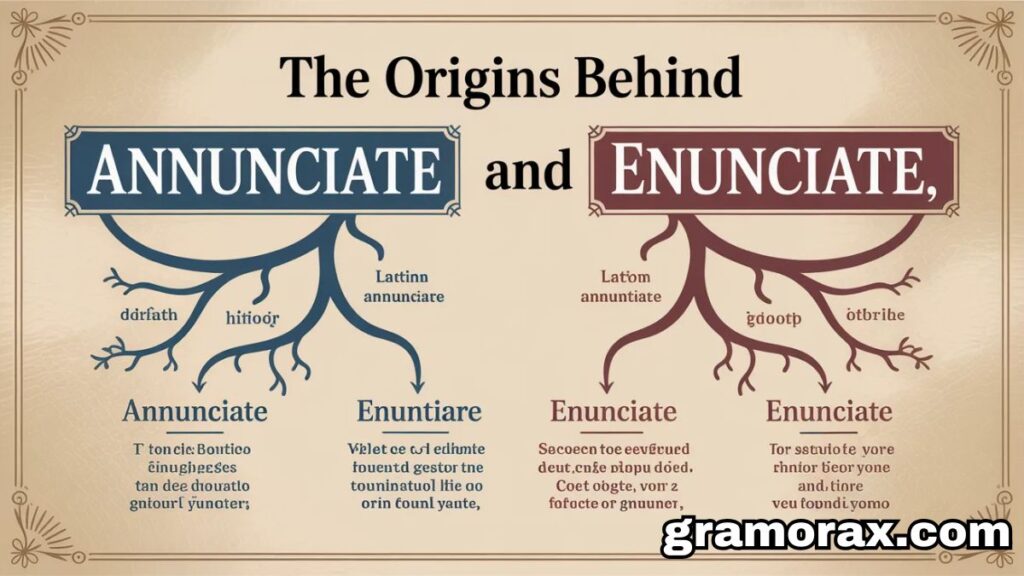
Both words trace their ancestry back to the Latin root nuntiare, meaning “to announce or declare.” That shared origin is exactly what makes them so easy to confuse — they really did start as linguistic cousins.
How Each Word Evolved
Annunciate
Annunciate descends from the Latin annuntiare, built from the prefix ad- (meaning “toward”) and nuntiare (to declare). In early Christian tradition, it became tied to the Annunciation — the angel Gabriel’s formal proclamation to the Virgin Mary. Over centuries, the word kept its ceremonial, proclamation-heavy identity and became more niche, rarely leaving formal or religious writing.
Enunciate
Enunciate comes from the Latin enuntiare, combining the prefix e- (meaning “out”) and nuntiare (to speak or tell). While it once covered declarations broadly, the word gradually narrowed its focus to how words are spoken — their precision, clarity, and articulation. Today, it’s the term that teachers, coaches, actors, and public speakers instinctively reach for.
What “Annunciate” Means (and When to Use It)
Core Definition of Annunciate
Annunciate (verb) — to announce, proclaim, or formally declare something, often in an official or ceremonial context.
It carries weight. When someone annunciates something, there’s a sense of authority behind the message — a king issuing a decree, a bishop making a religious proclamation, or an official broadcasting important news.
When Should You Use Annunciate?
Use annunciate when:
- You’re describing a formal or ceremonial declaration
- The context involves religious, historical, or official proclamations
- You want to emphasize the content and authority of what’s being announced
Examples of Annunciate Used Correctly
- The bishop annunciated the church’s new doctrine at the Sunday gathering.
- A herald annunciated the king’s arrival to the assembled court.
- The school principal annunciated the new attendance policy over the intercom.
Key Characteristics of “Annunciate”
| Feature | Detail |
|---|---|
| Word Type | Verb |
| Focus | The content of the declaration |
| Tone | Formal, ceremonial, authoritative |
| Frequency | Rare in everyday speech |
| Common Contexts | Religious, official, historical writing |
What “Enunciate” Means (and Why It’s Common Today)
Core Definition of Enunciate
Enunciate (verb) — to pronounce words clearly, distinctly, and with precise articulation so that each syllable is fully formed and easily understood.
Unlike annunciate, which focuses on the message, enunciate focuses on the mechanics — how your mouth shapes sounds, how your tongue moves, how your voice projects each word.
When Should You Use Enunciate?
Use enunciate when:
- You want someone to speak more clearly
- You’re discussing diction, articulation, or speech coaching
- The focus is on how words are delivered, not what is being said
Examples of Enunciate Used in Context
- The drama teacher reminded her students to enunciate every syllable.
- He tended to mumble, so his speech therapist worked hard to help him enunciate.
- If you want to be understood on stage, you must enunciate — especially in the back rows.
- Enunciating clearly during a job interview makes you sound confident and professional.
Key Characteristics of “Enunciate”
| Feature | Detail |
|---|---|
| Word Type | Verb |
| Focus | Clarity and precision of speech |
| Tone | Instructional, practical, everyday |
| Frequency | Very common |
| Common Contexts | Education, public speaking, speech therapy, acting |
Annunciate vs. Enunciate: The Core Comparison
| Annunciate | Enunciate | |
|---|---|---|
| Meaning | To proclaim or announce formally | To pronounce words clearly |
| Focus | The what (the message) | The how (the delivery) |
| Usage Frequency | Rare | Common |
| Typical Settings | Religious, ceremonial, historical | Classrooms, public speaking, everyday life |
| Latin Root | annuntiare (to announce toward) | enuntiare (to speak out) |
| Example | The herald annunciated the decree | She was told to enunciate her words |
A Quick Analogy
Think of a royal messenger in a medieval court. When he annunciates, he’s delivering the king’s proclamation — the what matters most. But when a speaking coach tells him to enunciate, she wants every word crisp and unmistakable — the how is everything.
Why Speech Clarity Matters: Enunciation in Real Life
Why Enunciation Matters
Clear enunciation is far more than a classroom exercise. It directly affects:
- Comprehension — listeners understand you the first time, every time
- Credibility — clear speakers are perceived as more confident and authoritative
- Professional success — from job interviews to client presentations, speech clarity signals competence
- Relationships — fewer misunderstandings means smoother conversations at home and work
Where Enunciation Is Especially Important
- Public speaking and presentations — audiences can’t rewind you
- Teaching and instruction — students need precision, not approximation
- Broadcasting and media — every syllable reaches thousands of listeners
- Acting and performance — dialogue clarity carries the entire story
- Customer service — misheard information leads to costly mistakes
Practical Tips to Improve Your Enunciation
1. Slow Down
Most unclear speech comes from rushing. Deliberately slow your pace — especially at the start of sentences — and you’ll naturally articulate more fully.
2. Open Your Mouth More
Many people mumble because their lips barely move. Consciously exaggerate your mouth opening when practicing, and you’ll find sounds form with much greater clarity.
3. Record Yourself
Your ears can deceive you mid-speech. Record five minutes of yourself reading aloud, play it back, and listen for words that blur together or syllables you drop entirely.
4. Practice Tongue and Lip Exercises
Tongue twisters like “She sells seashells by the seashore” are genuinely effective. They force your mouth to form precise shapes at speed. Daily repetition builds the muscular coordination needed for clear speech.
5. Use Controlled Breathing
Shallow breathing produces a weak, unsupported voice. Breathing deeply from the diaphragm gives your words a strong foundation and prevents trailing off at the end of sentences.
6. Speak With Intention
Before high-stakes conversations, take two slow breaths, drop your shoulders, and consciously commit to clarity on your first sentence. The pace you set at the start carries through the rest of the conversation.
Sentence Examples: Annunciate vs. Enunciate
Examples Using Annunciate
- The archbishop annunciated the beginning of the holy season.
- A royal guard annunciated the emperor’s decision to the gathered crowd.
- It is traditional for the eldest elder to annunciate the new council’s formation.
Examples Using Enunciate
- Please enunciate — I can barely hear you over the noise.
- Her vocal coach taught her to enunciate each consonant sharply.
- Public speakers must enunciate clearly to hold a large audience’s attention.
- The podcaster worked on enunciating his words more precisely after listener feedback.
Case Study: How Enunciation Changed a Career
A mid-level marketing manager was repeatedly passed over for client-facing roles despite strong analytical skills. Feedback from her manager pointed to one consistent issue: she was difficult to understand in meetings. She began working with a communication coach, focusing entirely on enunciation—slowing down, widening her mouth, and recording herself daily.
Within three months, the feedback shifted dramatically. She landed a senior client strategy role the following quarter. The content of what she said hadn’t changed. How she said it — her enunciation — made all the difference.
Case Study: A Writer’s Confusion Between Annunciate and Enunciate
A content writer for a corporate communications firm submitted a training module that repeatedly instructed employees to “annunciate clearly during client calls.” The error sailed past two reviews before a language editor flagged it. The correct term, enunciate, focuses on speech clarity — exactly what the module intended. The mixup, while seemingly minor, had made its way into onboarding materials used across 14 offices.
Knowing the distinction protects your authority as a writer — and your company’s credibility.
FAQs
What is the difference between “annunciate” and “enunciate”?
Annunciate means to formally announce or proclaim something; enunciate means to pronounce words clearly and distinctly. One is about the message, the other is about speech clarity.
Can I use “annunciate” in everyday speech?
It sounds awkward in casual use — most people would simply say “announce.” Annunciate fits formal, ceremonial, or religious contexts best.
Why is enunciation important in communication?
Clear enunciation prevents misunderstandings, boosts your credibility, and makes you sound more confident — in job interviews, meetings, presentations, and everyday conversation.
How can I improve my enunciation quickly?
Start by recording yourself speaking, then slow down your pace, open your mouth more, and practice tongue twisters daily. Consistent repetition over a few weeks produces real, noticeable change.
Can I use both words in the same sentence?
Yes — and it actually illustrates the difference perfectly: “He annunciated the new company policy but failed to enunciate it clearly, leaving half the room confused.”
Conclusion
At first glance, annunciate and enunciate look like interchangeable twins. Annunciate vs. Enunciate. But once you trace their roots and see how they’ve diverged over centuries, the distinction is unmistakable.
Annunciate = what you declare (formal proclamation, announcement) Enunciate = how you speak (clear articulation, precise pronunciation)
In nearly every everyday context — whether you’re coaching someone on the phone, giving a presentation, or writing instructional content — enunciate is the word you want. Save annunciate for the herald, the bishop, or the history novel. Annunciate vs. Enunciate.
Now that you know the difference, you’ll never second-guess yourself again — and your writing and speech will be sharper for it. Annunciate vs. Enunciate.