“Family & Friends” and “Friends & Family” are two interchangeable English phrases used to refer to the people closest to us — our loved ones, chosen circle, and blood relatives combined.
Word order carries quite emotional power. Placing one group before the other signals your priorities, sets the tone of your message, and shapes how your audience feels before they read another word.
Both phrases are grammatically correct, yet each serves a different purpose. Context, culture, and communication style determine which version truly fits — and knowing the difference makes every invitation, speech, and greeting more intentional.
Family & Friends or Friends & Family: Which One Feels Right and Why It Matters
You’ve probably typed or said both versions without giving it a second thought. But when you sit down to write a wedding invitation, draft a heartfelt card, or open a toast at a gathering, that small word-order question suddenly feels surprisingly important.
Both “family and friends” and “friends and family” are grammatically correct, and there are no specific rules dictating one over the other — it comes down to personal preference. That said, the choice is never entirely random. Context, cultural background, rhythm, and tone all play a quiet role in which phrase feels natural.
This guide breaks down every angle — grammar, culture, history, etiquette, and real-world usage — so you can choose with confidence every time.
Why People Commonly Say “Family & Friends”
Cultural Norms Put Family First
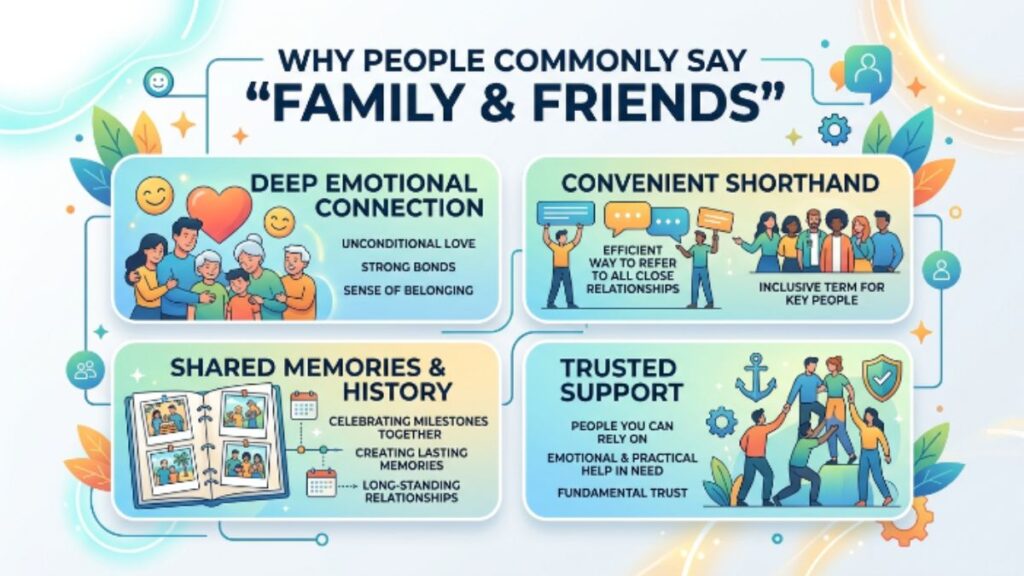
In most traditional societies, family occupies the top tier of personal relationships. Parents, siblings, and extended relatives are usually the first people we turn to in moments of crisis, celebration, or need. This deeply embedded cultural priority spills naturally into language.
In invitations, speeches, or announcements, phrases like “I would like to thank my family and friends” reflect the cultural idea that family holds a primary place in a person’s life. For many speakers, placing family first isn’t even a conscious decision — it simply mirrors how they think.
Emotional Foundations
Family relationships carry a unique weight. They’re not chosen; they’re inherited. That sense of permanence and depth is why “family” instinctively comes first for most people. When you say “family and friends,” you’re organizing your inner world the way most traditional cultures have done for generations.
Marketing Reinforced the Pattern
Advertising didn’t create this order, but it certainly reinforced it. Retailers have long used terms like “Family & Friends Sale” in their campaigns. Research shows that promotions framed as “friends and family” events are perceived as higher-value deals, particularly by customers with a community-oriented mindset. As these campaigns reached millions of people, the phrase became even more familiar in everyday speech.
Why Some People Prefer “Friends & Family”
When Friends Become Your Chosen Family
Not everyone’s biological family is their primary support network. For many people — particularly younger generations, LGBTQ+ individuals, and those who have moved far from home — close friends fill the emotional role that relatives traditionally held. Saying “friends and family” reflects that personal reality honestly.
Language evolves constantly, and this shift explains why “Friends & Family” appeals to many today — it reflects how their relationships actually work and matches the emotional truth of their situation.
Modern Social Dynamics
Urbanization, migration, and digital connection have changed the way people build their inner circles. Close friendships formed at work, online, or through shared interests can feel just as binding as blood ties. Putting “friends” first acknowledges that reality without dismissing family’s importance.
A Subtle Tone Change
Some people believe it is more polite to refer to friends before family. Many think that “friends and family” tends to sound more rhythmic than “family and friends.” It’s a small shift, but it carries a slightly warmer, more inclusive energy — as if no one in the room is being ranked above anyone else.
Language and Grammar Considerations
Does English Grammar Decide the Order?
The short answer is no. Grammatically, there is no official rule dictating which word should come first. Both forms are correct. The English language allows flexibility when connecting nouns with “and.”
However, linguists have observed patterns called binomial pairs — fixed word combinations that English speakers naturally prefer in one order. Think of:
- “Salt and pepper” (not pepper and salt)
- “Bread and butter” (not butter and bread)
- “Black and white” (not white and black)
These pairs feel locked because of long repetition and familiarity. “Family and friends” leans toward that same locked quality — but unlike the examples above, it hasn’t become fully irreversible.
2. Length and Sound
English tends to follow a euphonic order, meaning words are arranged based on how pleasing they sound — shorter words or those with fewer syllables often come first. Both “family” and “friends” carry three syllables and two syllables, respectively — wait, actually “family” has three syllables and “friends” has one. That difference could logically push “friends” first on pure syllable-count grounds, but cultural habit overrides phonetics in this case.
3. Rhythm and Flow
In psychology, the primacy effect means items mentioned first tend to receive more attention and weight. Saying “family and friends” makes family feel central, while saying “friends and family” shifts emphasis toward friendship.
Rhythm, Sound, and Natural Flow
Rhythm and formality also contribute to the selection between the two expressions. In formal settings like a wedding invitation or corporate event, “friends and family” creates a smooth flow and conveys professionalism and respect.
Cultural and Regional Differences
Where you grew up shapes which phrase sounds automatic to you.
United States
In American English, “Family & Friends” is more common, emphasizing familial ties first. You’ll see it in formal contexts, holiday greetings, and most traditional announcements.
United Kingdom
In British English, both variations are used interchangeably, with speakers switching freely based on context and personal taste.
Australia, New Zealand, Canada
These English-speaking cultures tend to follow American English patterns but vary depending on context. Informal speech leans toward “friends and family,” while formal documents often revert to “family and friends.”
Marketing and Advertising
The retail world has largely standardized around “Friends & Family” for promotional events. An example in email marketing goals references “the friends and family loyalty discount email campaign,” showing that commercial usage has made this the default phrase for sales events globally.
Which Phrase Works Best for Invitations, Cards & Announcements?
Use “Family & Friends” When:
- Writing formal invitations (weddings, funerals, religious ceremonies)
- Drafting official announcements or press releases
- Giving a structured speech with a traditional tone
- Addressing communities where family hierarchy matters culturally
Use “Friends & Family” When:
- Planning casual gatherings (birthday parties, barbecues, graduation dinners)
- Writing warm, conversational social media posts
- Reaching out to a mixed audience where friendships dominate
- Crafting retail promotions or loyalty offers
Examples of Correct Formal Salutations
| Context | Preferred Phrase |
|---|---|
| Wedding invitation | Dear Family and Friends, |
| Birthday party evite | Hey Friends and Family! |
| Fundraising letter | To Our Family and Friends, |
| Retail sale announcement | Friends & Family Event |
| Holiday card | Wishing our Friends and Family… |
| Eulogy or memorial | Gathered Family and Friends, |
Understanding Capitalization Rules
When using “Dear Family and Friends” or “Dear Friends and Family” in a letter or wedding invitation, capitalize the words “Dear,” “Family,” and “Friends” regardless of the order they appear. This follows standard rules for salutations, where you capitalize the first word and any proper nouns.
Common Capitalization Mistakes
- ❌ “Dear family and friends,” (lowercase in a formal salutation)
- ✅ “Dear Family and Friends,”
- ❌ “friends & Family sale” (inconsistent casing)
- ✅ “Friends & Family Sale” (title case in promotional material)
Historical and Modern Usage Trends
Historical Perspective
Older societies placed strong emphasis on lineage and ancestry, with family often determining social standing, inheritance, and identity. So the phrase “Family & Friends” dominated for centuries, with writings from the 1700s onward showing consistent use of this order.
Modern Shifts
As societies became more mobile, urban, and individualistic, chosen relationships gained equal standing with biological ones. Writers and speakers began treating friends as genuine equals to relatives — and the language followed.
Marketing Influence
Brands like to sound friendly, and “Friends & Family Sale” became a widespread phrase. Retail language often pushes trends into everyday speech. Today, “Friends & Family” is so common in commercial contexts that it sometimes feels fresher and more modern than the traditional order.
Practical Alternatives to “Family & Friends”
Sometimes neither phrase is quite right. Here are options worth considering.
Neutral, Flexible Alternatives
- Loved ones — warm, inclusive, no hierarchy implied
- Dear ones — slightly old-fashioned but deeply personal
- Close circle — modern, understated
- Community — broader, often used in organizational contexts
- Those near and dear — poetic, works well in toasts or letters
When to Use Alternatives
Use an alternative when your audience is mixed (colleagues, neighbors, online followers) or when you want to avoid any implied ranking between relationships.
Table: Choosing the Best Phrase
| Situation | Best Choice |
|---|---|
| Wedding invitation | Family & Friends |
| Casual party invite | Friends & Family |
| Corporate event | Loved Ones / Close Circle |
| Social media post | Friends & Family |
| Eulogy | Family and Friends |
| Retail promotion | Friends & Family |
| Personal letter | Either — follow your heart |
Case Study: How Order Changes Tone
Scenario
A couple is planning a relaxed backyard engagement party. Their guest list is mostly college friends, with a handful of relatives flying in.
Option A: Family & Friends
“We’re so excited to celebrate with our family and friends this Saturday!”
This reads as traditional and inclusive but places the emphasis on family — which may feel slightly misaligned with their mostly-friend guest list.
Option B: Friends & Family
“We’re so excited to celebrate with our friends and family this Saturday!”
This feels warmer, more casual, and reflects the actual makeup of their gathering. It signals: everyone here matters equally.
Result
They choose “Friends & Family” because it reflects how their relationships work and matches the casual nature of the event. The right order isn’t about grammar — it’s about emotional accuracy.
Real Quotes Showing Preference
The debate around these two phrases touches something meaningful about how we define belonging:
- “Friends became my family when my family wasn’t around.” — Anonymous
- “Family is who’s there during the hard times. Sometimes those people aren’t blood.” — Unknown
- “You don’t choose your family, but you choose your friends — and sometimes that makes all the difference.” — Paraphrased wisdom
These sentiments explain why the phrase order isn’t trivial. For many people, it’s a quiet declaration of who really belongs in their inner world.
FAQs
What’s more common: Family & Friends or Friends & Family?
“Family & Friends” is statistically more common in formal and traditional texts, while “Friends & Family” dominates in retail, casual communication, and modern usage.
Why do people say Friends & Family instead?
People prefer “Friends & Family” when their friend group functions as their primary support system, or when they want a warmer, more casual tone that treats both relationships equally.
Which phrase works better for invitations?
Use “Family & Friends” for formal occasions like weddings or memorials, and “Friends & Family” for casual events like birthday parties, reunions, or social media posts.
Does grammar dictate the order of the phrase?
No. There is no strict grammatical rule — both orders are correct, and the choice comes down to tone, context, and personal preference.
Should both words be capitalized?
In formal salutations like “Dear Family and Friends,” capitalize both words regardless of order, since they function as proper nouns in place of names. In casual writing, lowercase is fine.
Conclusion
The debate between “Family & Friends” and “Friends & Family” is less about grammar and more about what you value and who you’re speaking to. Traditional, formal contexts favor “Family & Friends.” Casual, modern, and inclusive settings lean toward “Friends & Family.” Neither is wrong — they just carry slightly different emotional weights.
When in doubt, ask yourself: Who comes first in this moment, and what tone do I want to set? The answer will almost always point you to the right phrase. And if you’re still unsure, “loved ones” covers everyone beautifully.