Correct is an adjective that describes nouns, while correctly is an adverb that describes how an action is performed. Though they share the same root, their grammatical roles are entirely different — and mixing them up weakens your writing instantly. Correct vs Correctly.
Most English learners use these words interchangeably without realizing the mistake. That small -ly ending carries real grammatical weight, and knowing when to apply it separates average writing from polished, professional English.
This guide breaks down every rule, pattern, and real-life example you need — making the correct vs correctly distinction feel completely effortless from this point forward.
Understanding the Core Difference Between Correct and Correctly
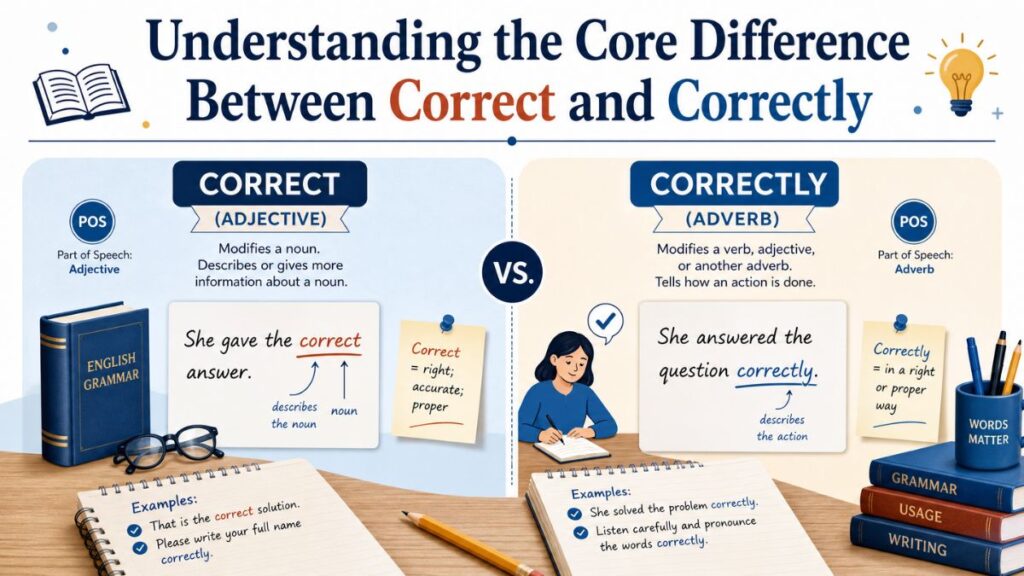
If you have ever typed a sentence and paused, wondering whether to write correct or correctly, you are not alone. Even fluent English speakers trip over this pair. The words share the same root, look nearly identical, and both deal with accuracy — yet they serve completely different roles in a sentence.
Here is the short version: correct is an adjective, and correctly is an adverb. Adjectives describe nouns. Adverbs describe verbs, adjectives, or other adverbs. That distinction — noun vs. action — is the only rule you truly need.
Think of it this way:
- Correct = labels a thing as accurate → The answer is correct.
- Correctly = describes how an action is done → She answered correctly.
Once that clicks, the rest falls into place naturally.
How to Use Correct in a Sentence
Correct functions primarily as an adjective. It attaches to nouns or follows linking verbs like is, was, seems, and appears. Its job is to tell you whether something — an answer, a method, a statement, a file — is accurate, true, or free from error.
Examples in Everyday Use
- The student gave the correct answer.
- Please make sure you’re using the correct file format.
- His calculations were correct.
- That is the correct interpretation of the law.
- She chose the correct method for the experiment.
Notice something important in each sentence. There is a noun being described — answer, format, calculations, interpretation, method. That is the signal. When a noun needs labeling as right or accurate, reach for correct.
When Correct Adds Nuance
Correct does more than mean right. It also carries shades of meaning:
- Socially acceptable → She used the correct form of address in her letter.
- Technically proper → Enter the correct password to continue.
- Contextually suitable → This is not the correct time to bring that up.
In formal and academic writing, correct often signals precision and objectivity. It keeps your reader focused on the quality of a thing rather than on how something was done.
Common Mistakes Learners Make
The most common error with correct is placing it after an action verb:
- ❌ She answered the question correct.
- ✅ She answered the question correctly.
- ❌ You did it correct.
- ✅ You did it correctly.
Why is this wrong? Because action verbs like answered and did need adverbs to explain how the action happened — not adjectives. Attaching an adjective to a verb breaks the grammatical function.
How to Use Correctly in a Sentence
Correctly is the adverb form of correct. It is formed simply by adding -ly to the adjective, which is the most common way English builds adverbs. Its entire job is to modify verbs — to tell the reader how an action was performed.
Examples in Everyday Use
- She spelled the word correctly.
- He correctly identified the problem before anyone else did.
- Make sure you install the software correctly.
- If you follow the steps correctly, the results will improve.
- The system is not functioning correctly.
In each sentence, there is an action being described — spelled, identified, installed, followed, functioning. The adverb correctly wraps around the action and tells us it was done correctly.
Why Adverbs Matter
Without adverbs like correctly, sentences can feel incomplete or vague. Compare these two:
| Without Adverb | With Adverb |
|---|---|
| He filled out the form. | He filled out the form correctly. |
| She wrote it. | She wrote it correctly. |
| The technician set it up. | The technician set it up correctly. |
The second column adds precision. It removes ambiguity and gives the reader confidence that the action met the required standard. That is the power of adverbs in real-world communication.
Common Mistakes Learners Make
Some learners over-apply correctly in places where correct should go:
- ❌ That is a correctly answer.
- ✅ That is a correct answer.
- ❌ Your answer is correctly.
- ✅ Your answer is correct.
Here, the sentence is describing a noun (answer), not an action. Linking verbs like is are followed by adjectives, not adverbs. Swapping them produces a grammatically broken sentence.
Common Confusions in Real Sentences
Some sentences genuinely look like either word could work. This is where most learners struggle the most.
| Sentence | Correct Choice | Reason |
|---|---|---|
| You got it ___. | correct | Refers to “it” (a noun — the answer) |
| She answered ___. | correctly | Describes how she answered (action) |
| That is the ___ approach. | correct | Modifies “approach” (noun) |
| He typed the report ___. | correctly | Describes how he typed (action) |
| Your calculations are ___. | correct | Describes “calculations” (noun) |
| Pronounce each word ___. | correctly | Describes how to pronounce (action) |
Quick Test: Try replacing the blank with “in a correct manner.” If the sentence still flows naturally, use correctly. If it sounds odd, use correct.
Grammar Breakdown: What Part of Speech Is Correctly?
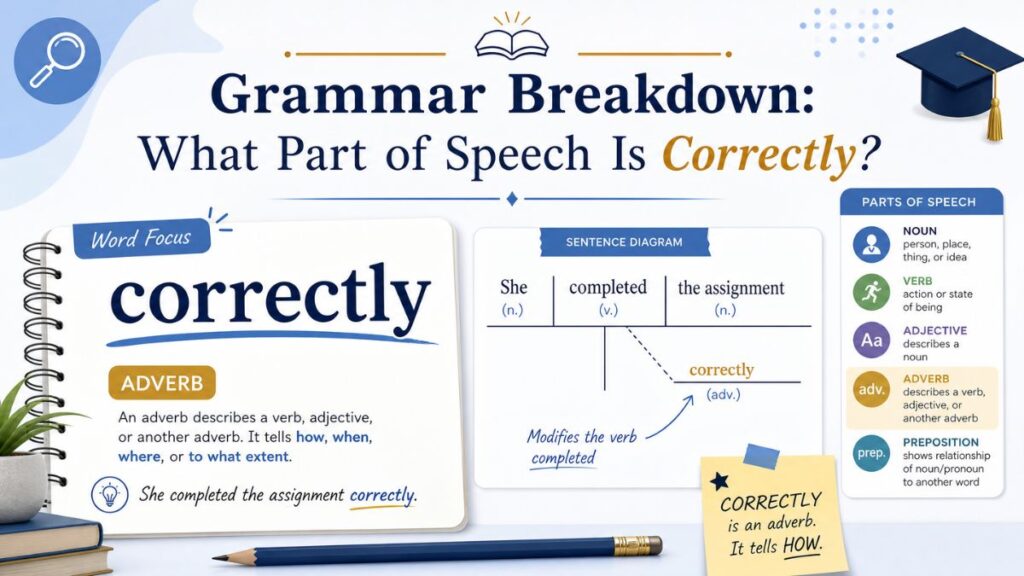
Correctly is an adverb. It was formed by adding -ly to the adjective correct. English creates most of its adverbs this way — quick → quickly, slow → slowly, clear → clearly.
As an adverb, correctly can describe:
- A verb → She spoke correctly.
- An adjective → That is correctly identified as a flaw.
- Another adverb → He did it more correctly than expected.
One flexible quality of adverbs is their placement. Unlike adjectives, which typically sit right before or after the noun they modify, adverbs can move around without breaking the sentence:
- She correctly completed the task.
- She completed the task correctly.
Both versions are grammatically sound. Placement only shifts the emphasis and rhythm.
Quick Rules for Spotting Adverbs
- Does it end in -ly? (Not always, but often.)
- Does it answer how, when, where, or to what degree?
- Does it modify a verb, an adjective, or another adverb?
- Can you remove it without breaking the sentence structure?
If the answer is yes, it is likely an adverb — and correctly fits squarely in that category.
Formal vs Casual Speech
Language does not always follow the textbook — especially in conversation. Native speakers regularly bend grammar rules when speaking informally, and correct vs correctly is one of the most common places this happens.
| Context | Typical Usage | Example |
|---|---|---|
| Casual speech | correct (even after verbs) | “You got it correct, nice!” |
| Formal writing | correctly (after action verbs) | “The student answered correctly.” |
| Academic English | correctly (strict usage) | “The formula was applied correctly.” |
| Professional emails | Depends on verb or noun | “Please ensure the form is completed correctly.” |
In fast conversation, dropping the -ly is so common that it barely registers. However, in written English — especially professional reports, academic essays, and formal communications — grammar precision matters. Using correct where correctly belongs can undermine your credibility.
When Correct Sounds Better
Reach for correct when:
- You are describing a noun, result, or thing
- The sentence uses a linking verb (is, was, seems, appears)
- You want to label something as right, proper, or accurate
- You are responding with a single-word confirmation (“Correct.”)
- You are in professional or academic writing where precision signals competence
Examples:
- That’s the correct form to submit.
- Her answer was correct.
- “Correct.” (As a standalone affirmation)
When Correctly Sounds Better
Reach for correctly when:
- An action verb is present in the sentence
- You want to describe how something was done
- You are giving instructions (do this correctly)
- You are stressing the method, process, or manner of an action
- Formal writing requires strict grammar compliance
Examples:
- Make sure you save the file correctly.
- If I remember correctly, the meeting is at noon.
- She correctly predicted the outcome.
Classroom Case Study
Imagine a grammar class where the teacher writes one sentence on the board:
“I did it ___.”
Student A writes: I did it correct. ❌ Teacher explains: Did is an action verb. Action verbs need adverbs to tell us how the action happened. The correct choice is correctly.
Student B writes: I did it correctly. ✅ Teacher confirms: Exactly right. The adverb correctly tells us how the action of doing was performed.
Then the teacher writes a second sentence:
“Your answer is ___.”
Student A writes: Your answer is correctly. ❌ Teacher explains: Is is a linking verb. Linking verbs are followed by adjectives, not adverbs. The noun being described is answer, so correct is the right choice.
Student B writes: Your answer is correct. ✅ Teacher confirms: Perfect. This is the pattern to memorize.
Memory Tricks to Never Forget
These shortcuts make choosing between the two feel effortless:
- The Thing vs. The Action Test → Describing a thing? Use correct. → Describing an action? Use correctly.
- The -ly Swap Test → Try replacing the word with another adverb like quickly or neatly. → If it works, you need correctly. → If it sounds wrong, you need correct.
- The “In a Correct Manner” Test → Replace the blank with “in a correct manner.” → If it still flows, use correctly.
- Verb Detector Trick → Spot the verb in the sentence. If the word you’re choosing modifies that verb, it must be the adverb — correctly.
- Linking Verb Alert → After is, was, seems, appears, or becomes — always use the adjective correct.
Quick Comparison Table
| Feature | Correct | Correctly |
|---|---|---|
| Part of speech | Adjective (also noun/verb) | Adverb |
| Modifies | Nouns, pronouns | Verbs, adjectives, adverbs |
| Answers the question | Which one? What kind? | How? |
| Follows linking verbs? | ✅ Yes | ❌ No |
| Follows action verbs? | ❌ No | ✅ Yes |
| Ends in -ly? | ❌ No | ✅ Yes |
| Formal use | Describing accurate nouns | Describing proper actions |
| Casual shorthand | “You got it correct.” | “You did it correctly.” |
FAQ’s
What is the difference between correct and correctly?
Correct is an adjective that describes nouns (the correct answer), while correctly is an adverb that describes how an action is done (she answered correctly). The core rule: use correct for things, correctly for actions.
Can I say “I did it correct”?
No — did is an action verb, and action verbs require adverbs. The grammatically accurate version is “I did it correctly.” In very casual conversation, people may say it informally, but it should be avoided in writing.
Is it right to say “You got it correct”?
Yes, this is acceptable. Here, it refers to the answer (a noun), so the adjective correct works properly — it describes the result, not the action of getting.
What part of speech is correctly?
Correctly is an adverb formed by adding -ly to the adjective correct. It modifies verbs, adjectives, or other adverbs, and answers the question “how?”
Can I use “right” instead of correctly?
Yes, especially in informal English. “You got it right” and “You did it right” sound perfectly natural in everyday conversation. For formal or academic contexts, correctly is the more precise and professional choice.
Conclusion
The difference between correct and correctly comes down to one simple grammar principle: adjectives describe things, and adverbs describe actions. Correct vs Correctly. Use correct when you are labeling a noun as accurate, proper, or right. Use correctly when you are explaining how an action was performed. Correct vs Correctly.
Master this distinction and your written and spoken English will immediately feel more polished. Correct vs Correctly. Practice the memory tricks, test yourself with real sentences, and soon choosing between these two words will become second nature — no hesitation, no second-guessing, just clean, confident grammar every time. Correct vs Correctly.