You’re texting a friend about weekend plans. They reply, “Let’s do next Friday instead.” Now you’re staring at your phone wondering: do they mean the Friday that’s three days away, or the one ten days away? If you’ve ever rescheduled, double-booked, or shown up on the wrong day because of this exact mix-up, you’re not alone. “This Friday” and “next Friday” are two of the most commonly misused time references in English, and the confusion isn’t your fault — it’s built into how the language works. Next Friday vs This Friday.
This guide breaks down exactly what each phrase means, why people interpret them differently, and how to make sure your plans never get lost in translation again.
Why “Next Friday” and “This Friday” Cause So Much Confusion
English doesn’t have a single, official rulebook for talking about future days. Instead, speakers rely on a shared sense of “where we are in the week,” and that sense shifts depending on the day, the region, and even personal habit. A word like “next” sounds precise, but in everyday speech it stretches to mean different things to different people.
A few root causes drive the confusion:
- There’s no universal grammar rule that locks “next Friday” to one specific date.
- The meaning can change depending on what day of the week you’re speaking.
- Regional habits (US, UK, Australia) don’t always agree.
- Calendar apps often interpret these phrases more strictly than humans do.
Once you understand these moving parts, the confusion starts to make a lot more sense.
The Core Difference Between “This Friday” and “Next Friday”
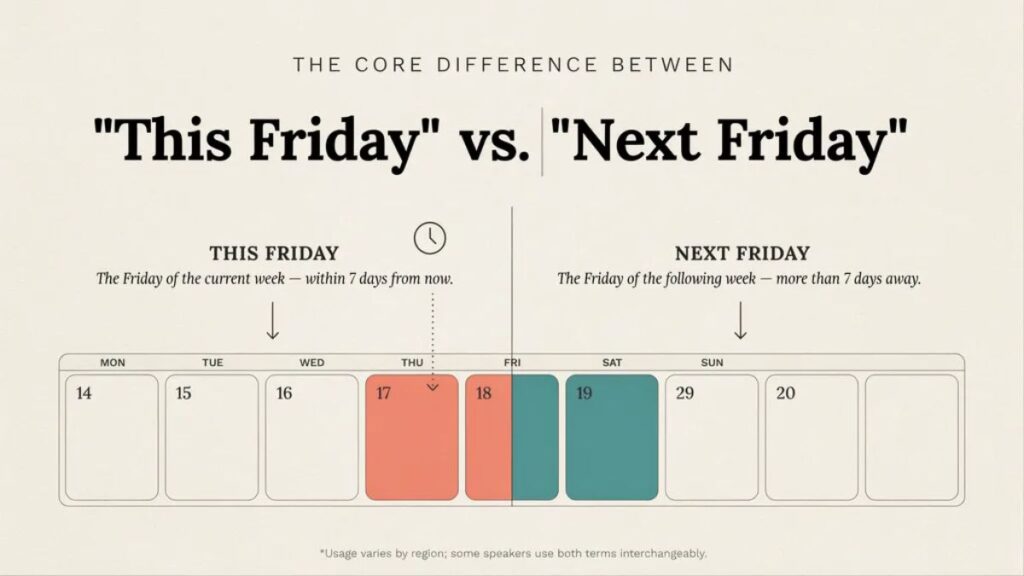
At the most basic level:
- This Friday refers to the Friday coming up in the current week — the nearest one on the calendar.
- Next Friday generally refers to the Friday of the following week, one full week after the upcoming Friday.
| Phrase | Typical Meaning | Distance From Today |
|---|---|---|
| This Friday | The closest upcoming Friday | A few days away (or today, if it’s already Friday) |
| Next Friday | The Friday after the upcoming one | About 8–13 days away, depending on the day you’re speaking |
That said, this is the standard interpretation — not a guaranteed one. Plenty of speakers use “next Friday” to mean the soonest Friday, especially in casual conversation. The difference is subtle but can lead to very real scheduling errors.
How the Structure of the Week Shapes Meaning
Your sense of “this week” versus “next week” plays a huge role in how you interpret these phrases. If you mentally treat Monday as the start of a new week, your “this Friday” resets every Monday. If your week feels like it rolls continuously forward (a “rolling-week” mindset), the nearest Friday is always “this Friday,” no matter what day it is.
This is why two people having the same conversation can walk away with two different dates in mind — neither person is technically wrong; they’re just using different mental calendars.
What “This Friday” Actually Means
In most everyday English, “this Friday” points to the Friday that falls within the current calendar week — the one closest to today, counting forward.
Using “This Friday” Earlier in the Week
If today is Monday, Tuesday, Wednesday, or Thursday, “this Friday” almost always means the upcoming Friday, just a few days away. There’s little ambiguity here — most native speakers agree on this interpretation, which makes it the safest part of the whole topic.
Using “This Friday” on Friday Itself
Things get a little more interesting once Friday actually arrives. If someone says “this Friday” on a Friday morning, it usually means today. By Friday evening, though, some speakers mentally shift toward the following week, especially if the day’s events have already wrapped up. This small shift is one of the most overlooked sources of miscommunication.
What “Next Friday” Really Means
“Next Friday” is the real troublemaker in this topic. In the strictest, most widely taught interpretation, it means the Friday of the following week — not the nearest one, but the one after that.
The Calendar-Based Interpretation
Most digital calendars and scheduling tools (including Google Calendar) follow the strict rule: “next Friday” skips the upcoming Friday and lands on the one a full week later. This is considered the formal, dictionary-aligned interpretation, and it’s the one most professionals are taught to use in writing.
The Conversational Interpretation
In casual speech, plenty of people use “next Friday” to mean the soonest Friday coming up, treating “next” as a synonym for “upcoming” rather than “the one after this one.” This usage is common, especially in parts of the US South, the UK, and Australia, but it directly contradicts the calendar-based rule — which is exactly why arguments happen.
The Biggest Misconceptions People Make
Assuming Everyone Uses the Same Rule
The single biggest mistake is assuming your interpretation is universal. Your “next Friday” might be someone else’s “this Friday.” Families, workplaces, and regions all develop their own habits, and none of them are officially “wrong.”
Believing Grammar Alone Decides Meaning
Grammar tells you that “next” means “the following one in a series.” But days of the week aren’t a simple linear list — they’re cyclical, repeating every seven days. That repetition is exactly what makes phrases like this so easy to misread, even for native speakers.
Ignoring Timing in the Conversation
When you say something matters just as much as what you say. The same sentence — “let’s meet this Friday” — can mean two completely different dates depending on whether it’s spoken on a Tuesday or a Saturday.
Real-Life Scenarios: “This Friday” in Context
Work deadlines
“Please send the draft this Friday,” said on a Tuesday, clearly points to the end of the current work week — a short, low-ambiguity deadline.
Social plans
“Want to grab dinner this Friday?” texted on a Wednesday almost always means the very next Friday, just two days out.
School or training schedules
“Class moves online this Friday,” announced midweek signals a change happening within days, not weeks — students rarely question this one.
Real-Life Scenarios: “Next Friday” in Context
Project timelines
“The report is due next Friday,” stated on a Monday, under the strict interpretation, means the Friday of the following week — giving the team roughly 11 days, not 4.
Appointments and bookings
A traveler who books “next Friday” flights, assuming it means the soonest Friday, can end up a full week off from what the airline or agent intended.
Conversations late in the week
Said on a Thursday or Friday, “next Friday” becomes far less ambiguous — most listeners agree it refers to the Friday more than a week away, since “this Friday” already covers the nearest one.
What Happens When the Weekend Starts
Friday night usage
Once Friday evening rolls in, some speakers start treating the day as “over,” shifting their internal sense of “this Friday” to the upcoming week’s Friday instead of today.
Saturday and Sunday usage
On a Saturday or Sunday, “this Friday” almost always refers to the Friday still ahead in the same calendar week. Meanwhile, “next Friday” pushes one Friday beyond that — though a few speakers, anchored to the just-passed Friday, may interpret it as the one immediately following.
Regional and Cultural Differences in Usage
Workplace vs casual speech
In professional settings, “next Friday” is more likely to follow the strict, calendar-based rule. In casual conversation with friends or family, “next” often loosely means “upcoming,” regardless of which week it technically falls in.
Global teams
For international or remote teams, regional habits collide constantly. Someone in the UK might say “next Friday” meaning the nearest one, while a US colleague assumes it means the following week. Multiply that across time zones, and the room for error grows fast.
| Region | Common Interpretation of “Next Friday” |
|---|---|
| US (general) | Friday of the following week |
| US South | Often the nearest upcoming Friday |
| UK | Frequently, the nearest upcoming Friday |
| Australia | Mixed; varies by speaker |
How to Avoid Confusion Completely
Use specific dates
The simplest fix is also the most effective: replace “next Friday” with an actual date, like “Friday, July 10.”
Use clarifying phrases
Phrases like “this coming Friday” or “Friday week” remove almost all ambiguity, since they explicitly signal which week you mean.
Confirm when stakes are high
For deadlines, flights, or bookings, a quick follow-up question — “Just to confirm, do you mean this week or next?” — takes seconds and prevents costly mistakes.
Professional Communication: Why Clarity Matters
In business, a misunderstood date can mean a missed deadline, a wasted trip, or an empty meeting room. Calendar invites with exact dates, written confirmations, and consistent phrasing all build trust and reduce friction. Teams that standardize on “always use the date” tend to avoid these mix-ups entirely, which is why so many workplace style guides now recommend it as a default habit.
Quick Decision Guide: Which One Should You Use?
- If the event is happening within the next 1–5 days → say “this Friday.”
- If the event is more than a week away → say “next Friday,” but pair it with a date.
- If you’re unsure how the other person interprets these phrases → skip both and use the exact date.
- If you’re scheduling internationally → always default to the calendar date to avoid regional clashes.
FAQ’s
What does “this Friday” usually mean?
It usually refers to the closest upcoming Friday within the current week, or today if it’s already Friday.
What does “next Friday” usually mean?
In the strict, calendar-based interpretation, it means the Friday of the following week, not the nearest one.
Does “this Friday” include today if today is Friday?
Yes. If today is Friday, “this Friday” typically means today, especially earlier in the day.
Is “next Friday” always one week later?
Not always. Many casual speakers use it to mean the nearest Friday, so confirming with a date is the safest approach.
How can I avoid confusion in professional settings?
Always pair these phrases with an exact date, like “next Friday, July 10,” in emails, invites, and messages.
Conclusion
Next Friday vs This Friday: The Clear Guide to Never Miss a Date Again shows one simple truth. These two phrases feel small, but they cause big mix-ups. Next Friday vs This Friday. People read them in different ways. Some think of the nearest Friday. Others jump a full week ahead. Neither side is wrong. They just follow different habits. Next Friday vs This Friday.
That’s why Next Friday vs This Friday: The Clear Guide to Never Miss a Date Again matters so much. The fix is easy. Say the exact date. Confirm when plans really count. Next Friday vs This Friday. This small habit saves time. It stops confusion before it starts. Clear words make every plan simple. Next Friday vs This Friday.