One small spelling slip can change your entire meaning. Between “due to” and “do to,” writers of all levels make this mistake every single day — and most don’t even notice. These two phrases sound identical in speech, but in writing, only one of them is almost always correct. This article breaks down exactly when to use each phrase, why people confuse them, and how to remember the difference for good. Whether you’re writing a formal email, an academic paper, or a casual blog post, this guide will sharpen your grammar and boost your confidence.
The Core Difference Between “Due To” and “Do To”
At first glance, “due to” and “do to” look almost identical. But their grammatical roles are completely different.
What “Due To” Means
“Due to” is a phrase used to explain the reason or cause of something. It functions as an adjective phrase and is typically connected to a noun. In other words, it tells you why something happened.
- The match was canceled due to heavy rain.
- Her absence was due to illness.
“Due to” is a legitimate English phrase meaning “because of,” “owing to,” or “caused by.”
What “Do To” Means
“Do to” is not a fixed phrase. It only appears in sentences where “do” is used as an action verb followed by the preposition “to.” “Do to” is a verb phrase meaning to act like someone or something.
- What did you do to the laptop?
- Don’t do to others what you wouldn’t want done to yourself.
Outside of this verb construction, “do to” has no grammatical role.
When To Use “Due To” Correctly
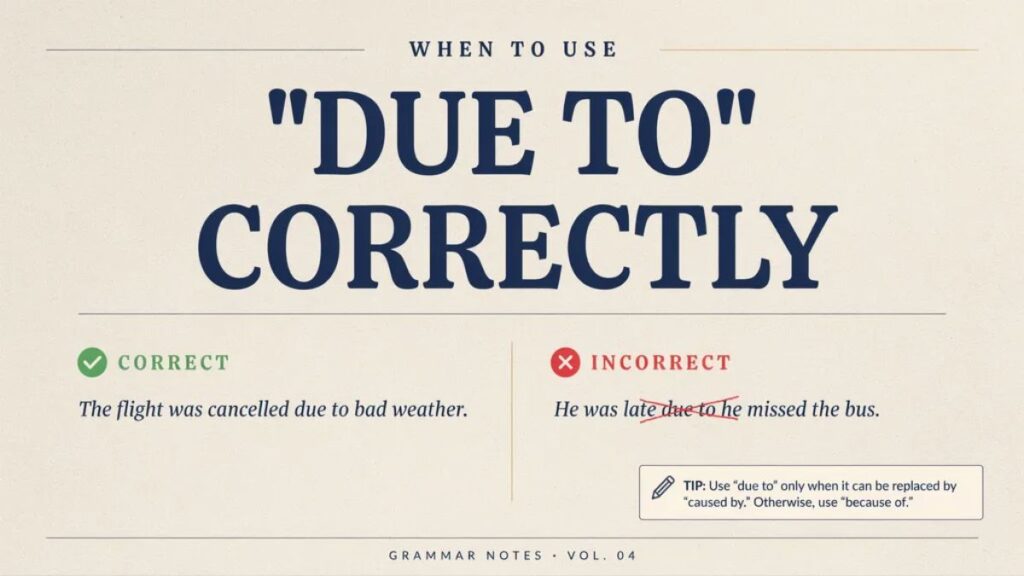
The phrase “due to” is widely used in English to explain a reason or cause. You will often see it in sentences that explain why something happened.
Correct Usage Patterns
“Due to” should modify a noun, not a verb. It typically follows a linking verb like is, was, or were.
Pattern: [Noun] + [linking verb] + due to + [cause]
- The delay was due to a system error.
- His success was due to years of hard work.
- The cancellation was due to bad weather.
Important Notes About “Due To”
Some style guides accept broader usage of “due to,” including starting sentences with it. The AP Stylebook allows “due to” at the start of sentences in news writing. The Chicago Manual of Style prefers due to ” for modifying nouns but acknowledges that common usage has broadened.
Even experts agree that language evolves — but knowing the traditional rules will always keep your writing safe and professional.
Quick Style Tip
Avoid the wordy construction “due to the fact that.” It adds bulk without adding meaning. Replace it with “because” for cleaner sentences.
❌ Due to the fact that it was raining, we stayed inside. ✅ Because it was raining, we stayed inside.
When To Use “Do To” Correctly
“Do to” is valid only when “do” is functioning as an action verb in a sentence. “Do to” only makes sense when “do” is a verb and “to” is part of a prepositional phrase. Outside this context, it’s usually incorrect.
Examples
- What did they do to the old building?
- She didn’t know what to do to fix the problem.
- What will you do to improve the situation?
In each of these, “do” is clearly performing the role of a verb, and “to” introduces an object or purpose.
Common Mistake: Confusing “Do To” with “Due To”
The confusion arises because “due” and “do” are homophones — they sound identical when spoken aloud. This phonetic similarity leads many writers to mistakenly write “do to” when they mean “due to.”
Fast typing, autocorrect, and casual speech all make this error worse. Grammar tools don’t always catch it either, because both spellings are technically real words.
Incorrect Examples
These sentences use “do to” where “due to” is required:
- ❌ The flight was canceled do to fog.
- ❌ She was late do to heavy traffic.
- ❌ The project failed do to a lack of planning.
- ❌ School was closed do to the storm.
Corrected Examples
- ✅ The flight was canceled due to fog.
- ✅ She was late due to heavy traffic.
- ✅ The project failed due to a lack of planning.
- ✅ School was closed due to the storm.
Quick Comparison Table
| Feature | Due To | Do To |
|---|---|---|
| Part of speech | Adjective phrase | Verb + preposition |
| Meaning | Because of / caused by | To act on |
| Modifies | A noun | Follows an action verb |
| Example | The loss was due to errors. | What did you do to the file? |
| Used as cause/reason? | ✅ Yes | ❌ No |
| Common mistake? | Often misused broadly | Often misspelled for “due to” |
Easy Fix: Replace With “Because”
The simplest way to check if you’re using the right phrase: substitute “because.” If you can use “because” in your sentence, the correct word to use is “due.”
- The delay was due to rain. → The delay was because of rain. ✅
- What did you do to the car? → What did you because of the car? ❌ (Doesn’t work — keep “do to”)
If the replacement feels natural, use “due to.”if it sounds wrong, you’re likely dealing with the verb “do.”
Synonyms & Alternatives for “Due To”
When “due to” feels repetitive or too formal, try these alternatives:
- Because of – The match was postponed because of rain.
- Owing to – Owing to delays, the package arrived late. (formal/academic)
- As a result of – As a result of the error, data was lost.
- Thanks to – Thanks to her effort, the event was a success. (positive tone)
- On account of – On account of illness, he missed the meeting.
- Caused by – The problem was caused by a software bug.
“Due” vs. “Do” – Breaking Down the Root Words
Due
“due” comes from Latin debere — “to owe.” It conveys reason or obligation. Beyond the phrase “due to,” it appears in:
- Expected context: The report is due on Friday.
- Owed context: Payment is due immediately.
- Directional context: Head due north for two miles.
Do
“Do” is one of the most common and versatile verbs in English. It functions both as a main verb and as an auxiliary (helping) verb.
- Main verb: She does excellent work.
- Auxiliary verb: Do you understand the question?
- Negative form: I do not agree with that decision.
Examples in Real Sentences
Due To
- The road closure was due to construction work.
- Her promotion was due to consistent performance.
- The delay was due to an unexpected power outage.
- School was canceled due to heavy snowfall.
Do To
- What did the mechanic do to the engine?
- She wasn’t sure what to do to calm the situation.
- What will the medicine do to your body?
Correct Uses of “Due To”
- ✅ The failure was due to human error.
- ✅ Traffic was heavy due to an accident on the highway.
- ✅ The event was postponed due to low attendance.
- ✅ His injury was due to overtraining.
Correct Uses of “Do To”
- ✅ What can we do to solve this problem?
- ✅ What did the update do to the app’s performance?
- ✅ I won’t do to others what I don’t want done to me.
Memory Tricks to Avoid Confusion
Use these simple mental shortcuts:
- “DUE = CAUSED BY” — If you can replace the phrase with “caused by,” use due to.
- “DO = ACTION” — If a verb is performing an action, use do.
- “BECAUSE TEST” — Swap in “because of.” If it sounds right, you want due to.
- Think of a bill — A payment is due. Something owed = due. Something caused = due to.
- Listen for a verb before “to” — “What did you do to…?” always has an action verb.
Quick Quiz – Test Your Knowledge
Choose the correct word for each blank:
- The game was called off ___ heavy rain. (due to / do to)
- What did you ___ the computer? (due to / do to)
- Her grade dropped ___ missed assignments. (due to / do to)
- What can she ___ improve the design? (due to / do to)
- The delay was ___ a server issue. (due to / do to)
Answers: 1. due to | 2. do to | 3. due to | 4. do to | 5. due to
Common Spell-Check and Grammar Tool Flags
Most writing tools handle this mistake inconsistently:
| Tool | Behavior |
|---|---|
| Grammarly | Usually catches “do to” when clearly out of place |
| Microsoft Word | Flags “due to” when incorrectly used after action verbs |
| Google Docs | Often misses the error entirely — human review needed |
| Quillbot | Flags the phrase and suggests the correct spelling |
Always apply the “caused by” vs. “action done” rule — don’t rely on software alone.
FAQs
What is the correct phrase: due to or do to?
“Due to” is the correct phrase when expressing a cause or reason. “Do to” is always wrong when used to mean “because of.”
Can “do to” ever replace “due to”?
No. “Do to” only makes sense when “do” is an action verb. Otherwise, it’s incorrect and unprofessional.
Is “due to” formal or informal?
“Due to” is considered more formal and is preferred in academic or business writing, while “because of” works in casual conversation.
How can I test if “due to” is right?
Replace it with “caused by.” If the sentence still makes sense, “due to” is correct.
Why do people confuse “do to” with “due to”?
Because “due” and “do” are pronounced identically in most English dialects, making it impossible to tell them apart by sound alone.
Conclusion
The difference between “due to” and “do to” comes down to one simple question: are you showing a cause, or describing an action? Use “due to” to explain why something happened — it’s almost always the phrase you need. Reserve “do to” for sentences where “do” is working as an action verb. When in doubt, swap in “because of” and let the test guide you. With this rule in your toolkit, you’ll write with more precision, professionalism, and confidence every time.