“Much needed” and “much-needed” are two forms of the same compound modifier in English grammar — one hyphenated, one not — and each belongs in a specific place in a sentence based on where it appears relative to the noun it describes.
Here is the truth most grammar guides skip: a single hyphen can be the difference between polished, professional writing and a sentence that quietly loses credibility with editors, teachers, and readers.
Both forms carry identical meaning — something greatly necessary — but placement is everything. Used before a noun, the hyphen is non-negotiable. Used after a verb, it disappears entirely. Master this one rule, and dozens of similar compound modifiers instantly fall into place.
Understanding “Much Needed” vs “Much-needed”
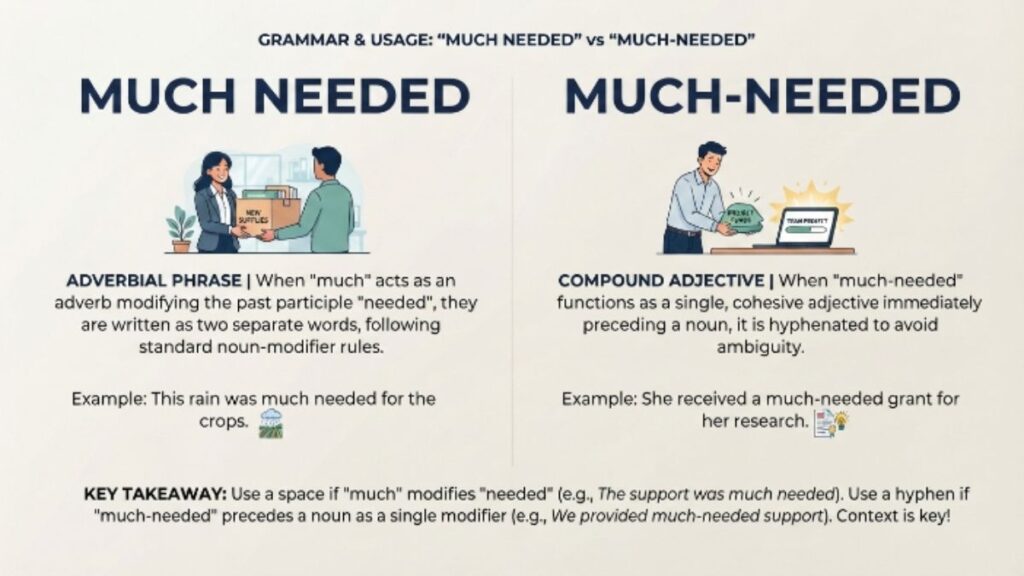
Both “much needed” and “much-needed” carry the same meaning: something that is very necessary or greatly required. The hyphen doesn’t change the meaning — it changes the grammatical role of the phrase in a sentence.
The Core Grammar Idea
The phrase functions as a compound modifier — two words working together to describe a noun. In English grammar, compound modifiers follow a specific hyphenation rule based on whether they appear before or after the noun they modify.
- Before the noun → use a hyphen: much-needed
- After the noun (following a verb) → no hyphen: much needed
This is the same rule that governs phrases like well-known, long-term, and high-quality. It’s not a gray area — both the AP Stylebook and the Chicago Manual of Style agree on this rule.
Examples Side by Side
The table below shows both forms in action. Same idea, different sentence position, different spelling.
| Sentence | Form Used | Why |
|---|---|---|
| She finally took a much-needed vacation. | much-needed | Before the noun “vacation” |
| The vacation was much needed. | much needed | After the linking verb “was” |
| He delivered much-needed supplies to the team. | much-needed | Before the noun “supplies” |
| Those supplies were much needed. | much needed | After the verb “were” |
| It was a much-needed reminder. | much-needed | Before the noun “reminder” |
| That reminder was much needed. | much needed | After the verb “was” |
When to Use “Much Needed” (Two Words)
Use “Much Needed” After a Verb
When the phrase comes after the noun it describes — typically following a linking verb like is, was, were, or felt — you drop the hyphen entirely. At this point in the sentence, the noun has already been introduced, so the modifier is completing a thought rather than directly attaching to a word.
Correct Examples
- The break was much needed after a long week.
- Rest is much needed when you’re running on empty.
- Their contribution was much needed at that stage of the project.
- The funding proved much needed as deadlines approached.
- Sleep felt much needed after three days of travel.
Common Contexts
You’ll see the unhyphenated form most often in:
- Expressions of relief or gratitude: “That coffee was much needed.”
- Statements after the fact: “The repair turned out to be much needed.”
- Casual writing and conversation: “Your help was much needed, thank you.”
In these cases, “much needed” acts as a predicate adjective — it follows the verb and tells us something about the subject. No hyphen required.
When to Use “Much-needed” (Hyphenated)
Use “Much-needed” Before a Noun
When “much-needed” comes directly before a noun, the hyphen is required. Here, both words work together as a single descriptive unit — a compound modifier — and the hyphen is the signal that they belong together.
Think of it this way: without the hyphen, a reader could briefly misread “much” as a standalone modifier. The hyphen removes that ambiguity instantly.
Correct Examples
- The organization received a much-needed grant.
- After hours of debate, they reached a much-needed agreement.
- She offered much-needed clarity on the issue.
- The city finally approved much-needed infrastructure repairs.
- This was a much-needed update to an outdated policy.
Why This Matters
In professional writing — including academic papers, journalism, marketing copy, and business communication — the hyphen signals intentional, precise writing. Editors notice when it’s missing. Readers may not name the issue, but they often feel a subtle friction when compound modifiers are left open before a noun.
Why the Hyphen Matters in Grammar
Hyphens in compound modifiers aren’t decoration. They act as clarity tools, linking related words so readers process them as a single idea rather than separate descriptors.
Without the hyphen: “She needed much needed support” — clunky and slightly ambiguous. With the hyphen: “She needed much-needed support” — clear, polished, and professional.
Research Insight
Studies on readability consistently show that well-formatted text reduces cognitive load. When readers don’t have to pause and reprocess a phrase, comprehension improves. A correctly placed hyphen does exactly that — it removes the mental friction of parsing two words that belong together.
Grammar Rule of Hyphenation in Compound Modifiers
General Rule
Hyphenate a compound modifier when it comes before the noun it modifies. Drop the hyphen when it comes after the noun.
This rule applies broadly across English grammar and is supported by every major style guide, including the AP Stylebook, the Chicago Manual of Style, and Grammarly’s usage guidelines.
Common Compound Modifier Examples
| Compound Modifier | Before Noun (Hyphenated) | After Noun (No Hyphen) |
|---|---|---|
| well known | a well-known author | The author is well known. |
| long term | a long-term plan | The plan is long term. |
| high quality | high-quality content | The content is high quality. |
| much needed | a much-needed reform | The reform was much needed. |
| fast acting | a fast-acting solution | The solution is fast-acting. |
Examples with Other Words Like “Much-needed”
More Compound Modifier Examples
“Much-needed” isn’t alone. Many common English phrases follow the same before/after rule:
- Well-known → a well-known fact / The fact is well known.
- Long-term → a long-term strategy / The strategy is long-term.
- Hard-working → a hard-working employee / The employee is hard-working.
- Up-to-date → up-to-date information / The information is up to date.
- High-quality → high-quality materials / The materials are high quality.
- Fast-growing → a fast-growing industry / The industry is fast-growing.
Once you internalize this pattern, you’ll apply it automatically — not just to “much-needed” but to dozens of compound modifiers you use every day.
Common Mistakes and How to Avoid Them
Mistake 1: Adding Hyphens Everywhere
Some writers hyphenate “much-needed” regardless of where it appears in a sentence. This overuse of hyphens can actually make writing look less polished.
❌ The support was much-needed during the crisis. ✅ The support was much needed during the crisis.
Fix: Check whether the phrase comes before or after the noun. If it follows a verb like was or is, remove the hyphen.
Mistake 2: Forgetting the Hyphen Before a Noun
The opposite error is equally common — writers who never hyphenate, even when the phrase directly precedes the noun.
❌ They approved a much needed renovation. ✅ They approved a much-needed renovation.
Fix: Ask yourself: Does “much-needed” sit directly in front of a noun? If yes, the hyphen belongs there.
Mistake 3: Inconsistent Usage
Using “much-needed” in one paragraph and “much needed” in the same context elsewhere creates inconsistency that editors and readers notice — even if they can’t pinpoint why.
Fix: Decide on position first (before or after the noun), then apply the correct form every time. Consistency is a hallmark of professional writing.
Quick Reference Guide
| Position in Sentence | Form | Example |
|---|---|---|
| Before a noun | much-needed (hyphenated) | a much-needed break |
| After a linking verb | much needed (no hyphen) | The break was much needed. |
| In a headline/title | much-needed (before noun) | “City Approves Much-Needed Repairs” |
| After a noun as predicate | much needed (no hyphen) | Sleep is much needed right now. |
Case Study: How a Hyphen Changed Meaning
Here’s a real-world writing scenario that illustrates why this rule matters in practice.
Sentence A
The company offered much needed support to employees.
At first glance, this reads fine. But a careful editor pauses — is “much” modifying “needed,” or is “much needed” a compound modifier describing “support”? The sentence is technically readable, but it introduces a split-second of hesitation.
Sentence B
The company offered much-needed support to employees.
The hyphen erases any ambiguity. “Much-needed” is clearly one unit of description attached to “support.” The sentence reads faster, flows better, and signals a writer who knows their craft.
That single hyphen is the difference between writing that’s acceptable and writing that’s sharp.
What to Remember (Key Takeaways)
- “Much-needed” (hyphenated) → use when it comes before a noun
- “Much needed” (no hyphen) → use when it follows a linking verb
- Both forms mean the same thing — position in the sentence determines the spelling
- This rule applies to all compound modifiers, not just “much needed”
- AP Style and Chicago Manual of Style both support this rule
- Consistency matters — pick the correct form based on sentence structure and stick to it
FAQs
Is “much needed” grammatically correct?
Yes, “much needed” is grammatically correct when it follows a linking verb — for example, “The support was much needed.” No hyphen is required in this position.
Why is “much-needed” hyphenated?
“Much-needed” is hyphenated when it directly precedes a noun, because the two words function together as a single compound modifier — for example, “a much-needed break.” The hyphen prevents ambiguity and signals that both words describe the noun as one idea.
Can I always use the hyphen to be safe?
No. Using a hyphen after a linking verb — “The rest was much-needed” — is grammatically incorrect. The hyphen is only appropriate before a noun.
Is “much-needed” formal or informal?
“Much-needed” suits both formal and informal writing. It appears in academic papers, news headlines, business documents, and casual blogs alike. The key is applying it in the correct position.
Are there other phrases like “much-needed”?
Yes — many common compound modifiers follow the same rule, including well-known, long-term, high-quality, fast-acting, and up-to-date. All of these take a hyphen before a noun and drop it after a verb.
Conclusion
The rule behind “much needed” and “much-needed” is simple. Before a noun, use the hyphen. After a verb, drop it. That single decision keeps your writing clean, correct, and professional every time.
Mastering “much needed” vs “much-needed” is one small step with a big payoff. It sharpens your grammar, builds reader trust, and eliminates a mistake most writers never even notice they’re making. Now you know the rule — use it with confidence.