“Feel” and “felt” are two forms of the same verb, but mixing them up is one of the most common tense errors in everyday English. Getting them right isn’t complicated once you understand the timing rule behind each one. This guide breaks down the meaning, grammar, and real-world usage of feel vs felt in plain, practical terms.
If you’ve ever paused mid-sentence wondering whether to say “I feel” or “I felt,” you’re not alone — this mix-up trips up native speakers and learners alike. A single wrong verb form can shift your entire sentence from present to past without you noticing.
By the end of this article, you’ll know exactly when to use feel, when to use felt, how they behave in different sentence patterns, and how to avoid the small mistakes that make writing sound unnatural. We’ll also cover idioms, pronunciation, and quick memory tricks you can use immediately.
Unveiling the Verbs: Understanding “Feel” and “Felt”
Both words come from a single irregular verb, but each one carries its own grammatical job. Knowing the base meaning of each form is the foundation for using them correctly in speech and writing.
What Does “Feel” Mean in English?
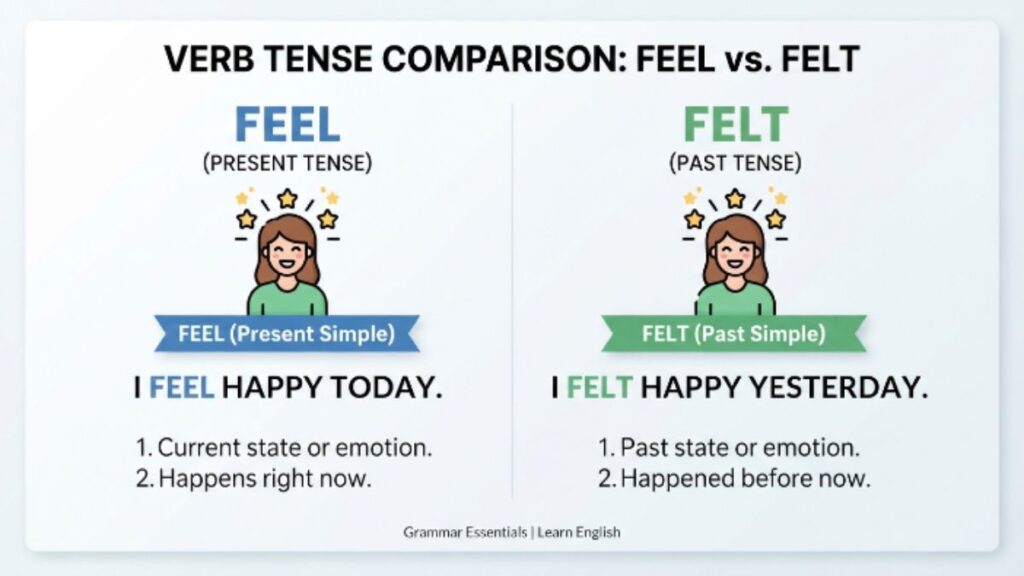
“Feel” is the base form and present tense of the verb. It describes emotions, physical sensations, opinions, or perceptions happening right now or in general. Example: I feel tired after a long day.
What Does “Felt” Mean?
“Felt” is the past tense and past participle of “feel.” It refers to an emotion, sensation, or perception that already happened. Example: I felt nervous before the interview.
Usage in Context: When to Use “Feel” for Present Experiences
“Feel” belongs in sentences describing the current moment, ongoing states, or general truths that don’t change with time. It’s the verb of “now.”
Present Emotional Expression
Use “feel” to express an emotion you’re experiencing at this moment. “I feel excited about the trip” places the emotion squarely in the present.
Present Physical Sensation
“Feel” also covers physical states — temperature, pain, touch, or texture. “I feel cold” or “The fabric feels soft” both describe sensations happening now.
Examples of “Feel” in Sentences
- I feel confident about the presentation.
- She feels sick today.
- They feel proud of their work.
- This blanket feels warm.
- I feel like eating pizza tonight.
Conveying Current Sensations and Emotions
When you want a reader or listener to understand what’s happening right now, “feel” is your go-to verb. It works equally well for emotional states (“I feel anxious”), physical conditions (“I feel dizzy”), and personal opinions (“I feel this plan will succeed”). Because it signals immediacy, “feel” is common in dialogue, personal updates, and first-person storytelling where the writer wants to stay grounded in the present moment.
Exploring Idiomatic Expressions with “Feel”
English uses “feel” in several fixed expressions that don’t always translate literally. Learning these idioms helps you sound more natural in conversation.
Common Feel Idioms
| Idiom | Meaning |
|---|---|
| Feel free | Permission to do something without hesitation |
| Feel for someone | To sympathize with them |
| Feel under the weather | To feel slightly unwell |
| Feel like a million bucks | To feel great |
| Get the feel of something | To become familiar with it |
The Past Tense Puzzle: Knowing When “Felt” Fits
“Felt” is used whenever the action or emotion is finished and belongs to the past. Time markers like “yesterday,” “last week,” or “when I was younger” almost always pair with “felt,” not “feel.”
Examples of “Felt” in Sentences
- I felt relieved after the test results.
- She felt happy when she opened the gift.
- We felt the ground shake during the tremor.
- He felt embarrassed about the mistake.
- They felt proud after finishing the race.
Grammar Deep Dive: Syntax and Meaning of Feel vs Felt
Grammatically, “feel” and “felt” follow the standard rules of English verb tense but come from an irregular conjugation pattern, meaning “felt” doesn’t simply add “-ed.” Both forms can act as linking verbs (connecting the subject to an adjective, as in “I feel happy”) or as full verbs describing sensory perception (“I feel the wind”). The choice between them hinges entirely on when the experience occurs relative to the moment of speaking or writing, not on the emotion itself.
Sentence Structures with Feel and Felt
Recognizing the common patterns each verb follows makes it easier to build correct sentences quickly.
Feel Patterns
- Subject + feel + adjective (I feel tired)
- Subject + feel + like + noun/verb-ing (I feel like resting)
- Subject + feel + object (I feel the heat)
Felt Patterns
- Subject + felt + adjective (She felt nervous)
- Subject + felt + object (We felt the impact)
- Subject + have/has felt + adjective (I have felt better)
The Importance of Tense Consistency
Mixing tenses within the same sentence or paragraph confuses readers and weakens your writing. A sentence like “Yesterday I feel nervous” is incorrect because the time marker “yesterday” demands the past tense “felt.” Keeping verb tense consistent with your timeline — whether recounting a story or describing the present — is one of the simplest ways to instantly improve clarity.
Mood and Modality: How Feel and Felt Express Nuance
Beyond simple timing, feel and felt can carry different shades of certainty and distance. “I feel this is right” expresses a present, active opinion, while “I felt this was right” suggests a belief held in the past that may or may not still apply. This subtle shift lets writers show emotional distance, tentativeness, or changed perspective without adding extra words.
Nailing Pronunciation and Common Confusions
Both words are short, but their vowel sounds are easy to mix up for many learners, especially since they look so similar on the page.
Pronunciation Guide
- Feel: rhymes with “wheel,” a long “ee” sound
- Felt: rhymes with “belt,” a short “e” sound
- Common confusion: writing “feeled” instead of “felt,” since regular verbs add “-ed”
Feel and Felt Across Variants of English
American, British, Australian, and other English variants all use feel and felt with the same grammar rules. The difference lies only in tone and formality, not structure. Formal writing might favor “I felt the impact of the decision,” while informal speech leans toward “I feel like it hit me hard.” Regardless of dialect, the underlying tense rule never changes.
Advanced Insight: Stative vs Dynamic Feel
“Feel” can function as either a stative verb (describing a state, like an opinion or emotion) or a dynamic verb (describing an action, like touching something). This distinction matters for continuous tense usage: “I feel happy” (stative, no continuous form) versus “I am feeling the fabric” (dynamic, continuous form allowed). Recognizing this helps explain why “I am feeling great” sounds natural in casual speech even though feel is often treated as stative.
Real-Life Case Study: Student Writing Performance
In classroom writing assessments, tense-agreement errors involving irregular verbs like feel and felt consistently rank among the most frequent mistakes in intermediate-level essays. Instructors often find that students who practice matching verbs to explicit time markers — using simple fill-in-the-blank drills — show measurable improvement within a few weeks. This pattern suggests that deliberate, targeted practice, rather than passive reading, is what closes the gap between recognizing the rule and applying it automatically.
Quick Memory Tricks
- Picture “feel” as “right now” and “felt” as “before.”
- Swap the verb with “was/were”: if it fits, use “felt.”
- Look for time markers like “today” (feel) or “yesterday” (felt).
- Remember: felt never pairs with present-time words.
FAQ’s
What is the main difference between feel and felt?
Feel refers to present or general experiences, while felt refers to past experiences that already happened.
Can feel be used in the past?
Not on its own; use “have felt” or switch to “felt” to describe an experience accurately.
What are common sentence structures?
Typical patterns include subject + feel/felt + adjective, or subject + feel/felt + object, depending on the timeframe.
Is felt always past?
As a verb, yes, felt is always past tense; as a noun, “felt” can also refer to a type of fabric.
Can feel work with modal verbs?
Yes, feel pairs naturally with modals like can, may, or should, as in “You may feel tired afterward.”
Conclusion
Choosing between feel and felt comes down to one simple rule: match the verb to the timing of the experience. Felt vs Feel. Use feel for anything happening now, general truths, or ongoing states, and reserve felt for experiences that already occurred. Felt vs Feel. Once this timing rule becomes automatic, your sentences will sound clearer and more natural in both speech and writing.
Mastering feel vs felt isn’t just a grammar exercise — it’s a small habit that sharpens everyday communication. Felt vs Feel. Pay attention to time markers, practice with real sentences, and the distinction between feel and felt will soon require no conscious thought at all.