Setup and set up are two forms of the same word pair, separated only by a space, yet grammatically worlds apart. setup is a noun naming an arrangement or system, while set up is a verb phrase describing the action of creating one. Setup vs Set Up.
One tiny space. One giant difference. Get it wrong, and even the most polished email or report can suddenly look careless — a small slip that quietly costs credibility.
This guide cuts through the confusion completely, breaking down meanings, real examples, common mistakes, and simple memory tricks so you can use setup and set up correctly, confidently, and effortlessly every single time.
Core Difference Between “Setup” and “Set Up”
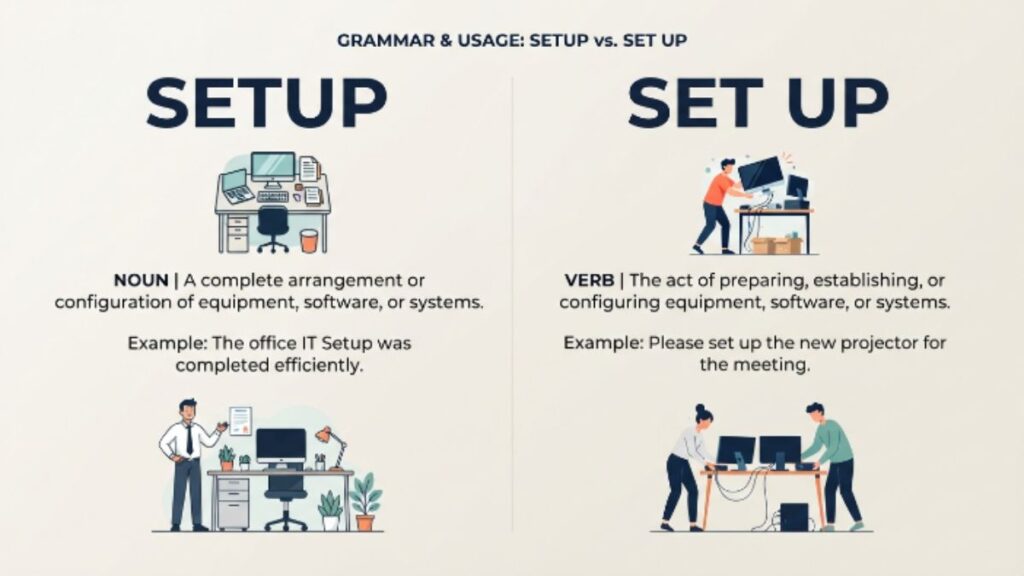
The short version: setup is a noun (and sometimes an adjective) that names a thing, while set up is a verb phrase that describes an action.
- Setup = a noun. It’s the arrangement, system, or configuration itself.
- Set up = a verb. It’s the act of arranging, building, or establishing something.
Think of it this way: you set up your desk, and once you’re done, you have a nice desk setup. One is the doing, the other is the result.
Quick Meaning Guide
| Form | Part of Speech | Meaning | Example |
|---|---|---|---|
| Set up | Verb (phrasal verb) | To arrange, build, or establish something | “Please set up the projector before the meeting.” |
| Setup | Noun | The arrangement, system, or configuration itself | “The projector setup took less than five minutes.” |
| Setup | Adjective | Describes or modifies another noun | “Follow the setup instructions on page two.” |
Set Up – As a Verb
Meaning of “Set Up”
“Set up” is a phrasal verb formed from set + up. It always describes an action — something being arranged, installed, organized, or established. Because it’s a verb, it can be conjugated: set up, sets up, setting up, set up (past tense).
Common Uses of “Set Up”
“Set up” shows up constantly in everyday and professional English, including:
- Preparing equipment or technology (“set up a laptop”)
- Organizing an event or meeting (“set up a conference call”)
- Establishing a business, account, or system (“set up a company”)
- Arranging furniture or physical spaces (“set up the chairs”)
- Informally, tricking or framing someone (“he was set up by his own team”)
Sentence Examples
- I need to set up my new phone before I leave for work.
- Can you set up the meeting room for tomorrow’s presentation?
- They’re planning to set up a small business next year.
- She set up the tent in under ten minutes.
- He felt like he’d been set up to take the blame.
Synonyms for Set Up
- Arrange
- Establish
- Organize
- Install
- Prepare
- Build
- Configure
Setup – As a Noun
Meaning of “Setup”
“Setup,” written as one word, is a noun that refers to the way something is arranged, organized, or configured. It names the finished result — the system, structure, or scenario — rather than the action of creating it.
Common Uses of “Setup”
“Setup” typically appears in these contexts:
- Technology and gaming (“gaming setup,” “computer setup”)
- Business operations (“office setup,” “workflow setup”)
- Events and staging (“event setup,” “camera setup”)
- Informal use meaning a trick or scheme (“the whole thing was a setup”)
Sentence Examples
- My home office setup includes two monitors and a standing desk.
- The setup for the event looked fantastic under the lighting.
- This gaming setup cost more than his car.
- Something about the deal felt like a setup from the start.
Synonyms for Setup
- Arrangement
- Configuration
- System
- Structure
- Layout
- Organization
Setup as an Adjective
How Setup Works as a Modifier
“Setup” can also function as a compound adjective, sitting directly before a noun to describe it. In this role, it behaves like any other modifier — no space, no hyphen needed in modern American usage.
Examples
- Read the setup guide before installing the software.
- The setup menu lets you customize your preferences.
- Our setup costs are lower than the industry average.
Common Confusions and FAQs About Setup vs Set Up
Is “Set Up” Ever Hyphenated?
Rarely in modern American English. You may still see “set-up” as a hyphenated noun in older texts or some British publications, but current style guides overwhelmingly favor the single word setup for the noun form and the two-word set up for the verb.
Do You Say “Setup a Meeting”?
No. “Setup” is never a verb, so “setup a meeting” is incorrect. The correct phrase is set up a meeting, since you’re describing an action.
Other Tricky Contexts
Technology Usage
In tech writing, people often default to “setup” out of habit, even when describing an action. Remember: you set up a device, but you review its setup afterward — the device’s configuration.
Business Context
In business communication, precision matters. Emails that read “I will setup the account” instead of “I will set up the account” can subtly undercut professionalism, even though the meaning is clear.
Side-by-Side Examples for Clarity
| Sentence with Set Up (Verb) | Sentence with Setup (Noun/Adjective) |
|---|---|
| I’ll set up the new printer today. | The printer setup was simple. |
| Let’s set up a time to talk. | Our meeting setup needs improvement. |
| They set up the booth early. | The booth setup drew a big crowd. |
| Please set up your workspace. | Check the setup instructions first. |
Quick Grammar Breakdown
- Verb phrase (set up) → subject + verb + object → “I set up the tent.”
- Noun (setup) → functions as subject or object → “The setup was ready.”
- Adjective (setup) → modifies a noun directly → “the setup process”
A simple test: if you can replace the word with “arrange” or “arranged,” you likely need set up. If you can replace it with “arrangement” or “configuration,” you need setup.
Memory Tricks to Remember
- Action = two words. Set up is something you do.
- Thing = one word. Setup is something you have.
- Picture “set up” as two building blocks stacking — the action of building.
- Picture “setup” as one solid block — the finished structure.
Common Mistakes People Make
- Using “setup” as a verb: ❌ “I’ll setup the meeting.” ✅ “I’ll set up the meeting.”
- Splitting “setup” when it’s a noun: ❌ “That was a clever set up.” ✅ “That was a clever setup.”
- Adding unnecessary hyphens: ❌ “The set-up was perfect.” ✅ “The setup was perfect.”
- Mixing tenses incorrectly: ❌ “He was setting uped the tent.” ✅ “He was setting up the tent.”
Practical Usage Guide
When to Use Set Up
Use set up whenever you’re describing an action — installing, arranging, organizing, or establishing something. If your sentence has a subject actively doing something, “set up” is almost always correct.
When to Use Setup
Use setup whenever you’re naming a thing — the system, arrangement, or configuration that results from the action. If the word could sit as the subject or object of a sentence, “setup” is the right choice.
Interesting Fact About Setup vs Set Up
The noun form “setup” only became common in the 20th century, largely driven by industrial and later technological writing that needed a compact word for “arrangement of equipment.” Before that, writers typically used longer phrases like “arrangement” or “configuration” instead.
Case Study: Business Communication
A small marketing agency reviewed a month of client-facing emails and found “setup” used incorrectly as a verb in nearly one out of every five messages. After a short internal style guide update clarifying the setup vs set up rule, editing time on outgoing emails dropped, and client-facing documents required fewer corrections. The takeaway: a tiny grammar fix can have a real impact on how professional your writing appears.
Real-Life Example Conversation
Alex: Did you set up the new software on your laptop yet? Jordan: Yeah, the setup only took about ten minutes. Alex: Nice. What’s your setup like now — any new tools? Jordan: Just a faster processor and dual monitors. Simple setup, but it works great.
Notice how naturally both forms appear in the same conversation — one describing the action, the other naming the result.
FAQs
What is the basic difference between setup and set up?
“Set up” is a verb describing an action, while “setup” is a noun (or adjective) naming the arrangement itself.
Can “setup” ever replace “set up”?
No. “Setup” cannot function as a verb, so it can never replace “set up” in a sentence describing an action.
Do Americans and Brits use setup differently?
Both generally follow the same noun/verb rule, though British English occasionally still uses the hyphenated “set-up” as a noun in more formal or older writing.
Is “setup” formal or informal?
“Setup” is neutral and works fine in both formal and informal writing, as long as it’s used as a noun or adjective, not a verb.
What’s an easy trick to remember the difference?
If it’s something you do, write “set up.” If it’s something you have, write “setup.”
Conclusion
Setup vs Set Up: Master the Difference Like a Pro (2K26 Updated) ✨ really comes down to one easy rule. Actions need two words. Things need one word. Once you see that pattern, the confusion disappears for good.
That’s the real win behind Setup vs Set Up: Master the Difference Like a Pro (2K26 Updated) ✨. Small grammar fixes build big trust. Your writing looks sharper. Your ideas land clearer. So next time you write, pause for one second, pick the right form, and write with confidence.