
Drove and driven are both past forms of the verb drive, but they serve completely different grammatical roles. drove is the simple past tense, while driven is the past participle — and mixing them up is one of the most common grammar mistakes in English writing. Drove vs Driven.
One wrong word can make a polished sentence sound instantly unprofessional — even to a casual reader.
Understanding drove vs driven comes down to a single rule: helper verbs. Mastering this difference sharpens your writing, eliminates errors, and builds real grammar confidence in everyday English.
Understanding the Verb “Drive”
The verb drive is one of the most commonly used irregular verbs in the English language. Its primary meaning is to operate or control a vehicle, but it also works figuratively — as in, “Her ambition drives her forward.” What makes it tricky is that, unlike regular verbs that simply add -ed in the past, “drive” changes its form entirely depending on the tense and sentence structure.
That is exactly where learners hit a wall. Both drove and driven relate to the past. Both sound plausible in a sentence. But they are not interchangeable — and using the wrong one, especially in formal or professional writing, can make your grammar look noticeably off.
Once you understand how each form works, this confusion disappears completely.
Forms of “Drive” at a Glance
Here is a quick reference to all the verb forms of “drive”:
| Form | Word | Example |
|---|---|---|
| Base Form | drive | I drive to work daily. |
| Simple Present (3rd person) | drives | She drives every morning. |
| Simple Past | drove | He drove for six hours. |
| Past Participle | driven | They have driven this route before. |
| Present Participle | driving | We are driving right now. |
The two forms at the center of today’s guide are drove (simple past) and driven (past participle).
What Is the Simple Past? (Drove)
The simple past tense describes a completed action that happened at a specific point in the past. There is no connection to the present moment. It is a finished story — start, end, done.
Drove is the simple past form of “drive.” It stands completely on its own as the main verb. No auxiliary (helping) verb is needed alongside it.
She drove to the airport last Tuesday.
That sentence is complete. The action is over. “Drove” needs no support.
What Is the Past Participle? (Driven)
The past participle is a verb form that cannot stand alone in a sentence. It always needs a helping verb — such as have, has, had, was, or were — to function correctly.
Driven is the past participle of “drive.” It appears in perfect tenses (present perfect, past perfect, future perfect) and in passive voice constructions.
I have driven this road many times. The car was driven carefully by the new student.
Remove the helper verb from those sentences, and the grammar breaks down immediately.
Drove vs Driven: What’s the Real Difference?
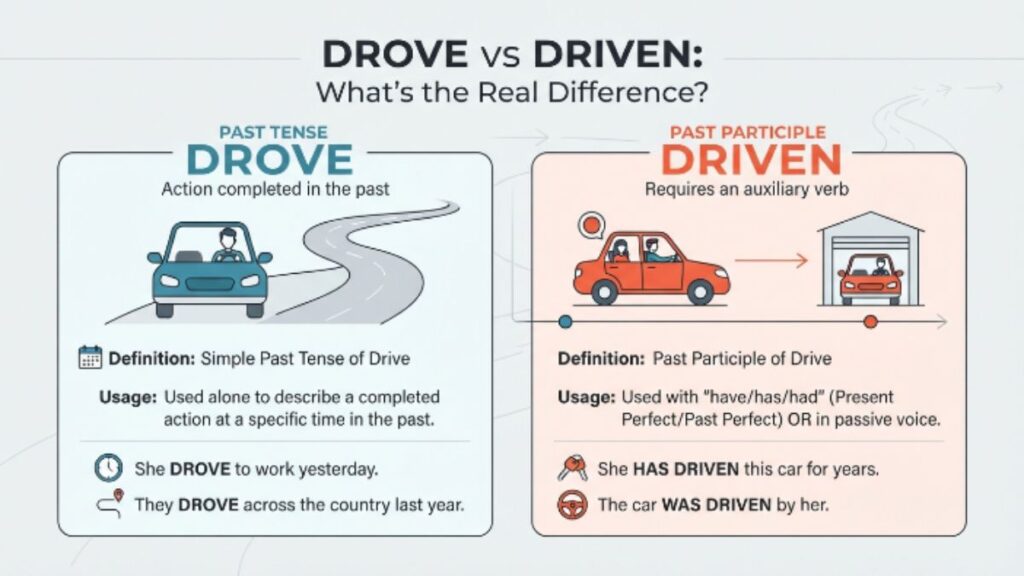
This is the core question, and the answer is simpler than most people expect.
| Feature | Drove | Driven |
|---|---|---|
| Type | Simple Past Tense | Past Participle |
| Needs helper verb? | ❌ No | ✅ Yes |
| Used in perfect tenses? | ❌ No | ✅ Yes |
| Used in passive voice? | ❌ No | ✅ Yes |
| Stands alone in a sentence? | ✅ Yes | ❌ No |
| Time signal words | yesterday, last night, last year | has, have, had, was, were |
The golden rule: If a helping verb is present in the sentence, use driven. If there is no helping verb, use drove.
How to Use “Drove” Correctly
When to Use “Drove”
Use drove when:
- The action happened and ended at a specific time in the past
- There is no auxiliary verb in the sentence
- Time signal words like yesterday, last week, last night, last year, or last Monday are present
Key Grammar Rule
Drove = Simple Past = No Helper Verb Required
Think of drove as a storytelling word. When you are narrating what happened, drove carries the full weight of the sentence alone.
Correct Examples
- I drove to the market yesterday.
- She drove her kids to school this morning.
- They drove for six hours without stopping.
- He drove very fast on the highway last night.
- We drove across the state last summer.
How to Use “Driven” Correctly
When “Driven” Is Required
Use driven when:
- A helping verb (has, have, had, was, were, will have) appears before it
- The sentence is in a perfect tense
- The sentence uses passive voice
Perfect Tense Examples
- I have driven this car for years. (present perfect)
- She had driven three hours before the accident. (past perfect)
- By Monday, they will have driven across three states. (future perfect)
Passive Voice Examples
- The car was driven carefully by the new student.
- The truck had been driven over 200,000 miles.
- The vehicle was driven off the lot within an hour.
Context Matters: How Tense Changes the Choice
1:Example
✔ She drove to the office yesterday. (simple past — complete action, no helper) ✔ She has driven to the office many times. (present perfect — experience, uses helper “has”)
2: Example
✔ He drove fast on the highway last night. (simple past — finished event) ✔ He had driven fast before, but this time was different. (past perfect — earlier past action)
3: Example
✔ They drove for hours without stopping. (simple past — storytelling) ✔ They have driven this route dozens of times. (present perfect — ongoing relevance)
Common Errors to Avoid With “Drove vs Driven”
Mistake 1: Using “Drove” with a Helping Verb
This is the most frequent error English learners make.
❌ I have drove this car before. ❌ She had drove all night. ❌ We have drove this route many times.
Why it’s wrong: Drove is the simple past form. It never pairs with auxiliary verbs like have, has, or had. Those helpers demand the past participle — which is driven.
✔ I have driven this car before. ✔ She had driven all night. ✔ We have driven this route many times.
Mistake 2: Using “Driven” Without a Helping Verb
❌ He driven to work today. ❌ They driven all night. ❌ I driven there last week.
Why it’s wrong: Driven is the past participle. It cannot function as the main verb in a sentence without a helper.
✔ He drove to work today. ✔ They drove all night. ✔ I drove there last week.
Quick Decision Guide (Drove vs Driven)
Use these checkpoints before writing your sentence:
✔ Does the sentence have a helper verb?
→ Yes → Use driven (e.g., has driven, have driven, had driven, was driven)
✔ Is it just a simple past action?
→ Yes, with no helper verb → Use drove (e.g., She drove home.)
✔ Is the sentence passive?
→ Yes → Use driven (e.g., The car was driven by her brother.)
✔ Am I describing an experience or a completed action with present meaning?
→ Yes → Use driven with have/has (e.g., I have driven in snow before.)
✔ Am I talking about a finished action in the past?
→ Yes, at a specific past time → Use drove (e.g., We drove there last Friday.)
Perfect Tenses With “Driven” (Deep Dive)
All three perfect tenses in English pair with driven, never with drove.
Present Perfect
Formed with have/has + driven. Used to describe experience with present relevance.
I have driven in heavy rain before. She has driven this car for three years.
Past Perfect
Formed with had + driven. Used when one past action happened before another past action.
By the time he called, I had already driven halfway home. They had driven 400 miles before realizing they forgot the tickets.
Future Perfect
Formed with will have + driven. Describes an action that will be completed before a future point in time.
By Friday, we will have driven over 1,000 miles. She will have driven this route ten times by the end of the month.
Case Study: Real-Life Use of Drove vs Driven
Case Study: A Road Trip Gone Wrong
Maria and John planned a cross-country road trip. Here is how their story sounds with correct grammar:
- John drove the first 200 miles. (simple past — completed action)
- Maria drove through the mountains while John slept. (simple past — narrating events)
- By noon, John had driven before in icy conditions, so he took over. (past perfect — experience before another past moment)
- Maria has driven farther in a single day, but never in fog this thick. (present perfect — experience with present relevance)
- The car was driven carefully through the narrow pass. (passive voice)
Why this matters: If Maria says “I have drove many times,” a native speaker immediately notices the error. The sentence breaks down grammatically and loses credibility — whether in conversation, an email, or an essay.
Quote to Remember
“Drove stands alone. Driven never walks without help.”
Keep that one line in mind, and the choice will always be clear.
FAQ’s
What is the difference between “drove” and “driven”?
Drove is the simple past tense of “drive” and stands alone in a sentence. Driven is the past participle and always requires a helping verb such as have, has, had, was, or were.
Can “driven” ever be used alone?
No. Driven always needs an auxiliary verb to form a grammatically correct sentence. Without one, the verb form is incomplete.
When should I use “drove”?
Use drove when describing a completed action in the past without any helping verb — especially when time signals like yesterday, last night, or last week are present in the sentence.
How do I quickly decide between “drove” and “driven”?
Scan the sentence for a helper verb. If one is there (has, have, had, was, were), use driven. If there is no helper, use drove.
What are examples of the perfect tense with “driven”?
Present perfect: I have driven this route before. Past perfect: She had driven for hours before stopping. Future perfect: By Sunday, they will have driven across four states.
Conclusion
Choosing between drove and driven comes down to one simple check: look for a helping verb. Drove handles simple past actions and works entirely on its own. Driven steps in whenever a helper like have, has, had, was, or were is present — whether in perfect tenses or passive voice structures.
These two forms cover everything you need to talk about driving in the past, correctly and confidently. Master this rule, practice with real sentences, and the right choice will start feeling as natural as shifting into drive.