Serpent and snake both describe the same limbless reptile, yet these two words carry completely different weight in the English language. One belongs to biology and everyday speech. The other belongs to myth, scripture, and storytelling. Understanding the difference between serpent vs snake changes how you read, write, and communicate.
Most people use them interchangeably — and that mistake quietly weakens their writing every time.
The real gap between these words is not about scales or fangs. It is about tone, history, and intention. Snake grounds your writing in reality. Serpent lifts it into symbolism. Knowing when to use each word gives your writing precision that most writers never achieve.
Why Serpent vs Snake Confuses So Many Writers
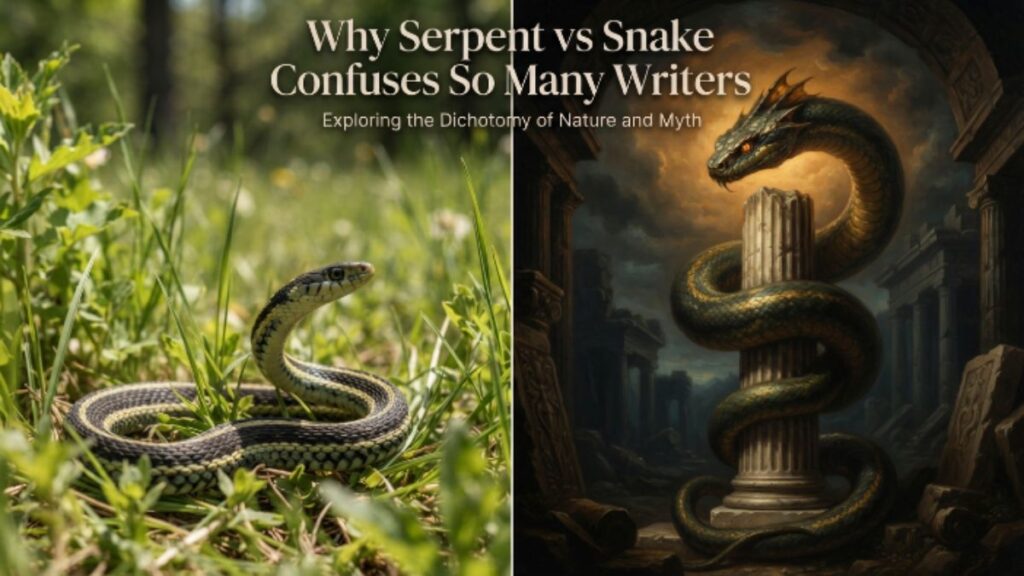
At first glance, serpent and snake look like two words for the same animal. Both describe long, limbless reptiles. Both appear in English dictionaries side by side. So why do so many writers get tripped up choosing between them?
The confusion runs deeper than vocabulary. These two words come from entirely different linguistic traditions and carry very different emotional weight. One belongs to textbooks and everyday speech. The other belongs to scripture, mythology, and literature. Choosing the wrong one does not just affect accuracy — it shifts the entire tone of your writing.
This guide breaks down the serpent vs snake difference in plain English, covering meaning, science, tone, religion, expressions, and practical writing guidance.
The Core Meaning of Snake
What snake means today
A snake is a real, living reptile. Scientifically, snakes belong to the suborder Serpentes — cold-blooded, legless vertebrates covered in scales. There are over 3,000 recognized species living across forests, deserts, oceans, and urban areas. The word itself comes from Old English snaca, rooted in the Proto-Germanic term for “creeping animal.”
In modern English, snake is the default, practical, and widely accepted term for these animals in biology, science, and casual conversation.
Common contexts for snake
- Scientific and educational writing
- Wildlife reports and documentaries
- Everyday speech and informal conversation
- Modern idioms and popular expressions
Examples
- A snake was found in the garden this morning.
- The biology student studied snake venom for her thesis.
- He is a total snake — I can’t trust anything he says.
The Core Meaning of Serpent
What serpent really means
Serpent traces back to Latin serpens, from the verb serpere, meaning “to creep or crawl.” It entered Middle English through Old French and arrived carrying strong religious and mythological undertones from the start. Unlike snake, the word serpent was never simply a label for an animal — it was always layered with symbolism.
In modern English, serpent rarely describes a literal animal. It describes an idea, a force, or a symbol. When you encounter serpent in text today, something dramatic and meaningful is happening on the page.
Key traits of serpent
- Poetic and formal in register
- Associated with mythology, religion, and allegory
- Implies moral weight, supernatural power, or hidden danger
- Rare in casual speech — sounds theatrical or archaic
Examples
- The great serpent coiled around the base of the tree.
- He was a serpent in human form, charming yet deadly.
- A golden serpent crowned the temple walls.
Are Serpent and Snake Scientifically Different?
Scientific reality
No. From a biological standpoint, there is no difference between a serpent and a snake. They refer to the same class of reptiles. Scientists, zoologists, and wildlife researchers use snake exclusively. You will never find serpent in a taxonomy chart, field guide, or scientific journal.
The suborder is called Serpentes — and that Latin root is the only time serpent-related language appears in formal science, and only as a classification name, not a descriptive word.
Why science avoids serpent
Science demands precision and neutrality. Serpent brings connotation, history, and emotion — none of which belong in objective reporting. When a biologist writes about a cobra, they write snake. The moment serpent appears, the text has shifted from fact into narrative.
Usage Differences in Modern English
Spoken English
In everyday conversation, almost no one says serpent. It sounds unnatural and forced. If someone tells you there is a serpent in their kitchen, you would probably pause before understanding they mean a snake.
- Common: There’s a snake under the porch.
- Uncommon: There’s a serpent under the porch.
Written English
In formal or creative writing, the choice opens up. Serpent appears in religious texts, poetry, fantasy fiction, historical writing, and allegory. Snake appears in journalism, academic writing, nature guides, and general nonfiction.
The word you choose signals to your reader what kind of writing they are in — literal or symbolic, factual or narrative.
Tone and Connotation: Why Word Choice Matters
Snake: neutral and descriptive
Snake is grounded. It carries little emotional weight on its own. It describes an animal and nothing more, unless used deliberately in a metaphor.
Serpent: symbolic and intense
Serpent immediately elevates the tone. It signals that something larger is at play — moral conflict, ancient power, or spiritual danger. Writers use serpent when they want the word itself to carry dramatic meaning.
Side-by-side comparison
| Feature | Snake | Serpent |
|---|---|---|
| Origin | Old English (snaca) | Latin (serpens) |
| Register | Casual, neutral | Formal, symbolic |
| Scientific use | Yes | No |
| Everyday speech | Yes | Rarely |
| Literary use | Sometimes | Frequently |
| Connotation | Neutral to mildly negative | Heavy — evil, wisdom, power |
| Mythological use | Rare | Very common |
Serpent vs Snake in Religion and Mythology
Religious usage
Sacred texts almost always choose serpent over snake. The word carries moral authority that snake simply lacks.
In the Bible, serpent appears throughout both the Old and New Testaments. in Genesis, the serpent tempts Eve in the Garden of Eden — representing deceit and forbidden knowledge. In Revelation, the “great dragon, that old serpent” becomes identified with the devil. in Numbers, Moses lifts a bronze serpent on a pole to heal the Israelites — the same image that inspired the modern medical symbol, the Rod of Asclepius.
The choice of serpent in these passages is deliberate. It transforms an animal into a moral and spiritual force.
Mythological symbolism
Mythology worldwide reached for serpent for the same reason — symbolic weight.
- Greek mythology: The Ouroboros (serpent eating its own tail) represents eternity and cosmic cycles
- Hindu tradition: Nāgas are semi-divine serpents that guard sacred waters and treasures
- Norse mythology: Jörmungandr, the Midgard Serpent, encircles the earth and signals the apocalypse
- Aztec tradition: Quetzalcoatl, the Feathered Serpent, symbolized wisdom, fertility, and the union of earth and sky
In every case, the word serpent signals something beyond biology — something ancient, powerful, and spiritually charged.
Common Expressions Using Snake
Popular expressions
English is rich with snake-based idioms, most of them modern and conversational.
- Snake in the grass — a hidden traitor or backstabber
- Snake oil — a fake remedy or fraudulent product
- Snake-like — describing cunning or deceptive behavior
- Snake pit — a chaotic or dangerous place
Example sentences
- He turned out to be a real snake in the grass — I never saw it coming.
- That investment was pure snake oil.
- The office politics in that department were like a snake pit.
Expressions and Symbolism Using Serpent
Typical uses
Serpent appears in expressions and contexts where the weight of history or mythology matters.
- Ancient serpent — biblical or mythological reference to evil or primordial chaos
- Serpent’s tongue — associated with deceit and treachery (used by Shakespeare)
- Sea serpent — legendary mythological creature from maritime folklore
- Serpentine — winding, curving movement, derived from the same Latin root
Examples
- The ancient serpent slithered through centuries of human imagination.
- His words had a serpent’s tongue — smooth and deadly.
- The road wound in a serpentine path through the mountains.
Real-World Writing Examples
Journalism
Journalists almost always use snake. News writing demands clarity and factual precision.
- Correct: A venomous snake was captured near the elementary school.
- Incorrect: A venomous serpent was captured near the elementary school. (Sounds theatrical)
Educational writing
Academic and scientific writing sticks firmly to snake. Using serpent in educational content about biology signals a lapse in register and undermines credibility.
Fiction and storytelling
Fiction is where serpent earns its place fully. In fantasy, historical fiction, or mythological retellings, serpent creates an immediate atmosphere.
- The great serpent rose from the depths, its scales black as obsidian.
- She recognized the serpent in his smile the moment they met.
Common Mistakes and Misconceptions
Mistake: Thinking serpent is just a fancy synonym
It is not. Serpent does not simply mean “a formal version of snake.” It carries entirely different connotations. Calling a garden snake a serpent does not elevate the sentence — it distorts it.
Mistake: Using serpent in scientific writing
Serpent has no place in zoology, biology, or wildlife journalism. It introduces subjectivity into objective content.
Mistake: Overusing serpent in modern content
Some writers reach for serpent to sound literary or sophisticated. Used carelessly, it reads as overdone or unintentionally comic.
Simple fix
Ask yourself: Am I describing a real animal or a symbolic force? If real — use snake. If symbolic — serpent may fit.
Quick Comparison: Serpent vs Snake
| Question | Snake | Serpent |
|---|---|---|
| Is it a real animal? | ✅ Yes | ⚠️ Symbolically |
| Is it used in science? | ✅ Yes | ❌ No |
| Is it used in religion? | Occasionally | ✅ Frequently |
| Is it used in mythology? | Rarely | ✅ Always |
| Is it used in daily speech? | ✅ Yes | ❌ Rarely |
| Does it carry moral weight? | Mild | ✅ Strong |
How to Choose the Right Word Every Time
Is this factual or symbolic?
If you are describing a real animal in a factual context — a news story, a biology lesson, a nature documentary — always use snake. If you are exploring a symbol, moral force, or mythological being, a serpent fits.
Is this modern or ancient in tone?
Snake belongs to modern, everyday English. Serpent belongs to classical, poetic, or religious registers. Match the word to the world your writing inhabits.
Is clarity or emotion more important?
When clarity matters most, snake wins every time. When emotional resonance and symbolic depth are the goal, serpent earns its place.
Why Writers Still Use Serpent Today
Despite its archaic flavor, serpent survives in modern writing for one reason: nothing replaces it. When a writer needs a single word that carries thousands of years of mythological, religious, and cultural weight, snake simply does not deliver. Serpent belongs to a rare category of words that age without becoming obsolete — because the ideas it represents are timeless. Temptation, transformation, hidden power, and ancient danger are not going away. And neither is the word that captures all of them at once.
FAQs
Is a serpent different from a snake?
Biologically, no — they are the same animal. The difference is linguistic and symbolic: snake is factual, while serpent is poetic and mythological.
Why does the Bible say serpent instead of snake?
Serpent carries moral and spiritual weight that snake lacks. Sacred texts chose it to signal that the creature represented more than just an animal — it was a symbol of temptation, power, or divine judgment.
Can serpent be used in modern English?
Yes, but mainly in literary, religious, or symbolic contexts. In casual speech or factual writing, it sounds unnatural and out of place.
Is serpent a metaphor rather than an animal?
Often, yes. In modern usage, serpent frequently functions as a metaphor for deceit, hidden danger, or primal evil rather than describing a literal reptile.
Which word is better for clear writing?
Snake is clearer, simpler, and more appropriate in almost all everyday and professional contexts. Use serpent only when symbolism is the deliberate goal.
Final Thoughts
The serpent vs snake debate is not really about biology — it is about language, tone, and intention. Snake is the word of science, journalism, and daily life. Serpent is the word of myth, religion, and literature. Both describe the same creature. But the experience of reading each word could not be more different.
Every serpent is a snake. But not every snake has earned the weight that serpent carries. When you write, choose the word that matches not just what you mean — but how deeply you mean it.