Emasculate means to strip away power, confidence, or masculine traits, whether through literal biological removal or a figurative loss of authority. Emasculate vs. Demasculate. Demasculate is the word people mistakenly use to mean the same thing, despite carrying no dictionary recognition at all.
One of these words has shaped English since the 1600s. The other exists only because “de-” felt more logical than “e-” — and that tiny mix-up has confused writers, readers, and even spellcheck tools for years.
From plant breeding labs to heated gender debates, “emasculate” carries real linguistic weight that “demasculate” can’t match. Knowing the difference sharpens your writing and saves you from a common, avoidable mistake.
Understanding “Emasculate vs. Demasculate”: What’s the Real Difference?
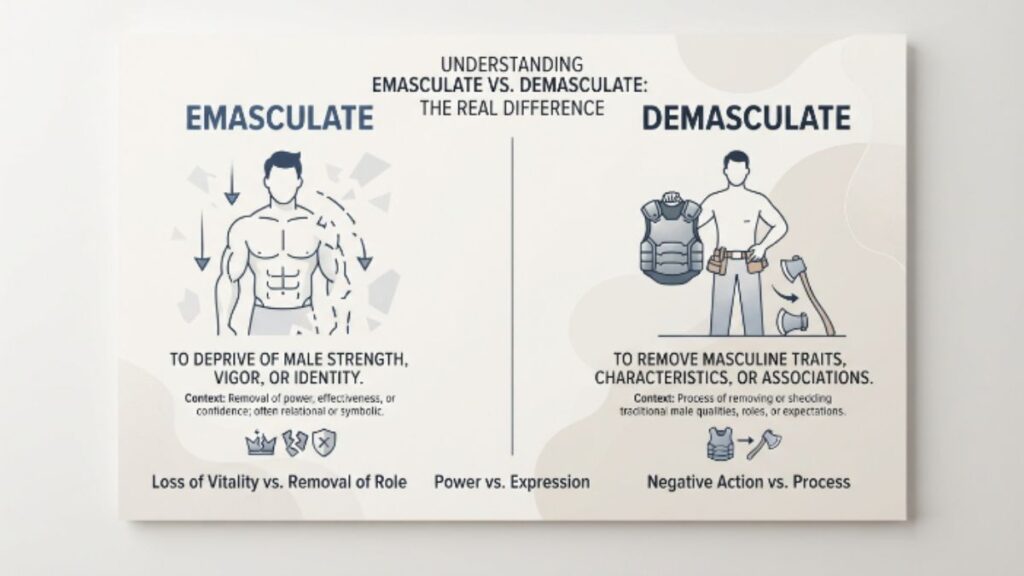
In short: emasculate is a real, dictionary-recognized verb meaning to weaken, deprive of power, or remove masculine qualities — literally or figuratively. Demasculate is not found in Oxford, Cambridge, or Merriam-Webster. It’s a word people invented by swapping prefixes, assuming “de-” (undo) makes more sense than “e-” (out of). It doesn’t, and that’s exactly why the confusion persists.
Understanding “Emasculate”: Meaning, Usage, and Real-World Contexts
“Emasculate” is one of those words people recognize instantly but rarely stop to define. It carries weight in biology, botany, politics, and everyday conversation — often in the same sentence.
What “Emasculate” Means (Core Definition)
To emasculate someone or something means to:
- Deprive a person (typically male) of strength, power, confidence, or authority
- Remove male reproductive organs, in a strictly biological or medical sense
- Strip an institution, policy, or role of its effectiveness or influence
The word works both literally and metaphorically, which is part of why it shows up so often in headlines and debates.
Linguistic Roots of “Emasculate”
The word traces back to the Latin emasculare, derived from ex- (“out of”) and masculus (“male”), literally meaning “to remove the male part.” It entered the English language around 1623, initially as a strictly medical and biological term before its figurative sense took hold.
Evolution of the Meaning: Quick Timeline Table
| Period | Primary Meaning | Common Context |
|---|---|---|
| 1600s | Castration, removal of male organs | Medicine, agriculture |
| 1700s–1800s | Loss of vigor or strength | Literature, legal texts |
| 1900s | Loss of authority or confidence | Social and political commentary |
| Today | Weakened power, control, or masculinity | Politics, relationships, pop culture |
Literal Uses of “Emasculate”
Biological Use
In its original sense, emasculation refers to castration — the surgical removal of male reproductive organs in humans or animals. This usage remains standard in veterinary and medical fields, where it’s a neutral, clinical term rather than an insult.
Botanical Use: A Critical Term in Plant Breeding
What It Means in Plant Science
In botany, emasculation has nothing to do with confidence or masculinity in the human sense. It’s a routine, technical step in controlled plant breeding.
How Emasculation Works in Botany
Plant breeders emasculate flowers to prevent self-pollination, allowing them to control which plants cross with which. This is essential for developing new hybrid varieties with desirable traits like disease resistance or higher yield.
Botanical Emasculation: Step-by-Step Table
| Step | What Happens | Purpose |
|---|---|---|
| 1 | Select an unopened flower bud | Prevents accidental pollination |
| 2 | Remove the anthers (male parts) | Stops self-fertilization |
| 3 | Cover the flower | Protects it from stray pollen |
| 4 | Apply desired pollen manually | Enables controlled cross-breeding |
| 5 | Label and monitor | Tracks the resulting hybrid seed |
Metaphorical Uses of “Emasculate”: The Most Common Meaning Today
Outside of science, “emasculate” almost always shows up in its figurative sense — describing a loss of power, confidence, or perceived masculinity.
Metaphorical Emasculation Means:
- Undermining someone’s authority or control
- Publicly diminishing a person’s confidence or status
- Weakening an institution, law, or role to the point it loses effectiveness
Examples of Metaphorical Emasculation
- “The new regulations emasculated the agency’s ability to enforce standards.”
- “He felt emasculated after losing his role as primary earner.”
- “Critics say the amendment emasculates the original bill.”
Why the Word “Emasculate” Gets So Emotional
Because the word ties directly to masculinity and power, it often carries a charged, sometimes uncomfortable tone. It’s frequently used in debates about gender roles, workplace dynamics, and shifting family structures — which is part of why it resonates so strongly (and controversially) in modern discourse.
“Demasculate”: What People Think It Means (But Doesn’t)
People generally use “demasculate” to mean the same thing as “emasculate” — stripping someone of masculine traits, confidence, or authority. The intended meaning is understandable. The problem is that the word itself isn’t standard English.
Is “Demasculate” a Real Word?
No. Demasculate is not recognized as an official English word by any major dictionary, despite showing up in memes, forums, and social posts.
Why People Think It’s a Real Word
- The prefix “de-” commonly signals “removal” or “reversal” (as in deactivate, devalue), so it feels logically consistent
- It sounds similar enough to “emasculate” that spellcheck and casual readers often accept it
- Social platforms accelerate the spread of invented words, and informal spoken English tends to forgive them
Key Differences: Emasculate vs Demasculate
Comparison Table
| Feature | Emasculate | Demasculate |
|---|---|---|
| Dictionary status | Recognized (Oxford, Merriam-Webster, Cambridge) | Not recognized |
| Origin | Latin emasculare | Informal prefix blend |
| First recorded use | Early 1600s | No formal record |
| Scientific use | Yes (biology, botany) | No |
| Acceptable in formal writing | Yes | No |
| Common in casual/online use | Yes | Yes |
Why People Confuse the Terms
Main Reasons
- Both words look and sound structurally similar
- “De-” feels more intuitive as a prefix meaning “remove” than “e-“
- Neither word is used in everyday conversation often enough for most people to double-check
- Autocorrect and predictive text sometimes fail to flag “demasculate” as an error
Cultural and Social Dimensions of “Emasculate”
Emasculation in Gender Roles and Masculinity Debates
The word frequently surfaces in conversations about shifting gender expectations — particularly around income, household roles, and public perceptions of strength. It’s often used to describe a perceived threat to traditional masculine identity, which keeps it central to ongoing cultural debates.
Quote:
“Language around masculinity evolves alongside society’s expectations of what it means to be strong, capable, or in control.”
Media and Pop Culture
Film, television, and political commentary use “emasculate” regularly — describing everything from a character’s loss of authority to a politician’s diminished influence after a public setback.
Modern Shifts in Perspective
As conversations around masculinity broaden, some writers and psychologists push back on how loosely “emasculate” gets applied, arguing that tying confidence or worth to traditional masculine traits can be limiting. This has led to more nuanced discussions about power, identity, and language itself.
How to Choose the Right Word (And Avoid Mistakes)
When You SHOULD Use “Emasculate”
- Describing a loss of power, authority, or confidence
- Referring to biological or botanical castration/removal of male parts
- Writing formal, academic, journalistic, or professional content
When You SHOULD NOT Use “Demasculate”
- In any formal, academic, or professional writing
- When accuracy and credibility matter
- When writing for SEO or editorial content meant to reflect correct English usage
Correct Alternatives Instead of “Demasculate”
- Emasculate
- Weaken
- Undermine
- Strip of authority
- Diminish
Quick Decision Guide
| If you mean… | Use this word |
|---|---|
| Remove male reproductive parts (biology/botany) | Emasculate |
| Reduce someone’s power or confidence | Emasculate |
| A casual, invented alternative | Avoid — not standard English |
FAQ’s
What does “emasculate” mean?
It means to deprive someone of strength, power, or masculinity, or literally to remove male reproductive organs.
Is “demasculate” a real word?
No, it’s not recognized by major dictionaries and is considered nonstandard English.
Where does the word “emasculate” come from?
It comes from the Latin emasculare, combining “ex-” (out of) and “masculus” (male).
How is “emasculate” used in botany?
It refers to removing a flower’s male parts (anthers) to control pollination during plant breeding.
Why is “emasculate” controversial?
Because it ties directly to masculinity and power, making it a loaded term in gender and identity discussions.
Conclusion
Emasculate vs. Demasculate: What They Really Mean (And Why People Confuse Them) 🌱⚡ comes down to one simple fact. Emasculate is real, backed by centuries of use in biology, botany, and everyday language. Demasculate is not. It’s a common slip, not a valid word.
Understanding Emasculate vs. Demasculate: What They Really Mean (And Why People Confuse Them) 🌱⚡ helps you write with more confidence and accuracy. Stick with “emasculate” in formal or professional writing. It’s correct, clear, and trusted by every major dictionary.