“Informational” and “informative” both come from the same root word — inform — but they carry different meanings in English. Informational describes content that contains or relates to facts and data. Informative describes content that actually delivers useful knowledge and helps the reader understand something new. Informational vs Informative.
Most writers use these two words as if they mean the same thing. That single mistake quietly weakens their writing, confuses their audience, and costs them credibility with every sentence.
Choosing the right word changes the tone, purpose, and impact of your content entirely. Informational content documents facts. Informative content builds understanding. Knowing which one fits your goal is the key to writing that truly connects.
What Informational vs Informative Really Means
At first glance, both words seem to do the same job. They both relate to sharing knowledge. But the difference comes down to intent and outcome.
Informational describes the purpose of something — it exists to present facts or data. Informative describes the quality of something — it actually teaches you something useful.
This is the core distinction. Something can be informational without being informative. A dry policy document has information, but it may not leave you feeling like you learned anything meaningful.
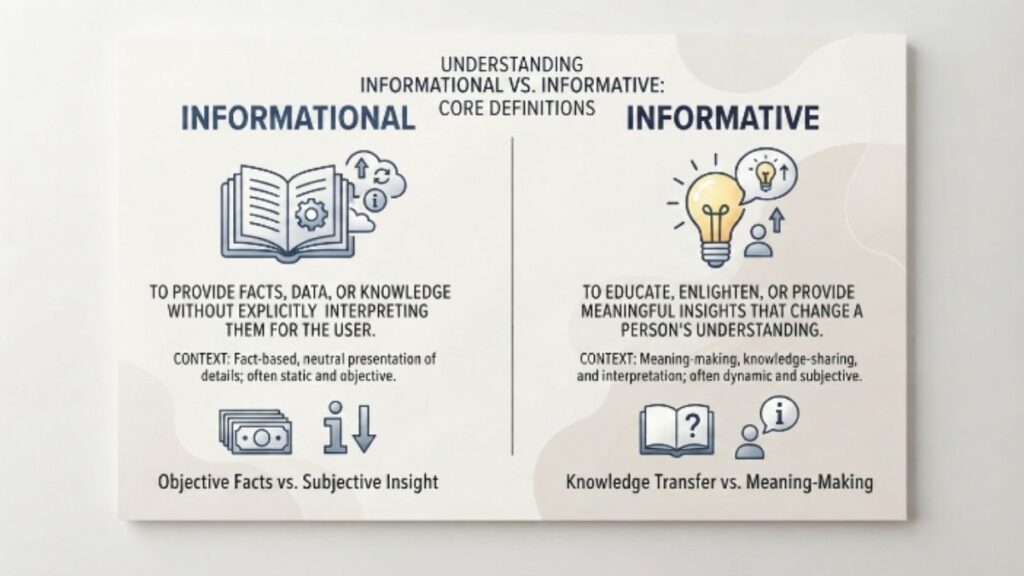
Informational vs Informative: Core Definitions
What “Informational” Means
“Informational” is a neutral, descriptive adjective. It tells you that something contains or relates to information. It does not say whether that information is useful, engaging, or easy to understand.
In simple words
If you can replace a word with “fact-based” or “data-focused,” then informational is the right choice. It describes the category of content, not its value.
Where you see informational content
- Government websites and official reports
- School textbooks and reference books
- Company brochures and manuals
- Instruction sheets and policy documents
Example
“The museum offers an informational pamphlet about the exhibit.”
The pamphlet has facts. Whether you found it helpful is a separate matter entirely.
What “Informative” Means
In simple words
“Informative” means the content actually delivers something valuable. It answers a question, explains a concept, or helps you understand something you did not know before. Ask yourself: Did I learn something useful? If yes, it was informative.
Where you see informative content
- Blog posts and explainer articles
- How-to guides and tutorials
- Engaging lectures and workshops
- Documentary films and educational videos
Example
“The doctor gave me a very informative explanation about the treatment.”
That explanation added value. It changed your understanding.
Key Differences Between Informational and Informative
| Feature | Informational | Informative |
|---|---|---|
| Focus | Presenting facts or data | Teaching or explaining concepts |
| Tone | Neutral and objective | Engaging and educational |
| Goal | Deliver raw information | Ensure understanding |
| Reader outcome | Awareness | Learning and insight |
| Typical formats | Reports, manuals, brochures | Blogs, tutorials, explainer videos |
| Answers | “What” and “when” | “How” and “why” |
Informational Texts: Features and Use Cases
Core Features of Informational Text
Informational texts are built for accuracy and structure. They prioritize facts over feelings. Key characteristics include:
- Objective tone — no personal opinion, no emotional language
- Structured layout — headings, subheadings, bullet points, and tables
- Fact-based content — verified data, statistics, and concrete details
- Formal or technical language — precise terminology suited to the subject
Common Formats
- Encyclopedias and reference guides
- News reports and press releases
- Technical manuals and data sheets
- Scientific journals and research articles
Where Informational Texts Fit Best
Informational content works best when the reader needs quick, reliable facts — not a full explanation. Think of a fire escape map, a product ingredient list, or a government census report. The goal is documentation, not discovery.
Informative Writing: Purpose, Style, and Characteristics
Purpose
Informative writing goes one step further. It does not just present facts — it helps the reader understand those facts. The writer’s job is to bridge the gap between raw knowledge and real comprehension.
Characteristics of Informative Writing
- Clarity and engagement — make complex ideas easy to grasp
- Explanatory tone — uses analogies, examples, and case studies
- Audience-focused language — written for general readers, not just specialists
- Actionable insights — often guide the reader toward a takeaway or next step
Common Formats
- How-to articles and step-by-step guides
- Educational blog posts
- Explainer videos and infographics
- Opinion-free essays that explain a topic in depth
Informational vs Informative in Practice
How Professionals Use Each Type
Different professionals lean on each type for different reasons. Here is a quick breakdown:
Businesses
Use informational content for product specs, terms and conditions, and company reports. Use informative content for blog posts, FAQs, and customer education pieces.
Teachers
Use informational texts like textbooks and reference materials to deliver curriculum content. Use informative methods — demonstrations, storytelling, analogies — to help students truly understand.
Content Creators
Write informative articles and videos because they want their audience to feel like they learned something, not just read something.
Marketers
Blend both. Product pages are often informational (specs, prices, features). Email newsletters and explainer videos lean informative to build trust and educate leads.
Researchers
Publish informational work in journals — structured, data-heavy, objective. When presenting to a general audience, they shift to an informative style to make findings accessible.
Mistakes Writers Make (and How to Avoid Them)
Mistake 1: Giving only facts when people need explanations
Listing data without context leaves readers informed but not educated. If your audience is asking why or how, raw statistics are not enough. Add context, analogies, or examples to make your content genuinely informative.
Mistake 2: Overexplaining simple facts
Not everything needs a deep dive. If a reader just needs a quick fact — a date, a statistic, a definition — keep it informational. Over-explaining simple data wastes the reader’s time and dilutes your content’s impact.
Mistake 3: Mixing tones accidentally
Informational content should stay neutral. Informative content can carry a warmer, more educational voice. Mixing them — adding opinions to a policy document or stripping explanation from a tutorial — confuses the reader and undermines trust.
Types of Informative Texts: A Quick Breakdown
Expository
Explains a topic or concept clearly and logically. No personal opinion. Just structured explanation. Example: “How does photosynthesis work?”
Descriptive
Provides a detailed picture of a concept, object, or event. Example: “What are the features of the latest smartphone model?”
Comparative
Highlights differences and similarities between two or more things. Example: “iPhone vs Android: Which fits your lifestyle?”
Procedural
Walks the reader through a process, step by step. Example: A recipe, a DIY guide, a software tutorial.
Analytical
Breaks down a topic to examine its parts and what they mean. Example: A market analysis or a literary breakdown.
The Role of Visual Aids in Both Types of Content
Visuals for Informational Content
Charts, tables, and graphs are the go-to tools. They present data clearly so readers can scan and absorb facts at a glance without reading dense paragraphs.
Visuals for Informative Content
Infographics, annotated diagrams, and step-by-step screenshots work best here. They do not just show data — they explain it. A labeled diagram of the water cycle, for example, teaches the process rather than just listing its stages.
Why Visual Aids Improve Understanding
Research consistently shows that visual content boosts information retention compared to text alone. Visuals reduce cognitive load, help different types of learners engage, and make complex processes far easier to follow.
Real-World Examples
Informational Examples
- A table of nutritional values on a food package
- A Wikipedia article listing historical dates
- A government census report showing population figures
- A product specification sheet
Informative Examples
- A blog post explaining why certain foods are high in sodium
- An explainer article on how the census data affects local funding
- A tutorial walking you through setting up your router
- A video explaining the causes and effects of climate change
SEO Angle: Search Intent Behind Both Terms
How Search Engines Interpret Informational Intent
Search engines classify queries by intent. “Informational intent” refers to searches where users want to learn something — not buy something or navigate to a specific page. Queries like “what is photosynthesis” or “difference between affect and effect” are purely informational in intent.
How Search Engines Interpret Informative Content
Google rewards content that genuinely educates users. Pages that explain concepts clearly, answer follow-up questions, and help users understand a topic — not just list facts about it — tend to rank higher. This is informative content doing its SEO job.
Choosing the Right Keyword Based on Intent
| User Search | Content Type to Create |
|---|---|
| “What is X?” | Informational — define it clearly |
| “How does X work?” | Informative — explain the process |
| “Difference between X and Y” | Informative — compare and clarify |
| “X statistics 2024” | Informational — present data |
| “Why does X happen?” | Informative — explain causes |
FAQs
What does “informational” mean?
“Informational” describes content that contains or relates to facts and data, presented objectively without judging the value of that information.
What does “informative” mean?
“Informative” describes content that provides useful or meaningful knowledge — it teaches the reader something they did not know before.
Can “informational” and “informative” be used interchangeably?
Not always. While they overlap, “informational” is neutral and describes content type, while “informative” implies quality and usefulness. Context determines which is correct.
Why does the difference matter for writing?
Using the wrong word can mislead your reader about the purpose or value of your content — especially in academic, professional, or SEO contexts where precision matters.
Which type is better for SEO?
Informative content generally performs better for SEO because it satisfies search intent more completely, encourages longer time on page, and earns more backlinks through genuine value.
Conclusion
The difference between informational and informative is subtle but significant. Informational content presents facts — it describes, lists, and documents. Informative content goes further — it explains, teaches, and helps readers truly understand. Informational vs Informative.
Knowing which one to reach for changes how you write, how you connect with your audience, and how well your content performs in search. Whether you are drafting a report, writing a blog post, or planning a lesson, matching your content type to your purpose is one of the simplest ways to produce work that actually resonates. Informational vs Informative.