Pre and post are two Latin-derived prefixes that define timing in the English language — pre means before an event, and post means after it. Pre vs Post.
These two tiny word parts carry enormous power. One wrong prefix flips an entire sentence’s meaning — turning preparation into reflection, anticipation into conclusion, and readiness into results.
Mastering pre vs post sharpens writing across medicine, business, education, and research. This guide delivers clear rules, real examples, and practical tips to eliminate confusion permanently.
Understanding What “Pre” and “Post” Mean
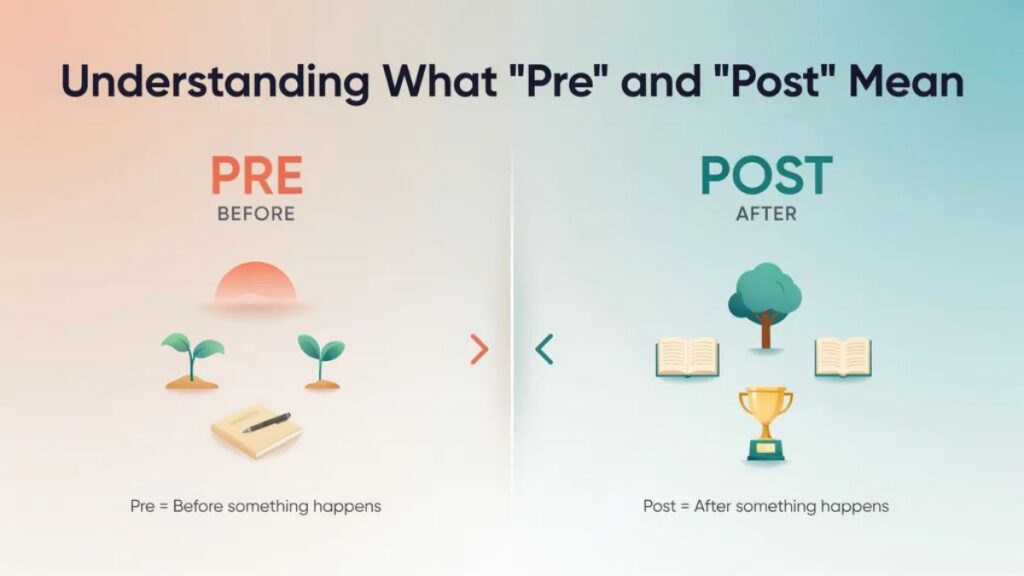
Two of the most useful prefixes in the English language are also two of the most misused. Pre means before — it signals that something happens earlier, in advance, or in preparation for a main event. Post means after — it describes what happens later, as a result, or in the period following that same event.
On the surface, this sounds simple. Yet the confusion between pre and post appears constantly — in student essays, business reports, medical documents, and everyday conversation. That’s because both prefixes attach to similar root words, creating pairs that look almost identical but carry opposite meanings. Getting one wrong changes the entire timeline of your message.
This guide breaks down both prefixes thoroughly: their origins, grammar rules, real-world applications, common mistakes, and practical tips to help you use them with complete confidence.
The Origins of “Pre” and “Post”
Both prefixes trace their roots to Classical Latin, which is exactly why they appear so often in technical, academic, and professional English.
- Pre- derives from the Latin word prae, meaning “before” or “in front of.” It entered English through Old French and has been part of the language since at least the 14th century.
- Post- comes directly from the Latin post, meaning “after” or “behind in time.” It is used in English in the same sense it carried in Latin.
Because Latin was the foundation of scientific, legal, and medical vocabulary, both prefixes became deeply embedded in specialized fields — which is why you’ll encounter them constantly in healthcare, academia, and professional writing.
How “Pre” Functions in English
When to Use Pre-
Use pre- whenever an action, event, or condition occurs before the main reference point. It signals preparation, anticipation, or an earlier stage in a sequence.
Ask yourself: Does this happen before something else? If yes, pre- is your prefix.
- The patient needs a pre-operative evaluation. ✅
- She submitted her pre-registration form online. ✅
Common Word Formations with Pre-
| Word | Meaning |
|---|---|
| Preheat | To heat before cooking |
| Prenatal | Before birth |
| Preview | To see before the official release |
| Pretest | A test taken before instruction |
| Pre-launch | Activities before a product launch |
| Preschool | Education before formal schooling |
| Pre-approval | Approval given before a full process |
Quick Rule of Thumb
Replace pre- with the phrase “before the” and check if the sentence still makes logical sense. If it does, you’re using it correctly.
Pre-surgery checkup → Before the surgery checkup ✅
How “Post” Functions in English
When to Use Post-
Use post- whenever something happens after the main event — a result, a follow-up, a reflection, or a recovery. It points to anything that exists or occurs on the other side of a key moment.
Ask yourself: Does this happen after something else? If yes, post- is your prefix.
- The surgeon reviewed the post-operative report. ✅
- The team held a post-meeting debrief. ✅
Common Word Formations with Post-
| Word | Meaning |
|---|---|
| Postwar | After the war |
| Postgraduate | After completing a degree |
| Posttest | A test taken after instruction |
| Post-launch | Activities after a product launch |
| Postnatal | After birth |
| Post-production | Work done after filming |
| Post-mortem | Analysis after an event or death |
Quick Rule of Thumb
Replace post- with “after the” and test the sentence. If it makes sense, your prefix is correct.
Post-workout recovery → After the workout recovery ✅
Pre vs Post: A Clear Comparison
The clearest way to understand these two prefixes is to see them side by side with the same root word.
Side-by-Side Examples
| Root Word | With Pre- | With Post- |
|---|---|---|
| Surgery | Pre-surgery (before the operation) | Post-surgery (after the operation) |
| Test | Pretest (before instruction) | Posttest (after instruction) |
| Launch | Pre-launch (before release) | Post-launch (after release) |
| War | Pre-war (before the conflict) | Postwar (after the conflict) |
| Season | Preseason (before competition) | Postseason (after competition) |
| Graduate | — | Postgraduate (after earning a degree) |
| Natal | Prenatal (before birth) | Postnatal (after birth) |
This table makes one thing obvious: these prefixes are direct opposites. Using the wrong one doesn’t just create a grammatical error — it reverses the timeline entirely.
Where the Difference Really Matters
1. Medicine
In healthcare, pre- and post-terminology can affect patient safety. Medical staff use these prefixes to document care at different stages of treatment.
- Pre-operative care covers assessments and preparation before a procedure.
- Post-operative care covers monitoring and recovery after a procedure.
Mislabeling either stage in a medical record creates serious confusion about what has or hasn’t been done for a patient.
2. Education
Teachers and researchers use pre- and post-testing to measure how much students learn.
- A pretest establishes baseline knowledge before a lesson begins.
- A posttest evaluates how much was retained after instruction ends.
The gap between the two scores shows learning progress. Using the wrong label makes the data meaningless.
3. Business and Marketing
Marketing teams run pre- and post-campaign activities that each serve a distinct purpose.
- Pre-launch work includes teasers, email lists, and audience building before a product goes live.
- Post-launch analysis covers sales data, customer feedback, and performance review after release.
Confusing these stages in a client report — labeling post-campaign data as pre-campaign — can cause significant misunderstandings and damage professional credibility.
4. Research and Data Analysis
Researchers depend on precise language to describe their methodology.
- Pre-study surveys collect information before an experiment begins.
- Post-study findings present conclusions after the experiment concludes.
Swapping these labels corrupts the integrity of the entire study.
Avoiding Common Mistakes with Pre and Post
Mistake 1: Using Pre and Post Interchangeably
These prefixes are not synonyms. They are antonyms. Writing “post-surgery preparation” instead of “pre-surgery preparation” completely reverses the intended meaning. Always verify: is the action happening before or after?
Mistake 2: Adding Them When Not Needed
Not every word benefits from a prefix. Adding pre- or post- unnecessarily creates clunky, redundant language.
- ❌ Pre-plan your strategy → ✅ Plan your strategy (planning already implies doing it in advance)
- ❌ Post-completed → ✅ Completed (“post” adds nothing here)
Mistake 3: Confusing Meaning Because of a Similar Sound
Some paired words sound alike but carry very different meanings. For example:
- Precede means to come before, not after.
- Postdate means to assign a later date to something.
- Posthumous refers to something that happens after a person’s death.
When in doubt, consult a dictionary. Sound alone is never a reliable guide to prefix meaning.
Practical Tips to Improve Prefix Usage
1. Translate the Prefix
Before writing, mentally swap the prefix with its plain meaning: before for pre-, after for post-. If the sentence still makes sense, you’re on the right track.
2. Break Down the Word
Separate the prefix from the root: pre + natal, post + war. Understanding the root word helps clarify whether “before” or “after” fits logically.
3. Use the Before/After Test
This is the fastest method. Insert “before the” or “after the” in place of the prefix and read the phrase aloud. The one that sounds natural is correct.
4. Think in Terms of Timelines
Draw a simple mental timeline with a main event in the center. Everything to the left uses pre-. Everything to the right uses post-. This visual trick works especially well in medical and research contexts.
5. Learn Through Real-World Examples
Read healthcare articles, academic papers, or business case studies. Notice how professionals use pre- and post- in context. Exposure to real usage builds intuition faster than memorizing rules alone.
Case Studies: Real Applications of Pre vs Post
Case Study 1: Marketing Launch Strategy
A digital marketing agency was preparing a campaign report for a retail client. Due to a labeling error, the team marked a document “Pre-Campaign Analysis” when it actually contained sales results after the campaign ended. The client reviewed the data expecting projections but received conclusions instead — creating hours of confusion and a delayed presentation. Accurate prefix use could have prevented the entire problem.
Case Study 2: Hospital Procedure
A teaching hospital introduced mandatory prefix training for nursing staff after discovering inconsistent documentation in patient files. Some staff were writing “post-operative assessment” on forms that were completed before surgery. After training, documentation accuracy improved significantly, and patient handoff errors dropped.
Case Study 3: Academic Research
A university psychology department published a paper on behavior change. The study’s methodology used a pretest-posttest design, measuring participants before and after an intervention. Reviewers noted that clear use of these prefixes made the paper’s timeline immediately understandable, requiring no additional explanation in the methodology section.
Helpful Quotes on Language and Meaning
“The limits of my language mean the limits of my world.” — Ludwig Wittgenstein
“Language is the road map of a culture. It tells you where its people come from and where they are going.” — Rita Mae Brown
“If you can’t tell when something happened, you can’t measure change.” — Education research principle
These quotes reflect a core truth: precision in language — including something as small as a two-letter prefix — shapes how clearly we communicate and how effectively we are understood.
FAQ’s
What does the prefix “pre” mean?
Pre- means before. It indicates that something happens earlier in time or in preparation for a main event — for example, prenatal (before birth) or preview (seen before release).
What does the prefix “post” mean?
Post- means after. It describes actions, events, or conditions that occur following a main event — for example, postgraduate (after earning a degree) or post-launch (after a product release).
Can “pre” and “post” be used interchangeably?
No. They are direct opposites. Using one in place of the other reverses the intended meaning entirely and can cause serious miscommunication, especially in professional or medical contexts.
Are both prefixes from Latin?
Yes. Pre- comes from the Latin prae (before), and post- comes from the Latin post (after). Both entered English through academic and scientific writing.
What’s an easy way to choose the right prefix?
Use the before/after test: replace the prefix with “before the” or “after the” and see which version makes logical sense. That’s your correct prefix.
Conclusion
Understanding pre vs post is not just a grammar lesson — it’s a communication skill that affects clarity in medicine, education, business, and research. Pre vs Post. These two small prefixes carry enormous meaning. Pre- tells your reader that something happened before. Post- tells them it happened after. Mix them up, and the entire timeline of your message collapses. Pre vs Post.
The good news is that mastering them takes nothing more than a simple mental habit: before or after? Once that question becomes automatic, correct prefix usage follows naturally. Apply the before/after test, study real-world examples, and keep a reference table handy when writing in specialized fields. Pre vs Post. With a little practice, pre- and post- will become two of the most reliable tools in your vocabulary.