Training is the correct spelling — a word rooted in Old French and Latin, meaning the systematic process of developing skills, knowledge, or behavior through guided practice. Trainning is simply a misspelling, unrecognized by any dictionary or style guide. Training or Trainning.
One extra letter. That’s all it takes to undermine an otherwise polished resume, proposal, or certification document — and most people never notice until it’s too late.
Understanding correct spelling in the English language isn’t just grammar trivia. It reflects precision, credibility, and communication clarity — qualities that matter across every professional field.
The Short Answer — And Why It Matters
Training is the only accepted correct spelling. Full stop.
You won’t find trainning in Merriam-Webster, Oxford, or Cambridge. No major style manual recognizes it. No regional dialect uses it. It’s simply a common misspelling — one that stems from a misapplied grammar rule.
Why does it matter? Think about the contexts where this word shows up: resumes, business emails, certification documents, academic papers, HR reports, client-facing proposals. A spelling error in any of these settings does quiet damage. It shifts a reader’s attention from your content to your competence. That’s a cost worth avoiding.
Understanding the Root Word — “Train”
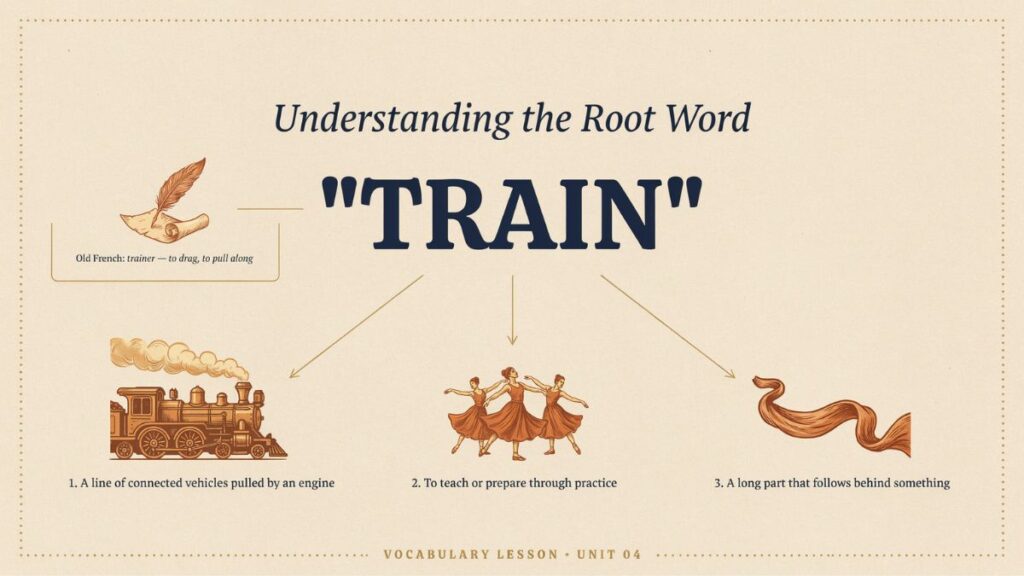
Before unpacking why training is spelled the way it is, it helps to understand where the word came from.
Where “Train” Comes From
The verb train has deep roots. It traces back to the Old French word trainer, meaning to drag or pull along. That itself descended from the Latin trahere — to draw or pull. By Middle English, the word had evolved into something closer to its modern meaning: to guide, shape, or lead.
By the late 14th century, “train” was being used to describe the act of guiding animals and shaping vines in horticulture. by the 16th and 17th centuries, military preparation and human instruction entered the picture. Athletic conditioning followed in the 19th century. The semantic evolution of train is genuinely fascinating — one word stretching across centuries to cover soldiers, athletes, teachers, and machine learning models.
What “Training” Actually Means
At its core, training means the process of developing skills, knowledge, or behaviors through systematic instruction or practice. Grammatically, it functions in two ways:
- As a noun: “The training lasted three weeks.”
- As a gerund (a verb acting as a noun): “Training every day builds discipline.”
Both forms share the same spelling — and the same rule that prevents that second “n” from sneaking in.
Why “Training” Is Correct — The Spelling Rule Behind It
This is the heart of the matter. Understanding consonant doubling — and when it doesn’t apply — clears up the confusion permanently.
The Consonant Doubling Rule, Explained Simply
In English word formation, when you add the “-ing” suffix to a base verb, you sometimes double the final consonant. But not always. The rule depends on a specific pattern.
You double the final consonant only when all three of these conditions are true:
- The base word ends in a single consonant
- That consonant is preceded by a single vowel
- The stress falls on the final syllable
This is the CVC pattern — Consonant, Vowel, Consonant. Words that fit it double up. Words that don’t, won’t.
Why “Train” Doesn’t Double
Look at the word train:
- It ends in -ain, which is a vowel combination (two vowels before the final consonant)
- The vowel sound is long, not short
- The ending is a consonant cluster — not a single final consonant preceded by a single vowel
None of the three doubling conditions apply. So when you add -ing, you simply write: train + ing = training.
No extra “n.” No doubling. Just training.
The Words That DO Double — For Contrast
Seeing the rule in action with other verbs makes this click faster:
| Base Word | Pattern | Add -ing | Double? | Result |
|---|---|---|---|---|
| Run | CVC (short vowel) | + ing | ✅ Yes | Running |
| Sit | CVC (short vowel) | + ing | ✅ Yes | Sitting |
| Begin | Final syllable stressed | + ing | ✅ Yes | Beginning |
| Plan | CVC (short vowel) | + ing | ✅ Yes | Planning |
| Stop | CVC (short vowel) | + ing | ✅ Yes | Stopping |
| Train | Long vowel combo (-ain) | + ing | ❌ No | Training |
| Explain | Long vowel combo (-ain) | + ing | ❌ No | Explaining |
| Read | Double vowel (-ea) | + ing | ❌ No | Reading |
The pattern is clear. Train belongs with explain and read — not with run or sit.
Why People Write “Trainning” — And Why It’s Wrong
Understanding the error is just as useful as knowing the rule. Here’s what causes it.
The Logic Trap
English spelling has plenty of “-ing” words that do double their final consonant — running, swimming, beginning, planning. When you encounter those words enough, your brain builds an association: adding “-ing” sometimes means doubling a letter. That’s true — but only under specific conditions. When those conditions don’t apply, the rule doesn’t either.
Trainning is what happens when the doubling habit fires at the wrong moment.
The CVC Pattern Mismatch
Here’s the breakdown that exposes the error:
- Run ends in a single vowel (u) + single consonant (n) → CVC → double → running ✅
- Train ends in a vowel combo (ai) + consonant (n) → NOT CVC → no double → training ✅
Writing trainning incorrectly forces train into a spelling pattern it was never designed for. It’s like putting the wrong key in a lock — it looks plausible until you try to turn it.
Other Misspelling Patterns to Watch
Beyond trainning, a few other misspelled variants appear in search data:
- Trainig — drops the “n” entirely
- Traning — drops the “i,” compressing the vowel
- Trainnig — doubles the “n” and drops the final “n”
All of these are incorrect. None appear in any recognized grammar guide or dictionary. Spelling accuracy means knowing not just what looks right but what is right — and why.
“Training” in Real-World Use
The word training shows up across virtually every professional field. Here’s how it’s used — and why spelling accuracy in these contexts carries real weight.
Professional and Corporate Contexts
In the workplace, training is everywhere. HR departments design onboarding programs. Managers schedule compliance courses. L&D (Learning & Development) teams build skill-building workshops. Professional writing in these settings — emails, reports, proposals, policy documents — demands correct spelling. A misspelled word in a cover letter or business proposal immediately draws a reader’s eye away from your qualifications.
“Fifty-eight percent of hiring managers say they would dismiss a candidate’s application due to spelling errors.” — CareerBuilder survey
Example sentences:
- “New employees complete a two-week training program before joining their teams.”
- “The HR team updated the workplace training materials ahead of the annual compliance review.”
- “She oversees leadership training for mid-level managers across five departments.”
Sports and Athletic Contexts
Athletes, coaches, and sports journalists use this word constantly — and almost always correctly. Strength training, endurance training, interval training, and training camp are all standard terms in sports writing.
Example sentences:
- “Pre-season training pushed the squad to its physical limits.”
- “His daily training regimen combines weights with track work.”
- “The coaching staff adjusted the training schedule after two players reported fatigue.”
Military and Law Enforcement Contexts
In these fields, communication clarity isn’t just professional — it’s operational. Boot camp training, tactical training, field training officers, and first responder certification programs all depend on precise documentation. Errors in official forms or compliance documents can create delays or flag credibility issues.
Example sentences:
- “Recruits undergo six weeks of intensive training before their first assignment.”
- “The department’s field training program pairs new officers with experienced mentors.“
Academic and Educational Contexts
Teacher training, vocational training, and academic certification programs make up a huge portion of how the word appears in educational writing. In academic papers, where spelling accuracy is treated as evidence of rigor, errors carry an outsized cost.
Example sentences:
- “The study examined outcomes across three teacher training programs.”
- “Vocational training prepares students for careers in skilled trades.”
- “Participants in the certification course completed 40 hours of clinical training.”
Technology and Machine Learning Contexts
One fast-growing use of the word sits in tech: machine learning model training. When a model processes a dataset to learn patterns, that process is called training. Developers, data scientists, and technical writers use the word constantly — and always spell it correctly, since documentation errors in code-adjacent fields tend to cause real problems.
Example sentences:
- “The model required 72 hours of training on the full dataset.”
- “Improving training data quality directly impacts model accuracy.”
Correct vs. Incorrect — Side-by-Side Examples
Here’s a quick reference table to anchor the correct usage in context:
| Correct ✅ | Incorrect ❌ |
|---|---|
| “The training session starts at 9 a.m.” | “The trainning session starts at 9 a.m.” |
| “She has years of athletic training.” | “She has years of athletic trainning.” |
| “Employee training is mandatory.” | “Employee trainning is mandatory.” |
| “Model training requires clean data.” | “Model trainning requires clean data.” |
| “His training regimen is intense.” | “His trainning regimen is intense.” |
| “Safety training is scheduled for Friday.” | “Safety trainning is scheduled for Friday.” |
| “Teacher training improves outcomes.” | “Teacher trainning improves outcomes.” |
| “Training begins after orientation.” | “Trainning begins after orientation.” |
Every instance on the right is wrong for the same reason — an unnecessary extra “n” that no spelling rule in the English language supports.
How to Never Misspell “Training” Again
A few solid memory tricks — grounded in the actual pronunciation rules and patterns — make this stick permanently.
The Simple Memory Rule
Think of it this way: “Train doesn’t gain a letter when it runs.”
The word already contains the motion. It’s a verb about moving forward — and adding “-ing” just keeps it going, without any extra baggage. Training or Trainning.
The Pronunciation Test
Say the word out loud: TRAY-ning.
Notice anything? The vowel sound is long — the “ai” in train sounds like the letter “a” in the alphabet. Long vowel sounds are one of the clearest signals that consonant doubling doesn’t apply. When you hear a short, clipped vowel — like in run or sit — doubling usually follows. When the vowel stretches out, it doesn’t.
This is one of the most reliable pronunciation rules in English spelling. Say it, hear it, and the correct form usually reveals itself.
Spot the Pattern — Words That Behave Like “Training”
Train isn’t alone. An entire family of words follows the same pattern — no doubling, even with “-ing”:
| Base Word | Add -ing | Result |
|---|---|---|
| Explain | + ing | Explaining |
| Remain | + ing | Remaining |
| Contain | + ing | Containing |
| Obtain | + ing | Obtaining |
| Sustain | + ing | Sustaining |
| Maintain | + ing | Maintaining |
Every one of these words ends in the -ain vowel pattern. None of them double. Recognizing this family of words gives you a portable rule that extends far beyond training itself.
The Proofreading Habit
Even if the rule is clear, proofreading catches what tired eyes miss. A quick pass — or reading aloud — before sending anything important is worth the 30 seconds it takes. Spell-checkers catch trainning most of the time but not always, especially in auto-populated fields or older software. Don’t outsource your spelling accuracy entirely to a machine.
Quick Reference — Spelling Rules for -ING Words
| Condition | Example | Double? | Result |
|---|---|---|---|
| Short vowel + single consonant (CVC) | Run | ✅ Yes | Running |
| Single vowel + single consonant, final syllable stressed | Begin | ✅ Yes | Beginning |
| Long vowel combination (-ai, -ea, -oa) | Train, Read | ❌ No | Training, Reading |
| Ends in silent -e | Make, Write | ❌ No (drop e) | Making, Writing |
| Ends in two consonants | Help, Jump | ❌ No | Helping, Jumping |
| Ends in two vowels + consonant | Rain, Lean | ❌ No | Raining, Leaning |
Keep this table bookmarked. It answers 90% of the “-ing” spelling questions that come up in everyday English language writing.
FAQ’s
Is “trainning” ever correct in any form of English?
No. Neither American nor British English recognizes “trainning.” Every major dictionary — Merriam-Webster, Oxford, and Cambridge — lists only “training.”
What is the correct spelling — training or trainning?
“Training” is always correct. The consonant doubling rule doesn’t apply to “train” because it ends in a long vowel combination (-ain), not a single short vowel.
Why do so many people misspell “training” as “trainning”?
Most people confuse it with words like “running” or “swimming,” which do double their final consonant. “Train” follows a different spelling pattern entirely.
Does spell-check always catch “trainning”?
Not always. Most modern tools — including Grammarly and Microsoft Word’s 2024 editor — flag it. However, older software and some form fields may let it slip through undetected.
Is the spelling rule for “training” the same in British and American English?
Yes. Both varieties agree — “training” takes one “n,” always. Unlike words such as “travelling” vs. “traveling,” this spelling has no regional variation whatsoever.
Conclusion
The answer to training or trainning: which one is correct is clear — it’s always training. One “n,” no exceptions. The consonant doubling rule simply doesn’t apply to train, and no dictionary, style guide, or regional dialect says otherwise. Training or Trainning.
Spelling accuracy matters more than most people realize. Whether you’re writing a resume, a business email, or an academic paper, getting training or trainning right signals professionalism and attention to detail. Training or Trainning. Master this rule once and you’ll never second-guess it again.