If you’ve ever paused mid-sentence, wondering whether to write “there has been” or “there have been,” you’re not alone. This tiny grammar choice trips up even confident English speakers, especially in emails, reports, and everyday conversation.
The good news? Once you understand the simple rule behind it, you’ll never hesitate again. This guide breaks down everything — structure, rules, examples, tables, and real-world case studies — so you can use both phrases with total confidence.
Understanding the Structure of “There + Has/Have Been”
“There” in this construction isn’t the real subject of the sentence. It’s what grammarians call a dummy subject — a placeholder used to introduce something into the conversation without naming it first.
The actual subject sits after “been.” For example:
- There has been a delay. (subject = delay)
- There have been several delays. (subject = delays)
Once you realise “there” doesn’t control the verb, the whole rule becomes much simpler.
Present Perfect Basics: “Has Been” vs. “Have Been”
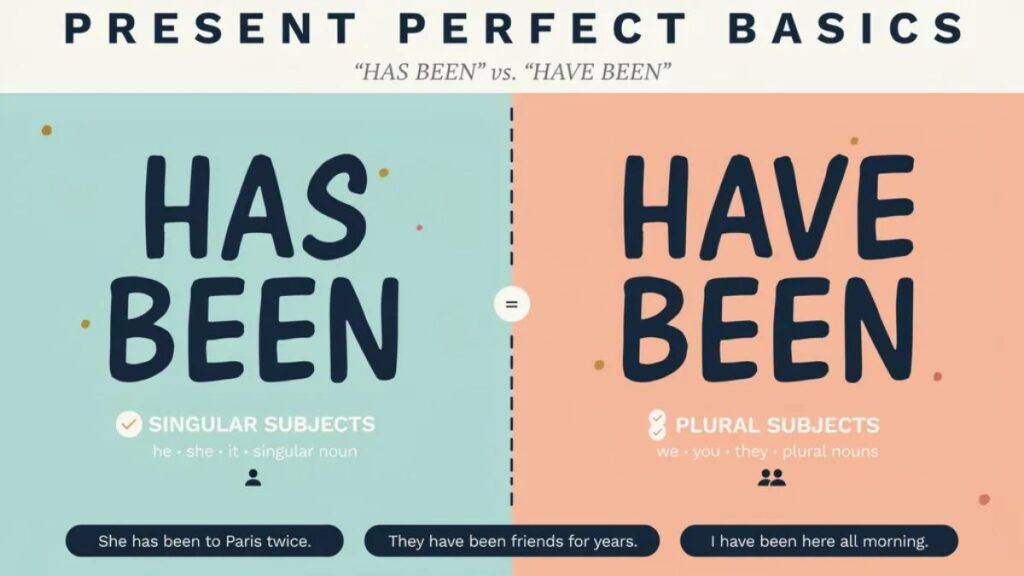
Both phrases belong to the present perfect tense, formed with has/have + the past participle “been.” This tense links something from the past to the present moment.
- Has been pairs with singular subjects (he, she, it, or a singular noun).
- Have been pairs with plural subjects (we, you, they, or plural nouns).
It’s the same agreement pattern you already use elsewhere in English — just hidden behind the word “there.”
Why English Uses the Present Perfect
The present perfect isn’t just about timing. It’s about relevance. Here’s why this tense shows up so often with “there.”
1. To show continuity
It signals that something started earlier and is still going on or still relevant.
Example: There have been ongoing discussions about the merger.
2. To show past experiences
It points to something that happened (possibly more than once) without specifying exactly when.
Example: There has been talk of expansion for years.
3. To show recent events with present impact
It connects a recent happening to the current situation.
Example: There has been a power outage, so the office is closed today.
The Real Difference: “There Has Been” vs. “There Have Been”
The entire decision comes down to one question: is the real subject singular or plural?
| Form | Used With | Example |
|---|---|---|
| There has been | Singular nouns, uncountable nouns | There has been a problem. |
| There have been | Plural nouns | There have been problems. |
Examples of there has been (singular):
- There has been a change in management.
- There has been an accident on the highway.
- There has been confusion about the new policy.
Examples of there have been (plural):
- There have been three accidents this month.
- There have been multiple complaints.
- There have been improvements across the board.
When to Use “There Has Been”
Use “there has been” when the noun following it is singular or uncountable.
Correct Examples
- There has been a misunderstanding.
- There has been progress on the project.
- There has been heavy rainfall this week.
- There has been a rise in remote work.
Common Traps
Some sentences look plural but aren’t, and vice versa. Watch for nouns like “noise,” “information,” or “research” — they’re uncountable and take “has been.”
❌ There has been many issues. ✔️ There have been many issues.
When to Use “There Have Been”
Use “there have been” when the noun following it is plural.
Correct Examples
- There have been several updates this week.
- There have been many requests from customers.
- There have been two power cuts since Monday.
Confusing Situations
Quantifiers like “several,” “a lot of,” and “plenty of” can mislead learners. The key is to check the noun that follows the quantifier, not the quantifier itself.
- There have been several complaints. (complaints = plural)
- There has been several complaints reported. (focus shifts to “number” as singular — rare, but used in precise formal writing)
Using “Has Been” With Singular Third-Person Subjects
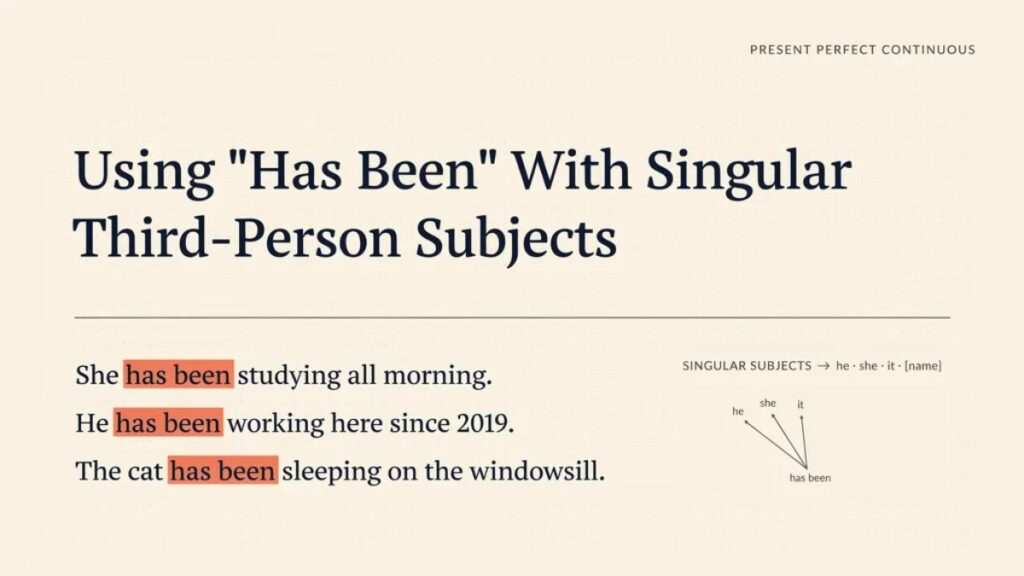
Outside of the “there” structure, the same logic applies to ordinary sentences. “Has been” goes with he, she, it, and singular nouns.
Examples
- She has been working late all week.
- The system has been down since the morning.
- My manager has been very supportive.
Using “Have Been” With Plural and First-Person Subjects
“Have been” goes with I, you, we, they, and plural nouns.
Examples
- I have been waiting for an hour.
- They have been traveling since June.
- The students have been studying hard.
Introducing “Had Been”: The Past Perfect Version
“Had been” is the past perfect form. It’s used when describing something that happened before another past event.
Meaning:
It shows a sequence — one past action completed before a second past action began.
Example: There had been three complaints before the manager finally responded.
Comparison Table: Present Perfect vs. Past Perfect
| Tense | Form | Use Case | Example |
|---|---|---|---|
| Present Perfect | has/have been | Past action connected to now | There has been a delay. |
| Past Perfect | had been | Past action before another past action | There had been a delay before the flight was cancelled. |
How Subject–Verb Agreement Actually Works Here
The rule never changes: find the real subject, then match the verb to it. “There” simply repositions the subject after the verb for smoother sentence flow. Ignore “there” completely when deciding between has and have.
Navigating Compound Subjects
When two nouns are joined by “and,” the subject becomes plural, so use “have been.”
- There have been a manager and an assistant assigned to the task.
Exception: when the compound noun functions as one unified idea, it can stay singular.
- There has been a rise and fall in prices. (“rise and fall” = one trend)
Prepositional Phrases That Confuse Learners
Long prepositional phrases between “there” and the real subject often cause learners to match the verb to the wrong word.
Rule:
Ignore any prepositional phrase before identifying the subject. Look for the noun that the verb should actually agree with.
❌ There has been, over the past few months, several delays. ✔️ There have been, over the past few months, several delays.
Identifying the Real Subject in Complicated Sentences
In longer or inverted sentences, the real subject may be buried after an inserted phrase or clause. Strip away extra words mentally and ask: “What’s actually existing or happening here?”
Example: There has been, according to recent reports, a noticeable shift in consumer behaviour. (subject = “a noticeable shift,” singular)
Expanding the Verb Phrase With Adverbs
Adverbs typically sit between the auxiliary verb and “been.”
Correct structures:
has/have + adverb + been + past participle/complement
Examples:
- There has recently been a change in leadership.
- There have consistently been delays in shipping.
Practical Examples: Present Perfect & Past Perfect
Present Perfect (“Has Been” / “Have Been”)
- There has been a noticeable improvement in sales.
- There have been several new hires this quarter.
Past Perfect (“Had Been”)
- There had been no response before the deadline passed.
- There had been warnings before the system finally crashed.
Quick-Reference Table (Bookmark This)
| Subject Type | Correct Form | Example |
|---|---|---|
| Singular noun | There has been | There has been an error. |
| Uncountable noun | There has been | There has been confusion. |
| Plural noun | There have been | There have been errors. |
| Compound subject (and) | There have been | There have been a delay and a refund. |
| Before another past event | There had been | There had been issues before the launch. |
Common Mistakes and How to Fix Them
Mistake 1: Using “has been” with plural subjects
❌ There has been many changes. ✔️ There have been many changes.
Mistake 2: Ignoring the real subject after “there”
❌ There has been, in many cases, errors found. ✔️ There have been, in many cases, errors found.
Mistake 3: Getting confused by long noun phrases
❌ There has been a series of meetings and reports submitted late. ✔️ There have been a series of meetings and reports submitted late. (if “meetings and reports” is the focus)
Mistake 4: Mixing present perfect and past perfect
❌ There has been a delay before the event started. ✔️ There had been a delay before the event started.
Mistake 5: Not identifying compound subjects
❌ There has been a manager and a supervisor present. ✔️ There have been a manager and a supervisor present.
Case Studies: Real-Life Usage
Case Study 1: Workplace Communication
A project manager writing a status update used: “There have been delays in the design phase, but there has been steady progress in development.” This single sentence shows both forms working side by side correctly — plural delays, singular progress.
Case Study 2: Customer Support Replies
A support team replied to a client: “There has been an issue with your order, and there have been similar reports from other customers today.” Mixing both forms accurately reassured the client that the issue was understood and being tracked.
Case Study 3: Academic Report
A research paper stated: “There have been numerous studies on this subject, though there has been limited consensus on the root cause.” This demonstrates how academic writing relies on precise subject-verb agreement to maintain credibility.
FAQs
When should I use “there have been”?
Use it when the noun following the verb is plural, such as “there have been delays” or “there have been changes.”
When do I use “there has been”?
Use it when the noun is singular or uncountable, such as “there has been a delay” or “there has been confusion.”
What’s the biggest difference between “have been” and “has been”?
“Has been” agrees with singular subjects; “have been” agrees with plural subjects. The rule is pure subject-verb agreement.
Can I use “has been” with plural subjects?
No. “Has been” only works with singular or uncountable nouns. Plural subjects always require “have been.”
Why does subject–verb agreement matter here?
It keeps writing clear, professional, and grammatically correct, especially in formal emails, reports, and academic work.
Conclusion
Choosing between “there have been” and “there has been” becomes simple once you stop focusing on “there” and start identifying the real subject. Singular or uncountable nouns take “has been.” Plural nouns take “have been.” For actions completed before another past event, switch to “had been.” There Have Been or There Has Been.
Whether you’re writing a business report, a customer reply, or an academic paper, this one rule keeps your sentences accurate and polished. There Have Been or There Has Been. Practice spotting the real subject, and you’ll never second-guess this construction again.