Entwined and intertwined both describe things wound or twisted together, but they carry subtle shades of meaning that shape how precise and polished your writing feels. Entwined often suggests two elements joined closely, almost delicately, while intertwined implies a deeper, more complex weaving between multiple strands. English vocabulary guide.
Picture two vines climbing the same trellis, their stems curling around each other until you can’t tell where one ends and the other begins — that image alone reveals why one word fits some sentences better than the other.
Beyond poetry and metaphor, this distinction matters in everyday writing too — from describing relationships and emotions to explaining complex systems, fates, or histories. Choosing the right word sharpens clarity, strengthens imagery, and signals a writer’s command of nuance and tone.
Introduction: Why Entwined vs Intertwined Confuses So Many Writers
You’ve seen both words. You’ve probably used both — maybe even in the same paragraph — and wondered if it even mattered. It does.
Entwined and intertwined look almost identical, share the same root, and often land in the same sentence types. That’s exactly why so many writers pause before choosing one. The confusion isn’t a sign of weak vocabulary. It’s a sign that you’re thinking carefully about language — and that’s what separates average writing from precise, powerful writing.
This guide breaks down the real difference between entwined vs intertwined, shows you when to use each one, and gives you concrete memory tools so you never second-guess yourself again.
Core Meanings of Entwined and Intertwined
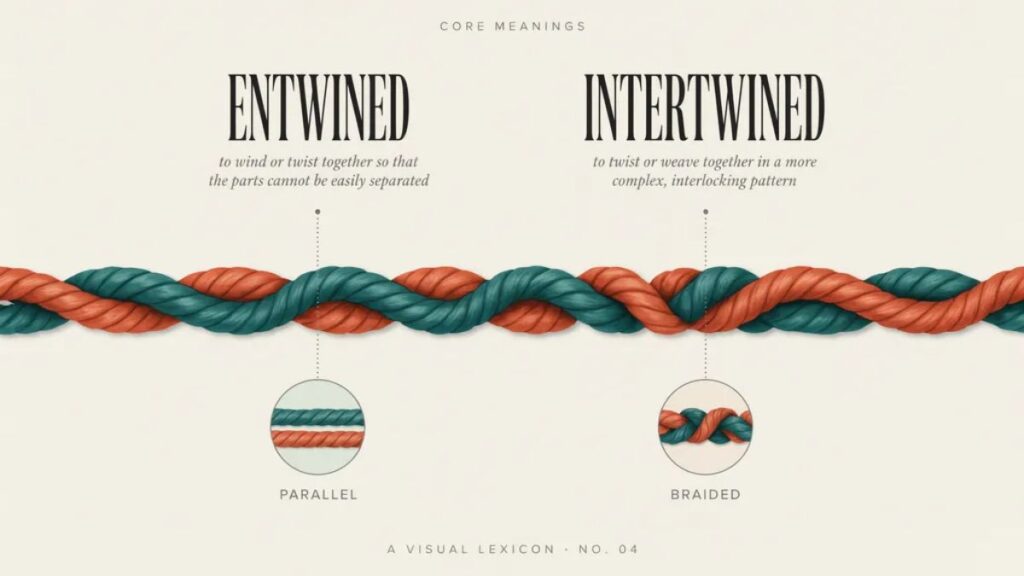
Both words come from the root verb twine, meaning to twist, wind, or weave together. But the prefixes change everything about how they feel and function.
- En- means into or within — suggesting something wrapped closely around or inside something else.
- Inter- means between or among — suggesting mutual involvement across multiple elements.
That small prefix shift is where the real divergence begins.
Quick Meaning Snapshot
| Word | Root | Prefix Meaning | Core Tone |
|---|---|---|---|
| Entwined | twine | en- = into/within | Emotional, intimate, poetic |
| Intertwined | twine | inter- = between/among | Structural, complex, analytical |
What Does Entwined Mean in English?
Entwined means closely twisted, wound, or wrapped together — either physically or emotionally. It emphasizes closeness, intimacy, and a sense of things being bound up within each other in a personal, often tender way.
How Entwined Is Commonly Used
Writers reach for entwined when they want to evoke warmth, closeness, or deep personal connection. It’s the language of poetry, romance, and emotional storytelling. The word paints a picture that’s gentle and intimate — two things so close they’ve essentially become one.
Typical Contexts for Entwined
- Romantic relationships: describing love, affection, or emotional bonds
- Nature and physical imagery: vines around a gate, branches of two trees growing together
- Symbolic writing: fates, destinies, or souls bound by an invisible thread
- Literary and poetic prose: anywhere emotional resonance matters more than analytical precision
Connotations of Entwined
The word carries warmth, tenderness, and a lyrical quality. It doesn’t feel clinical or neutral — it feels human. When readers encounter entwined, they sense closeness, even vulnerability.
Example Sentences Using Entwined
- Their fingers were gently entwined beneath the table.
- The ivy grew entwined along the old stone wall.
- Her memories and grief had become so entwined she could no longer tell them apart.
- Two destinies were entwined long before they ever met.
What Does Intertwined Mean in English?
Intertwined also means woven or connected together, but it emphasizes complexity, interdependence, and mutual influence across multiple elements or systems. Where entwined focuses on closeness, intertwined focuses on structure.
How Intertwined Is Commonly Used
Intertwined is the word of choice in academic papers, journalism, business analysis, and professional writing. It signals that two or more things are so structurally linked that each affects the other — not necessarily romantically or emotionally, but in a practical, systemic one.
Typical Contexts for Intertwined
- Academic writing: describing interconnected theories, systems, or disciplines
- Journalism: covering politics, economics, technology, or global issues
- Business and science: analyzing interdependent processes, markets, or networks
- Storytelling with multiple plot threads: when complex narratives weave together
Connotations of Intertwined
The word feels neutral, analytical, and precise. It doesn’t whisper — it diagrams. When readers encounter intertwined, they think of networks, dependencies, and structured complexity, not heartbeats and held hands.
Example Sentences Using Intertwined
- The global economies are so deeply intertwined that a crisis in one country ripples across all.
- Technology and daily life have become increasingly intertwined over the past decade.
- The two crises are politically intertwined and cannot be addressed separately.
- The documentary explored how language and identity are intertwined in immigrant communities.
The Real Difference Between Entwined and Intertwined
Side-by-Side Comparison
| Feature | Entwined | Intertwined |
|---|---|---|
| Tone | Emotional, lyrical, intimate | Analytical, structural, neutral |
| Best for | Romance, poetry, personal bonds | Systems, ideas, complex relationships |
| Formality | Literary, creative | Academic, journalistic, professional |
| Imagery | Two vines hugging each other | Multiple threads woven into a network |
| Usage frequency | Less common in modern writing | More dominant across modern contexts |
| Example | Their hearts were entwined. | Their careers are deeply intertwined. |
Why They Aren’t Truly Interchangeable
Consider these two sentences:
- ✅ Their hands were entwined lovingly. — The emotional intimacy fits perfectly.
- ❌ Their hands were intertwined lovingly. — The analytical prefix clashes with the romantic context.
And the reverse:
- ✅ Politics and economics are deeply intertwined. — Complex, structural — exactly right.
- ❌ Politics and economics are deeply entwined. — This sounds overly poetic and mismatched for the analytical context.
The grammar may technically allow both, but the stylistic effect is very different. Word choice shapes reader perception. Smart writers treat them as distinct tools, not interchangeable synonyms.
Visual Thinking: How to Picture Entwined vs Intertwined
Mental Image for Entwined
Picture two vines wrapping around each other — spiraling upward, pressed closely together, almost inseparable. There’s beauty in their closeness. One vine curves gently around the other. They support each other, but they’re also emotionally bonded in the image. That’s entwined — close, intimate, singular.
Mental Image for Intertwined
Now picture a spider’s web — or better yet, a braided rope with three or four distinct strands. Each strand is clearly itself, but they all pass through and over each other, creating something stronger and more complex than any one strand alone. That’s intertwined — structured, layered, multi-directional.
Simple Conceptual Diagram (Explained in Words)
ENTWINED:          INTERTWINED:
   A               A — B — C
   |                \  |  /
   B (together)      \ | /
                     [D]
   Two things        Multiple things
   wrapped closely   woven into a
   — intimate        complex network
Which Word Is More Common in Modern Usage?
Data from Google Books Ngram Viewer consistently shows intertwined appearing more frequently than entwined in modern writing — roughly 1.5 to 3 times more often depending on the decade and genre analyzed.
Why Intertwined Dominates Today
Modern writing — especially online journalism, academic publishing, and professional content — values analytical precision over lyrical warmth. Intertwined fits those contexts naturally. It describes interconnected systems, layered narratives, and mutual dependencies without adding emotional color that might undermine an objective tone.
Where Entwined Still Thrives
Entwined hasn’t disappeared — it’s simply found its home. Poetry, literary fiction, romance writing, and symbolic or spiritual writing still favor it. Its emotional resonance is a feature, not a limitation. In creative contexts, entwined does something intertwined simply can’t — it makes readers feel the connection, not just understand it.
Common Mistakes Writers Make with Entwined and Intertwined
Mistakes to Avoid
- Using entwined in technical or academic writing — It sounds poetic in places where precision is expected. “The supply chains are entwined” feels awkward. Use intertwined instead.
- Using intertwined in romantic or personal descriptions — It sounds cold. “Their hearts were intertwined” reads like a biology textbook entry. Use entwined for warmth.
- Treating them as identical in formal writing — Even when they overlap grammatically, they don’t overlap stylistically. In professional or academic contexts, intertwined is the safer, more expected choice.
- Switching between both words in a single paragraph — Unless you’re deliberately signaling a tonal shift, using both words close together creates confusion about which nuance you intend.
- Overusing either word — Strong verbs like linked, connected, woven, bound, and coupled can add variety and avoid repetition.
Practical Tips to Remember the Difference
Easy Memory Anchors
- En- = Embrace. Entwined is intimate. Think of a hug, a held hand, a vine wrapping around something it loves.
- Inter- = Interconnected. Intertwined is structural. Think of a network diagram, a web, a system map.
- Heart test: If your sentence is about emotion, use entwined. If it’s about complexity or systems, use intertwined.
Quick Decision Guide
Ask yourself one question before writing:
Is this connection emotional and intimate, or is it structural and complex?
| If the answer is… | Choose… |
|---|---|
| Emotional, personal, romantic | Entwined |
| Structural, systemic, analytical | Intertwined |
| Physical and intimate | Entwined |
| Multi-layered, interdependent | Intertwined |
| Poetic or literary | Entwined |
| Academic or journalistic | Intertwined |
Case Studies: Real Usage in Context
Entwined in Literature
Thomas Hardy, known for his emotionally rich prose, frequently used entwined to describe natural growth and human intimacy. In romantic fiction, phrases like “their fates were entwined before they ever spoke a word” appear regularly — using the word’s lyrical quality to carry emotional weight the plot alone cannot.
Intertwined in Modern Writing
Academic and journalistic publications consistently favor intertwined. A typical headline might read: “Technology and Privacy Are Increasingly Intertwined in Daily Life” — or a research paper might argue that “economic inequality and educational outcomes are structurally intertwined.” The word signals analysis, not feeling.
Popular Media Examples
- Romance films: “Their destinies were entwined forever” — emotional, fateful, cinematic.
- News headlines: “The climate crisis and global poverty are deeply intertwined” — analytical, societal, broad.
- Literary fiction: Entwined appears in character-driven narratives where connection is the point.
- Documentaries and essays: Intertwined appear when explaining how systems affect each other.
FAQ’s
What does entwined mean in English?
Entwined means closely twisted or wound together, and it often suggests emotional intimacy, physical closeness, or symbolic connection. It’s most common in poetic, romantic, or literary writing.
What does intertwined mean in English?
Intertwined means woven together in a complex or mutually dependent way. It describes systems, ideas, or relationships that are structurally connected — commonly used in academic, journalistic, and professional writing.
Can entwined and intertwined be used interchangeably?
Grammatically, they sometimes overlap — but stylistically, they are not true synonyms. Entwined conveys emotional closeness; intertwined conveys structural complexity. Swapping them carelessly can weaken your sentence’s tone and precision.
Which word is more common in modern writing?
Intertwined is significantly more common in contemporary writing, particularly in academic papers, journalism, and non-fiction. Entwined remains the preferred choice in creative writing, poetry, and literary fiction.
Can I use entwined in academic writing?
It’s possible, but uncommon and often stylistically mismatched. Academic writing prioritizes precision and neutrality, which favors intertwined. Entwined can work in literary analysis or expressive academic essays, but use it sparingly and intentionally.
Conclusion
Entwined vs Intertwined comes down to one simple idea: closeness versus complexity. Entwined fits two things wrapped gently together. Intertwined fits multiple strands woven into something deeper. Once you see this difference, the right word choice becomes easy every time you write.
Smart writers don’t guess — they choose with purpose. Keep this Entwined vs Intertwined guide nearby, and your sentences will feel sharper and more natural. The Real Difference is simple, the Correct Usage is clear, and now you know exactly How Smart Writers Choose the Right Word. Entwined vs Intertwined.