Impatient and inpatient are two English words that differ by just one letter yet carry completely unrelated meanings — one describes a feeling, the other a medical status. Impatient vs Inpatient.
That single letter swap has caused real errors in hospitals, insurance documents, and professional reports — turning emotional frustration into clinical admission in ways that genuinely mislead readers.
This complete guide breaks down every dimension of both words, from their Latin roots and grammatical roles to real-world usage, common mistakes, and foolproof memory tricks that make the right choice effortless.
Why Impatient vs Inpatient Confuses So Many People
At first glance, these two words look nearly identical. They share the same root word (patient), they sound almost the same when spoken quickly, and autocorrect often switches one for the other without warning. To make things trickier, both prefixes — im- and in- — look nearly identical in lowercase type.
The result? Writers across every skill level accidentally swap them, sometimes in high-stakes documents like medical reports, insurance forms, and clinical notes.
The Core Difference Between Impatient and Inpatient
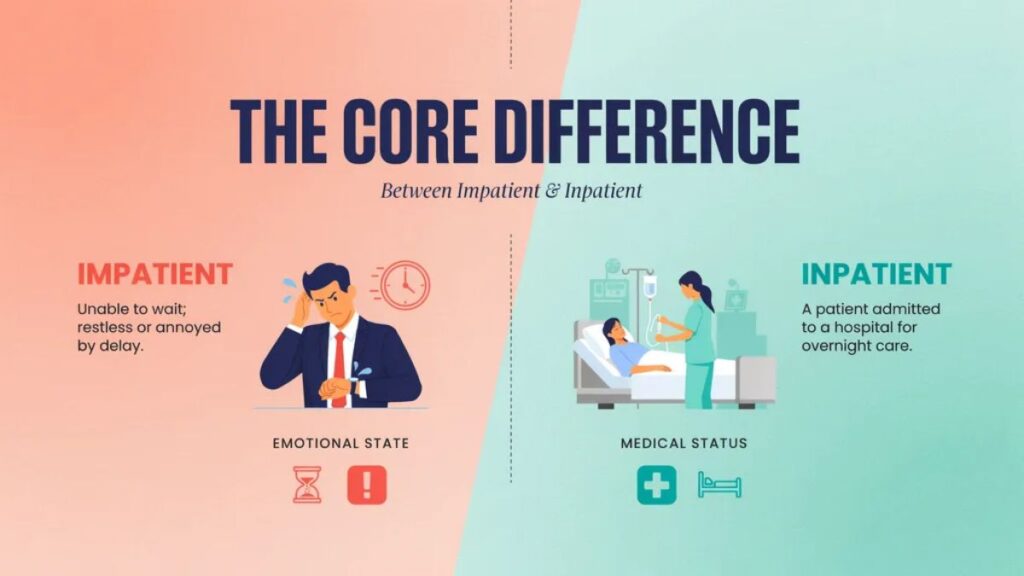
The simplest way to understand the difference: impatient is emotional; inpatient is medical.
Impatient describes a feeling — specifically, the frustration or restlessness someone feels when things are moving too slowly. Inpatient, by contrast, is a clinical term that refers to someone formally admitted to a hospital for treatment requiring an overnight stay or longer.
Quick Comparison Table
| Feature | Impatient | Inpatient |
|---|---|---|
| Part of speech | Adjective only | Noun or adjective |
| Category | Emotional/behavioral | Medical/clinical |
| Prefix meaning | im- = not | in- = inside |
| Opposite of | Patient (calm) | Outpatient |
| Example | “She was impatient at the checkout.” | “He was admitted as an inpatient.” |
| Used in hospitals? | No | Yes |
What Impatient Really Means
Simple Definition
Impatient is an adjective that describes someone who finds it difficult or impossible to wait calmly. It signals emotional restlessness, irritability, or eagerness that makes delays feel intolerable.
Everyday Examples
- Tapping your foot while waiting in a slow checkout line
- Checking your phone every two minutes for a reply
- Interrupting someone mid-sentence because you want to speak
- Feeling annoyed when a web page takes too long to load
Key Characteristics of Being Impatient
People who display impatience often show these recognizable traits:
- Restlessness — difficulty sitting still or tolerating quiet
- Impulsive decision-making — acting before thinking just to speed things up
- Frequent interruptions — struggling to let others finish speaking
- Irritability under pressure — small delays trigger disproportionate frustration
- Short tolerance for repetition — explaining something twice feels exhausting
Emotional and Behavioral Implications of Impatience
In Daily Life
Impatience affects personal relationships more than most people realize. When someone is frequently impatient, they can come across as dismissive, rushed, or uninterested. A parent who seems impatient with a child’s questions, or a friend who keeps glancing at their watch during a conversation — these behaviors send a clear emotional signal, even when unintended.
In Professional Settings
At work, impatience can erode trust. A manager who appears impatient during team meetings discourages employees from speaking up. A customer service representative who sounds impatient over the phone can lose a client in seconds. In writing, using impatient correctly in professional communication shows precision and emotional awareness.
Common Emotional Signs of Impatience
- Sighing loudly or visibly
- Checking the time repeatedly
- Finishing other people’s sentences
- Losing focus during long tasks
- Showing visible frustration when plans change
Common Expressions and Phrases Using Impatient
Common Examples
- Growing impatient — frustration building over time
- Impatient with someone — directed toward a specific person
- Impatient to do something — eager to the point of restlessness
- Impatient for results — wanting an outcome to arrive faster
Sentence Examples
- “After three hours of waiting, the customers grew visibly impatient.”
- “She was impatient to hear whether she got the job.”
- “The coach became impatient with the team’s lack of effort.”
- “Don’t be impatient — good things take time.”
Notice how impatient pairs naturally with prepositions like with, for, and to. These word patterns are useful signals when editing your writing.
The Linguistic Roots of Impatient
Understanding where impatient comes from makes it much easier to remember. The word traces back to Latin: im- (meaning “not”) + pati (meaning “to suffer” or “to endure”). Literally, impatient means not able to endure.
In medieval English, impatience was sometimes treated as a moral failing — an inability to accept hardship gracefully. Today the word carries less judgment, but the core meaning remains: an impatient person struggles to endure waiting or delays without reacting.
The same im- prefix appears in words like impossible, immature, and impractical — all meaning “not” something.
What Inpatient Actually Means
Simple Definition
Inpatient is a medical term for a person who has been formally admitted to a hospital or healthcare facility and stays overnight or longer to receive treatment. It can function as a noun (the inpatient received excellent care) or an adjective (inpatient treatment, inpatient ward).
Crucially, inpatient has nothing to do with emotions. It describes physical location and medical status — not how someone feels.
Key Characteristics of an Inpatient
- Formally admitted to a hospital or medical facility
- Requires an overnight stay — at minimum
- Receives continuous medical monitoring and care
- Subject to hospital policies, schedules, and discharge procedures
- Status affects insurance billing and coverage
Inpatient vs Outpatient: A Critical Medical Distinction
In healthcare, the natural pairing is inpatient vs outpatient — not inpatient vs impatient. Getting this distinction right matters for billing, insurance claims, and clinical documentation.
Comparison Table
| Aspect | Inpatient | Outpatient |
|---|---|---|
| Stay duration | Overnight or longer | Same day, no overnight |
| Admission required | Yes, formal admission | No formal admission |
| Level of care | Intensive, continuous | Limited, periodic |
| Cost | Generally higher | Generally lower |
| Examples | Surgery recovery, ICU care | Blood tests, X-rays, routine checkups |
Using Impatient and Inpatient Correctly in Sentences
Identifying Impatient in Everyday Language
Ask yourself: Is this sentence about a feeling, mood, or behavior? If yes, impatient is almost certainly the right word.
- ✅ “The students were impatient for the school bell to ring.”
- ✅ “He gets impatient when technology doesn’t work.”
- ❌ “She was an impatient at the clinic.” (Wrong — impatient is never a noun.)
Understanding Inpatient Through Real Medical Scenarios
- A patient admitted to a hospital after a car accident and staying for a week = inpatient
- A person visiting a clinic for a routine flu shot = outpatient
- Someone receiving rehabilitation services while staying at a medical facility = inpatient
- A child getting stitches in an emergency room and going home the same day = outpatient
The key question in medical contexts is simple: Did they stay overnight? If yes, they’re an inpatient.
Why People Confuse Impatient and Inpatient
Main Reasons for the Mix-Up
- One-letter difference — m vs n is nearly invisible in fast typing
- Similar pronunciation — spoken quickly, the words sound almost identical
- Shared root — both come from the word patient, suggesting a relationship that doesn’t exist
- Autocorrect failures — phones and word processors can’t detect context, only spelling
- Both prefixes look alike — im- and in- are visually very similar
Common Real-World Errors and Why They Matter
Harmless Example
Someone texts a friend: “I’m being so inpatient waiting for your reply!”
The friend understands the intended meaning. The error is harmless in casual conversation, though it looks sloppy in written communication.
Serious Example
A medical billing document reads: “Patient referred for impatient care following surgery.”
This is a significant error. In a clinical or insurance setting, impatient care is meaningless. It could cause billing disputes, rejected claims, or miscommunication between healthcare providers. The correct term is inpatient care.
Common Misconceptions to Avoid
Confusing Emotional Words With Medical Terms
Impatient and inpatient belong to entirely separate categories. One lives in the world of feelings; the other lives in the world of hospitals. Never substitute one for the other based on how similar they look.
Assuming Similar Spelling Means Related Meaning
Just because two words share letters or sound alike doesn’t mean they’re related in meaning. Inpatient does not mean “not patient” — it means “inside the facility.” These words have different prefixes with different purposes.
Relying on Autocorrect Without Context
Spell-checkers flag misspelled words, but they cannot detect the wrong word used correctly. Impatient and inpatient are both correctly spelled English words — which means autocorrect will never flag a mix-up between them.
Easy Ways to Remember the Difference
The Hospital Trick
Think of the IN in inpatient as meaning inside. When someone is an inpatient, they are in the hospital. Short, simple, and accurate.
The Emotion Trick
Read the IM in impatient as I’M — as in, “I’m frustrated” or “I’m annoyed.” If the sentence is about how someone feels, I’M (impatient) is your word.
Why Correct Usage Matters More Than You Think
Precision in language builds trust. In casual conversation, a mixed-up word rarely causes lasting damage. But in professional writing, medical documentation, journalism, or academic work, using impatient where inpatient belongs — or vice versa — signals unfamiliarity with the subject matter.
A healthcare report that mentions impatient treatment tells any medical reader immediately that the writer doesn’t know clinical terminology. A job application that describes someone as an inpatient person signals a grammar error. Context is everything, and choosing the right word shows you understand it.
FAQ’s
What is the exact difference between impatient and inpatient?
Impatient is an adjective describing emotional frustration or restlessness. Inpatient is a medical term for a hospital patient who stays overnight or longer.
Can impatient be used in medical writing?
Only to describe emotions or behavior — for example, describing an impatient staff member. It should never replace inpatient in clinical or billing contexts.
Is inpatient a noun or an adjective?
It functions as both. As a noun: “The inpatient received excellent care.” As an adjective: “She was transferred to the inpatient unit.”
How do hospitals define inpatient status?
A patient is classified as an inpatient when they are formally admitted and require at least one overnight stay for treatment, monitoring, or recovery.
Why do people confuse these two words so often?
The words differ by just one letter (m vs n), sound nearly identical when spoken, and both derive from the root word patient — which makes them feel related even though their meanings have nothing in common.
Conclusion
Impatient vs Inpatient comes down to one simple rule — emotions take impatient, hospitals take inpatient. One letter makes a massive difference in meaning. Using the wrong word can confuse readers, damage credibility, and cause serious errors in medical or professional writing. Impatient vs Inpatient.
This complete guide to Impatient vs Inpatient gives you everything needed to choose correctly every time. Remember the tricks: IM = I’m frustrated, IN = inside the hospital. Keep context in mind, slow down while typing, and you will never mix these two words up again.